


Sixth in US Stock History: Broadcom Hitches a Ride with Google, Joins the $2 Trillion Market Cap Club
Broadcom's market capitalization has officially crossed the $2 trillion threshold, becoming the sixth tech giant in US stock history to achieve this milestone. Google's launch of its eighth-generation TPU and a supply agreement extending to 2031 served as core catalysts, not only calming market concerns about share loss but also triggering a record-high stock price. UBS subsequently raised its AI revenue forecast for Broadcom for fiscal year 2027 to $145.4 billion, stating that computing power demand from both Google and Anthropic will continue to drive its earnings explosion
Broadcom's market capitalization has surpassed the $2 trillion mark, making it the sixth company in US stock history to reach this milestone, standing alongside tech giants like Apple and Microsoft. This marks the transformation of this semiconductor firm into a top-tier valuation institution driven by the AI chip wave.
On Wednesday, Google announced the launch of the eighth-generation Tensor Processing Unit (TPU) co-developed with Broadcom, triggering a nearly 5% single-day surge in Broadcom's stock, which closed at $422.65. This set a new all-time historical closing high since complete data records began in 2009 and marked the first time the historical high was broken since 2026. According to Dow Jones Market Data, Broadcom's market cap has officially broken through $2 trillion, becoming the sixth company in US stock history to reach this level after Nvidia, Alphabet, Microsoft, Amazon, and Apple.
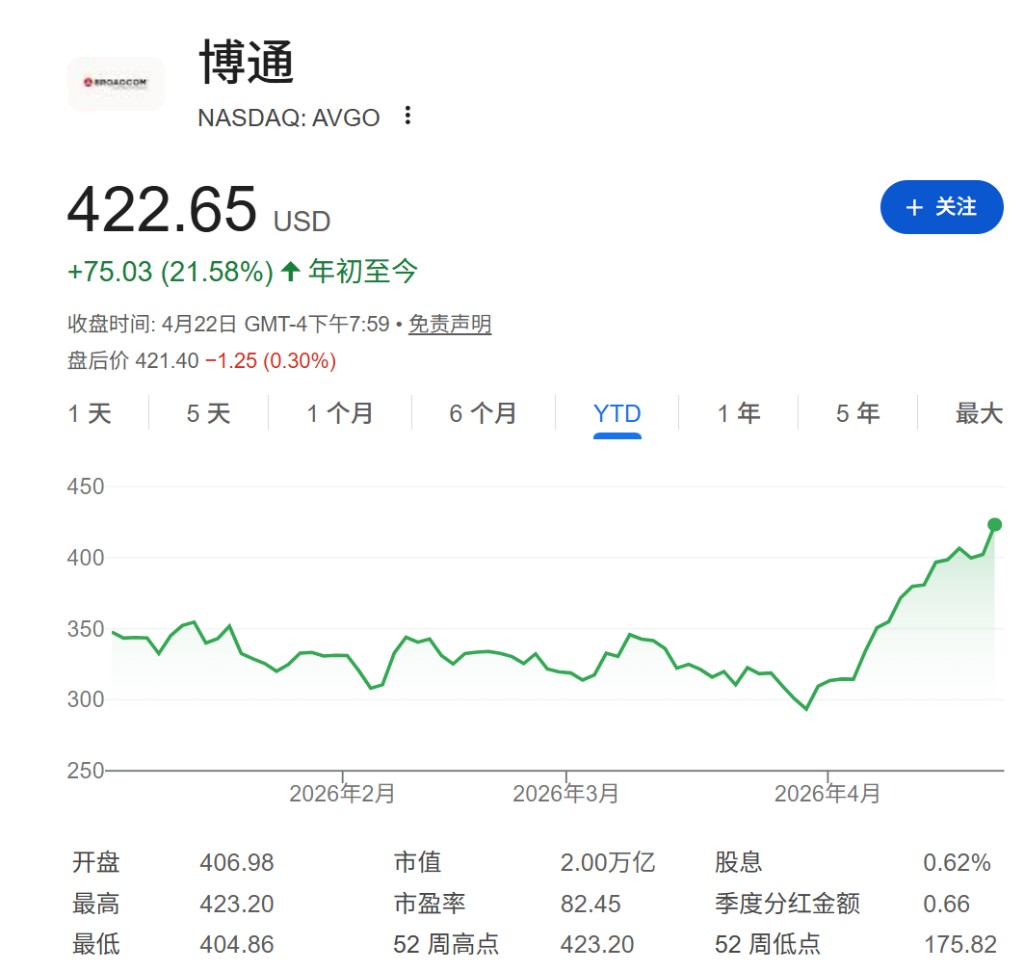
The announcement simultaneously confirmed a long-term supply agreement for TPU and networking equipment extending to 2031 between the two parties, partially quelling market disputes over whether Broadcom is losing share to Google. On that day, the entire semiconductor sector rallied; the iShares Semiconductor ETF (SOXX) rose approximately 3%, while Micron Technology and SanDisk both gained more than 8%.
Jay Goldberg, an analyst at Seaport Research, characterized Google's TPU announcement as the primary catalyst for the day's trading in an interview with MarketWatch, describing it as a positive signal for Broadcom. According to TradeWind Desk, citing a UBS research report released on April 13, the bank significantly raised its AI revenue forecast for Broadcom for fiscal year 2027 to approximately $145.4 billion, maintaining a "Buy" rating and a $475 price target.
Eighth-Generation Google TPU Becomes the Primary Catalyst
Broadcom and Google have signed an agreement to jointly develop TPUs and provide networking equipment to the latter, with the contract extending to 2031. On Wednesday, Google announced the launch of the eighth-generation TPU, which Jay Goldberg listed as the primary driver of the day's market movement. He stated that Wall Street previously had significant controversy over whether Broadcom was losing share to MediaTek or Marvell within Google's ecosystem; this announcement "does not prove anything," but the interpretation leans positive for Broadcom.
Morningstar analyst William Kerwin described the day as "a really good day for the semiconductor industry," pointing out that as the "lead design partner" for Google's TPU, Broadcom is expected to benefit from both pricing increases and shipment growth in the new generation of chips—each new generation of TPU corresponds to higher price nodes due to increased memory capacity. He estimated Broadcom's fair value at $500, higher than the day's closing price of $422.65, and emphasized that AI chip revenue primarily driven by TPU is the core driver of Broadcom's current growth and valuation.
Agreement Extended to 2031, Share Controversy Temporarily Mitigated
The core market concern previously centered on whether Google would gradually reduce its reliance on Broadcom by mass-producing MediaTek TPUs. The announcement of the eighth-generation TPU and the extension of the cooperative agreement provided a phased positive footnote to this debate.
According to UBS's April 13 research report, the long-term agreement extended to 2031 announced by Broadcom and Google covers supply guarantees for future generations of TPUs and key rack-level components, addressing investor concerns regarding the risks of Google's transition toward autonomous chip design to some extent. Nevertheless, UBS also pointed out that as MediaTek TPU shipments continue to rise, Broadcom's progress in diversifying its business beyond AI custom chips (ASIC) will remain a core issue for investors to focus on in the long term, and related risks have not completely dissipated.
UBS Significantly Raises Forecasts, AI Revenue Target Aims for $145.4 Billion
The extension of the Google TPU agreement combined with the expansion of the Anthropic partnership prompted UBS to significantly raise its earnings forecasts for Broadcom in its April 13 research report. UBS raised its revenue forecasts for Broadcom's fiscal year 2027 (F27) and fiscal year 2028 (F28) to $194.9 billion and $248.4 billion respectively, representing increases of approximately 7% and 8% compared to previous estimates; non-GAAP earnings per share for F27 were raised by 7% to $22.56, and for F28 by 7% to $28.59.
Regarding AI revenue, UBS raised its F27 AI revenue forecast from $132.7 billion to $145.4 billion and increased its 2027 calendar year TPU shipment forecast from approximately 6 million units to approximately 7.3 million units. At the level of Google Cloud Platform (GCP) TPU spending, UBS raised its forecasts for C27 and C28 from $46 billion and $61 billion to $61 billion and $79 billion respectively.
Anthropic's rapid expansion also constitutes a significant incremental factor. According to disclosures from Anthropic, its annualized revenue has exceeded $30 billion, a substantial jump from the approximately $9 billion scale at the end of 2025; the number of customers with an average annual recurring revenue (ARR) exceeding $1 million increased from approximately 500 in February to over 1,000. Starting in 2027, Anthropic will receive approximately 3.5 gigawatts of TPU computing power support, and all relevant infrastructure expansions will be implemented within the United States.
Valuation Above Historical Average, Diversification Progress Remains a Long-Term Risk
UBS maintains its "Buy" rating and $475 price target for Broadcom, utilizing a Sum-of-the-Parts (SOTP) valuation method. It assigns an approximately 26x EV/FCF multiple to Broadcom's 2027 calendar year semiconductor free cash flow contribution of $73 billion, and an approximately 12x multiple to its software free cash flow contribution of $42 billion for the same period.
From the current valuation perspective, Broadcom's NTM P/E ratio is approximately 26 times, higher than the 10-year historical average of 18 times; its EV/FCF is approximately 27 times, also higher than the historical average of 19 times, placing it in a relatively high range. In terms of earnings forecasts, according to UBS estimates, its F27 revenue and EPS forecasts are approximately 23% and 25% higher than market consensus expectations respectively. However, UBS noted that most investors they contacted already expect actual figures to be in this magnitude.
UBS also warned that although the above announcements have a marginal positive effect on short-term TPU risk debates, Broadcom's progress in customer and business diversification beyond AI custom chips remains the key validation required for the market to support its long-term valuation. This issue will become increasingly prominent as MediaTek's scale continues to expand.
