US Semiconductor Stocks Surge for 17 Consecutive Days, Shattering Records and Shocking Markets; Goldman Sachs Traders: Watch These Signals
Semiconductor stocks recorded an unprecedented 17-day consecutive rally, with the SOX ETF breaking through 10,000 points for the first time, marking the most severe overbought level in history. Goldman Sachs technology traders highlighted key data points and charts to watch moving forward, while admitting that their prior view on the attractiveness of positioning ahead of ServiceNow's earnings report was clearly at odds with market sentiment
Over the past two months, the most prominent trading theme in the stock market—aside from the ongoing Iran conflict—has been the seemingly endless rise in semiconductor stocks, alongside the sustained heavy losses suffered by software stocks amid panic over AI disruption. Just two weeks ago, software stocks posted the largest two-day decline relative to semiconductor stocks in history.
After a strong rebound with eight consecutive days of gains in software stocks over the past two weeks—a move many believed might signal a phased bottom for the sector—Goldman Sachs released its most unequivocal defense report on the software segment yet. However, recently the old trend has returned:
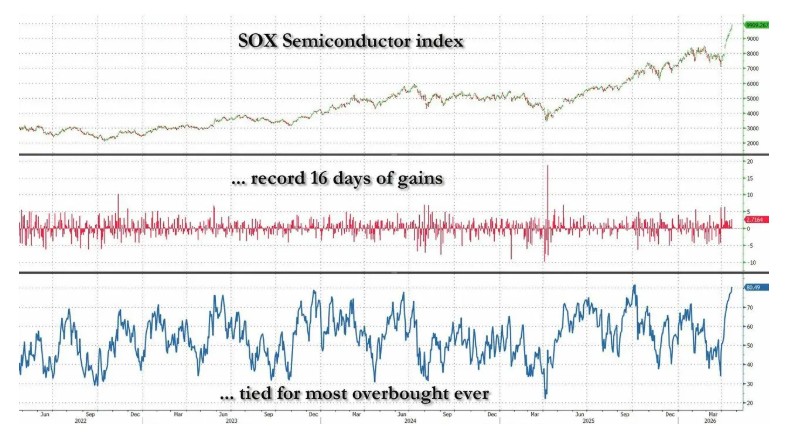
- Semiconductor stocks recorded an unprecedented 17-day consecutive rally, with the SOX ETF breaking through 10,000 points for the first time, establishing the most severe overbought conditions in history.
- At the same time, the software ETF IGV plummeted 5%, triggered by disappointing guidance from ServiceNow. The stock tumbled as much as 18% intraday, and the software/semiconductor basket fell 8%, registering one of the largest declines on record.
In response, Goldman Sachs TMT expert Peter Callahan wrote in Thursday's morning briefing: "There is quite a bit worth noting at the micro level in the TMT space, content that appears poised to drive semiconductors outperforming software once again."
On Wednesday, the most frequently asked questions by Goldman Sachs clients included:
Why did Micron Technology (MU) surge 9%? Is it purely a catch-up rally?
How should we interpret the 4-6% decline in Booking and Expedia?
Coordinated rally across the semiconductor ecosystem (Broadcom +5%, Marvell +4%)
Earnings outlook for large-cap tech stocks (have market expectations become too high?)
Core Data Points Highlighted by Goldman Sachs
Software & Services:
Performance is mixed, but stock price trends are highly synchronized (declining), at least in the early trading session.
ServiceNow: The market disputes whether its organic growth momentum aligns with industry AI enthusiasm. IBM: Software business revenue growth slowed by approximately 3 percentage points quarter-over-quarter in Q1. INFY: Full-year revenue guidance of +1.5% to +3.5% falls short of market expectations by about 5%. HCL Tech: Dropped approximately 11% earlier this week due to weak outlook.
Regarding ServiceNow, Callahan admitted:
I previously believed positioning ahead of the earnings report was attractive (especially with the NOW Knowledge conference approaching), but the market clearly took the opposite stance. This feels like a recurrence of the Q4 earnings narrative (selling off short-term EPS data points because longer-term uncertainties remain unresolved), while the market also debates NOW's organic growth momentum (such as Q2 organic implied cRPO growing approximately 17.25% year-over-year).
Goldman Sachs Research maintains a Buy rating and sees multiple catalysts over the next six months, including product portfolio maturation, increased customer engagement willingness, and clearer GAAP profitability paths (Goldman Sachs Research estimates earnings per share exceeding $9 by 2030).
As market focus shifts to SAP's earnings, Callahan distilled several "macro software takeaways":
M&A activity (particularly add-on acquisitions aimed at accelerating AI deployment) may only blur profit margins and revenue narratives.
Q1 is seasonally weak, and Q2 will face even tougher comparisons (industry-wide YoY difficulty likely increases by about 2 percentage points).
Macro uncertainty and disruptions from the Middle East situation.
AI pricing and product packaging are still being adjusted and refined.
Semiconductor Cycle:
Texas Instruments (TXN)'s industrial business continues to accelerate (YoY growth exceeding 30%). Management indicated that industrial signals now have broader coverage, and data center business momentum is strong (approximately +90% YoY). Notably, if TXN achieves the upper end of its June quarter revenue guidance (+4% to +12% QoQ), it would mark the largest quarterly growth since the financial crisis for the June quarter. Bulls believe that re-pricing toward data centers and business structure transformation are beginning to materialize.
Additionally, STMicroelectronics rose 7% in European markets, guiding for mid-point June quarter revenue growth of +12% QoQ, citing demand improvement, strong orders, and inventory normalization. Analog semiconductors had long been one of the few controversial areas within the semiconductor sector; attention now turns to whether this segment can continue to rise following better-than-expected results (referencing Renesas Electronics' 7% gain in Japanese markets last night).
Elsewhere: Dover (DOV) saw accelerating orders, and ABB's electrification orders grew 44% YoY (market expectation was +13%).
AI Infrastructure:
Semiconductor equipment (Lam Research guidance significantly exceeded expectations by +1%) and memory (SK Hynix in Korea reported massive beats but stock remained flat) indicate robust fundamentals, though some feel like "arriving at the destination" (similar to pre- or post-earnings movements seen with ASML or TSMC).
Regarding the earnings outlook for AI infrastructure, while short-term expectations are indeed high, there appears to be no shortage of buyers on dips. Market confidence in the "Token economy" continues to solidify—see Google's update on Wednesday. Ultimately, earnings results are just one of many important data points; model updates, ARR progress, supply chain dynamics, and other factors are equally critical.
Consumer Sector Dynamics:
US discretionary consumer stocks underperformed the broader market by 200 basis points on Wednesday, with the retail sector lagging by 230 basis points. The reasons are not entirely clear (a few minor factors can be mentioned). Investor sentiment is shifting toward pessimism (even though core discretionary consumer Q1 performance may overall be quite resilient).
Current core disputes and bearish logic include: tapering benefits from tax refund season, Easter consumption timing mismatch (later this year), oil price pressures, and ongoing concerns regarding credit conditions.
Key Charts
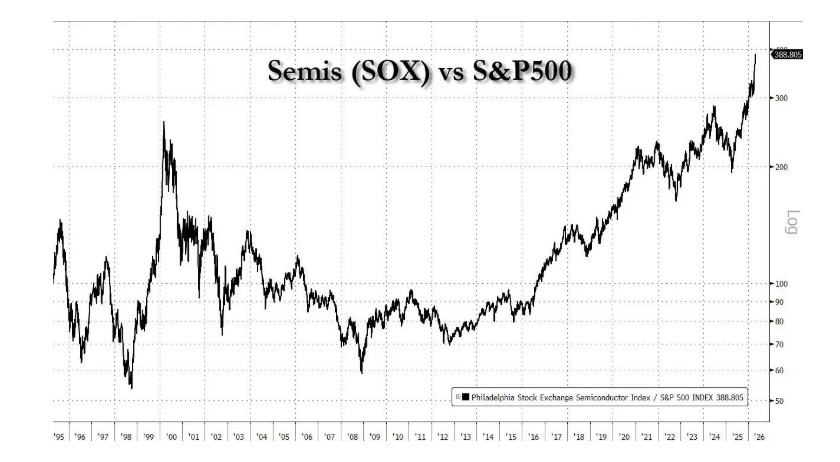
Semiconductor "Super Cycle": The SOX has risen for 16 consecutive trading days, setting the longest streak since data tracking began in 1994, with Thursday marking the 17th consecutive day.
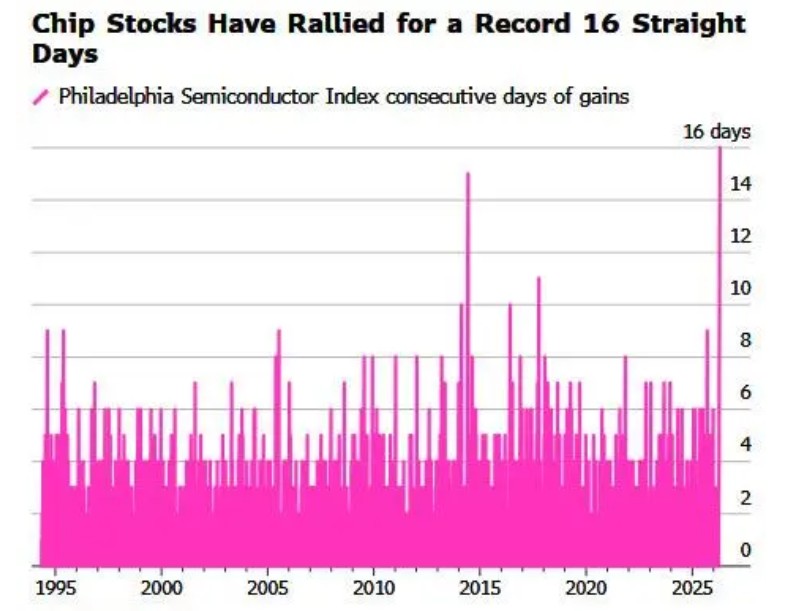
The SOX's 14-day RSI closed around 80.5 on Wednesday, reaching levels seen only a handful of times in the past decade-plus (Autumn 2025, December 2021, January 2021, Q4 2017).
The Information Technology sector's market cap currently accounts for approximately 35% of the S&P 500 (reaching this weight in late autumn last year), marking the highest level since the Internet bubble era—though today their earnings contribution differs vastly from the year 2000.