What Signals Did SK Hynix Release Regarding Memory in Q1?
SK Hynix reported a 60.2% quarter-over-quarter surge in revenue for the first quarter, with operating profit nearly doubling. The company explicitly stated that supply shortages are structural in nature and that the current favorable pricing environment will last longer than previous cycles; it also projected that HBM (High Bandwidth Memory) demand over the next three years will far exceed its own supply capacity and plans to significantly increase capital expenditure in 2026
In the first quarter, SK Hynix reported revenue of 52.6 trillion won, a 60.2% increase quarter-over-quarter, while operating profit reached 37.6 trillion won, nearly doubling from the previous quarter. Overall performance aligned closely with the latest market consensus.
According to Zhuifeng Trading Desk, a report by Bernstein on April 23 indicated that SK Hynix's Q1 2026 results demonstrate that the strong pricing in memory chips is not a fleeting phenomenon. The company explicitly stated that supply shortages are structural in nature and that the current favorable pricing environment will last longer than previous cycles.
Notably, driven by revaluation gains on Kioxia equity stakes, net profit soared to 40.3 trillion won, a 164.6% quarter-over-quarter increase, significantly exceeding expectations. Company guidance indicates that DRAM and NAND shipments will both rebound in the second quarter, suggesting continued strength in the storage market.
Looking ahead, SK Hynix projects that HBM (High Bandwidth Memory) demand over the next three years will far exceed its own supply capacity, and plans to significantly increase full-year capital expenditure in 2026 compared to the previous year.
Strong Pricing: Company Deems Shortage Structural
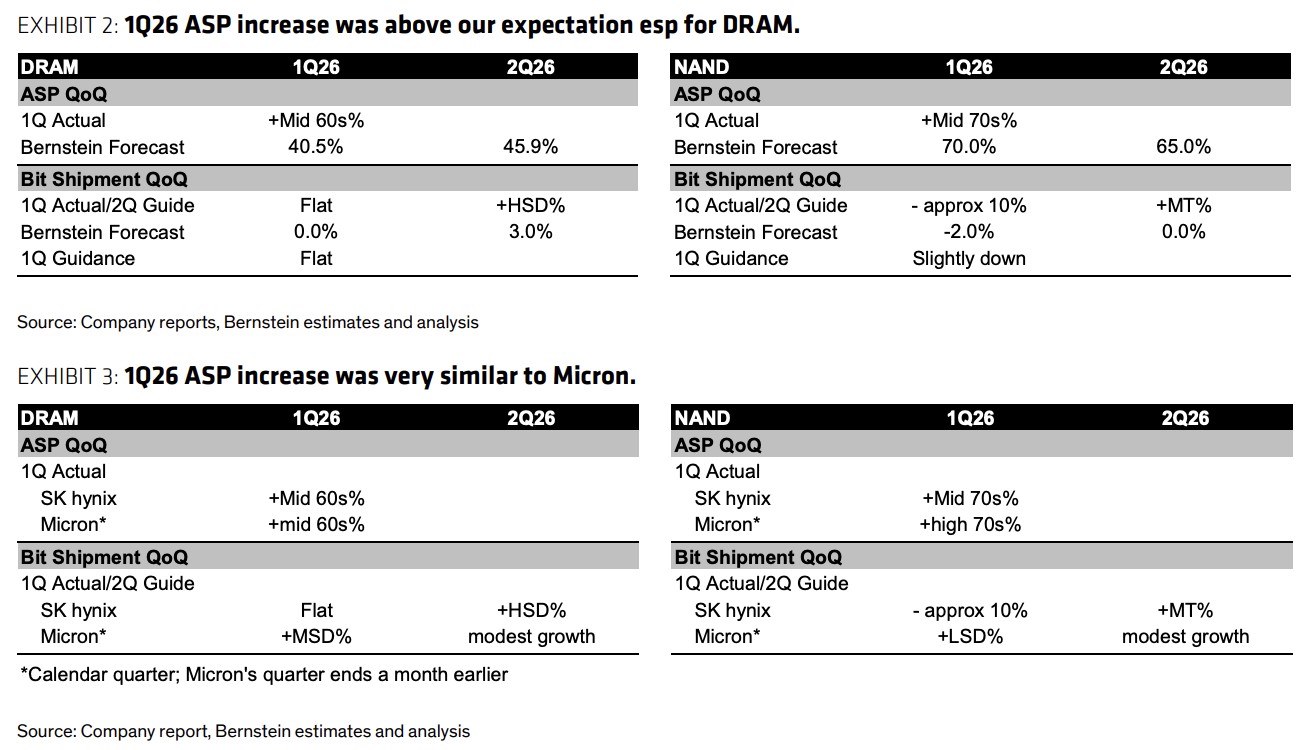
SK Hynix saw its average DRAM price rise by approximately 60% quarter-over-quarter in Q1, while the average NAND price increased by roughly 70%. In comparison, Micron's average DRAM price rose by about 60% during the same period, and its NAND price increased by around 70%, showing highly consistent pricing trends between the two companies.
SK Hynix clearly stated that the current storage supply shortage is a structural issue, with customers prioritizing securing supply over negotiating lower prices. Consequently, the company judges that the duration of this strong pricing environment will be longer than in past cycles, and temporary spot price dips do not indicate that this cycle has peaked.
From a profitability perspective, this assessment is well-founded: SK Hynix achieved an overall gross margin of 79.3% in Q1, with DRAM margins reaching approximately 80% and NAND margins potentially exceeding 60%. The company's overall gross margin level now clearly surpasses historical peaks seen in 2017-2018.
HBM Demand Remains Robust: Supply Falls Short Over Next Three Years
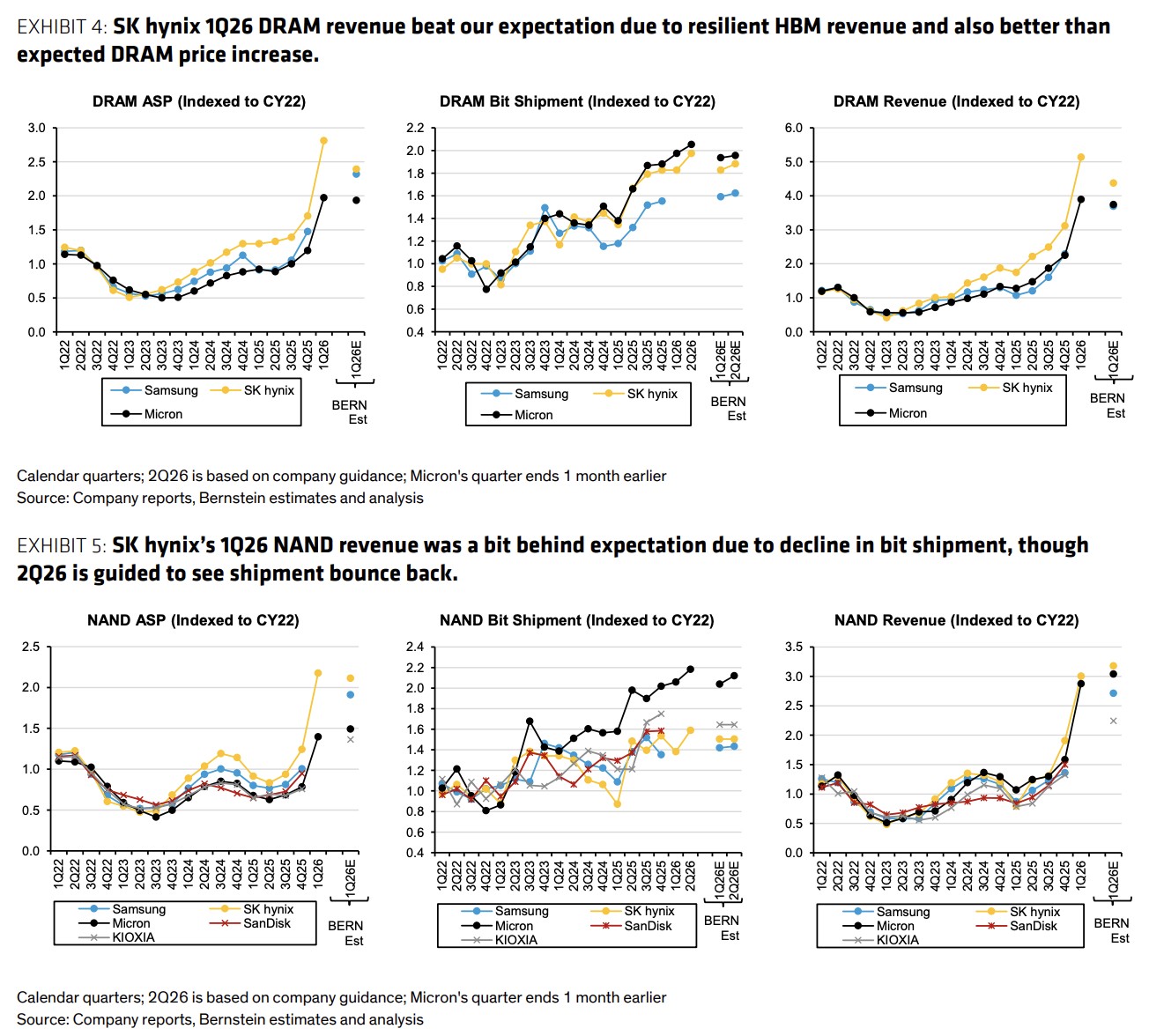
HBM business was the core driver behind DRAM revenue exceeding expectations this quarter.
SK Hynix stated that HBM demand over the next three years will far exceed its own supply capacity, and the company will maintain a balanced allocation of production capacity between HBM and traditional DRAM.
On the product roadmap, HBM4 mass production will proceed according to customer schedules, though specific timelines were not disclosed; HBM4E entered the customer sampling phase in the second half of 2026 and is planned for formal mass production in 2027.
Regarding shipment volumes, DRAM shipments remained flat quarter-over-quarter in Q1, falling short of Bernstein's earlier forecast of growth; NAND shipments declined by approximately 10% quarter-over-quarter.
Company guidance indicates that DRAM shipments will grow by high single-digit percentages in the second quarter, while NAND shipments will turn from decline to growth, achieving a quarter-over-quarter rebound.
Significant Capital Expenditure Increase: Capacity Expansion Proceeds Steadily
SK Hynix guided that full-year capital expenditure in 2026 will increase significantly compared to the previous year, though specific amounts were not disclosed.
According to Bernstein forecasts, full-year capital expenditure is expected to be approximately 42 billion won (in the range of 42 trillion won), up from 27.5 billion won in 2025. The company stated that spending will focus on infrastructure construction and strategic equipment procurement.
In terms of specific capacity planning, the first-phase cleanroom at the Y1 wafer fab in Yongin is expected to be completed in February 2027, designated for DRAM production. The overall project comprises six phases.
For NAND, SK Hynix is expanding capacity through technological upgrades, planning to migrate 50% of domestic capacity to 321-layer stacking technology by the end of 2026.
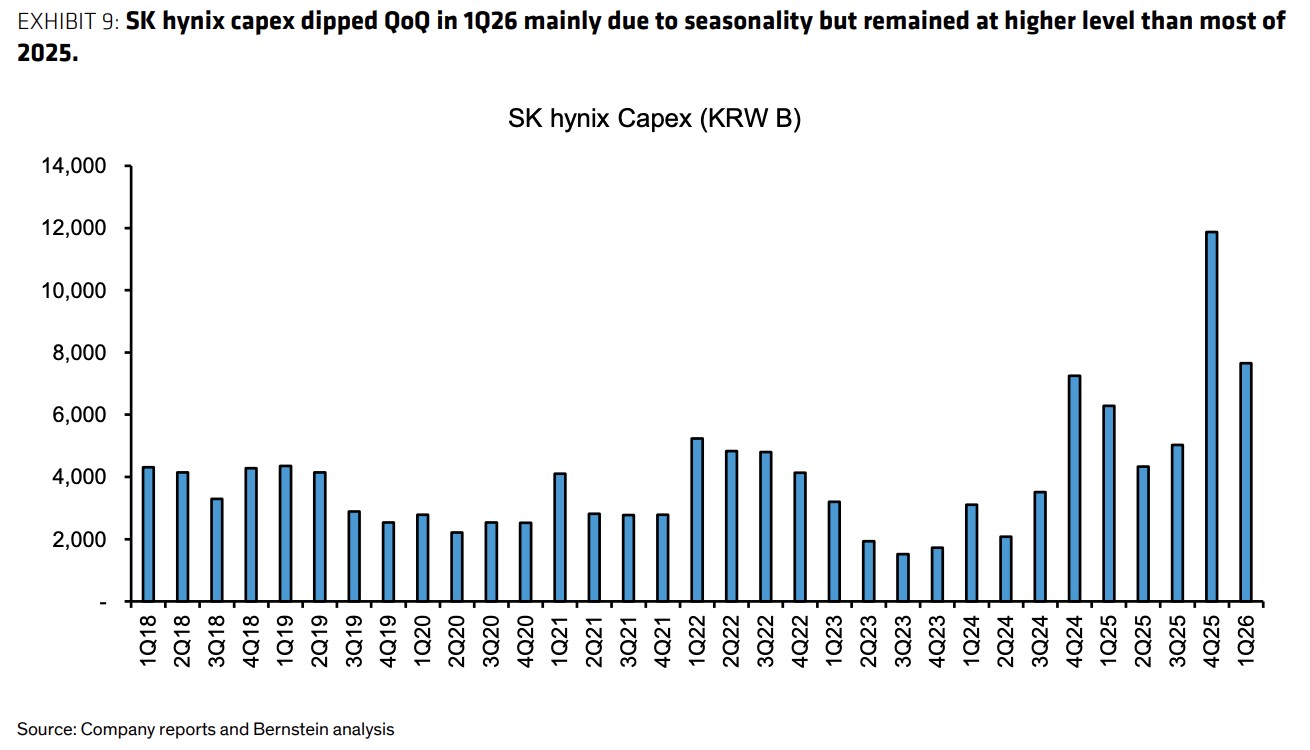
Although capital expenditure decreased quarter-over-quarter in Q1, primarily due to seasonal factors, it remained significantly higher than most quarters in 2025.