


"Luxury Leader" Worries About Global Consumption: LVMH CEO Warns Middle East Conflict Could Evolve Into a "Global Catastrophe"
This is one of the strongest public statements to date by an executive at a top global luxury company regarding the Middle East conflict. Arnault stated that if the situation is not resolved soon, global consumer confidence will continue to be undermined, and the demand recovery anticipated by the luxury industry may fail to materialize. Data shows the conflict has already cost LVMH approximately one percentage point in organic sales growth for the first quarter, with sales at Middle Eastern stores dropping as much as 70% at one point
The head of the world's largest luxury group, LVMH, issued a stern warning: if the war in the Middle East continues to spread, it could trigger an economic disaster affecting the entire globe.
On April 23, according to the UK Financial Times, LVMH Chief Executive Bernard Arnault stated during the group's annual general meeting that if the war between the United States and Israel against Iran does not end soon, LVMH will face a severe crisis.
He warned that the situation could evolve into "a global catastrophe, bringing extremely serious and very negative economic consequences." This is one of the strongest public statements to date by an executive at a top global luxury company regarding the Middle East conflict.
This warning is not unfounded. LVMH disclosed last week that the war in the Middle East has already cost its organic sales growth for the first quarter of this year by approximately one percentage point, with organic sales growth for the quarter registering only 1%.
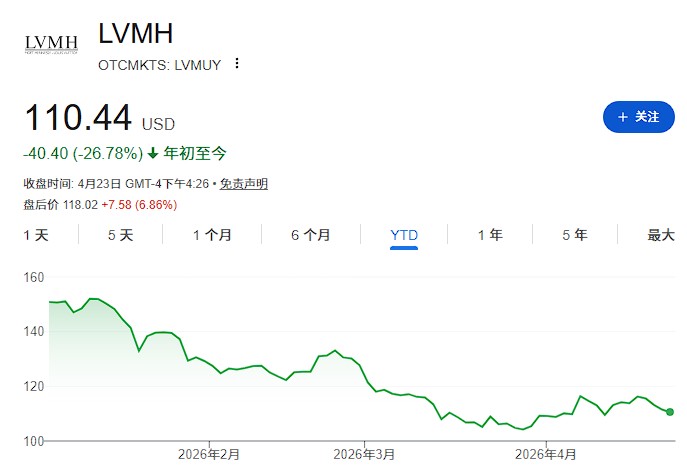
At the same time, LVMH's stock price has fallen cumulatively by 26% this year. Competitors Kering, Hermès, and Richemont also saw their share prices drop by double digits, putting significant pressure on the entire luxury sector.
War Impact: From Middle Eastern Stores to Global Consumer Confidence
There is concrete data to prove the impact of the Middle East conflict on LVMH.
According to reports, shortly after hostilities broke out in early March this year, sales at some shopping centers in the Middle East under LVMH dropped sharply by as much as 70%. This figure vividly illustrates the destructive power of regional conflicts on high-end consumption scenarios.
Arnault pointed out that the situation in the Middle East is "extremely unpredictable," and this uncertainty is dragging down global consumer confidence, thereby delaying the long-awaited demand recovery in the luxury industry following years of downturn.
He stated that if the situation is resolved quickly, all business lines under LVMH, including fashion, handbags, hotels, and premium spirits, could achieve overall growth this year; "otherwise, we will have to face a crisis."
LVMH's predicament reflects the situation of the entire luxury industry. Analysts point out that after several years of weak demand, the market had hoped for a cyclical recovery in 2025 to 2026, but the continued escalation of the war in the Middle East is disrupting this rhythm.
