


ZTE Q1 Revenue Up 6% Year-on-Year, Net Profit Down 46.6% Dragged by Exchange Losses | Earnings Insights
ZTE's Q1 2026 report shows revenue grew 6.13% year-on-year to 34.988 billion yuan, while net profit attributable to shareholders fell 46.58% to 1.31 billion yuan. The triple impact of exchange rate fluctuations, increased asset impairment provisions, and the retreat of policy-driven gains pressured profits. Net cash outflows from operating activities reached 1.979 billion yuan, turning negative from a positive figure. Non-current liabilities due within one year surged 48.53%, raising short-term solvency pressure, while the asset side remained generally stable
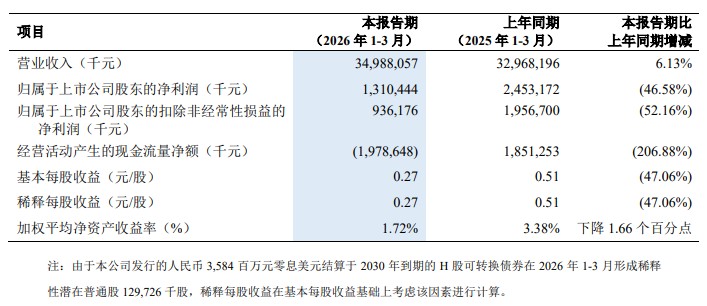
On April 24, ZTE released its financial report for the first quarter of 2026. The report shows that the company achieved revenue of approximately 34.988 billion yuan in the first quarter, an increase of 6.13% year-on-year; net profit attributable to shareholders of the listed company was approximately 1.31 billion yuan, a decrease of 46.58% year-on-year; net profit after deducting non-recurring gains and losses was approximately 936 million yuan, a decrease of 52.16% year-on-year.
Profit decline driven by multiple factors. Regarding financial expenses, due to exchange rate fluctuations, the net income of 340 million yuan from the same period last year turned into a net expenditure of 341 million yuan. Asset impairment losses were nearly 239 million yuan, up nearly twofold year-on-year, primarily due to increases in inventory write-down provisions and accounts receivable impairment provisions. Other income (including government subsidies, etc.) decreased from 805 million yuan in the same period last year to 373 million yuan.
In terms of cash flow, the net cash flow generated from operating activities was approximately -1.979 billion yuan, compared to a net inflow of 1.851 billion yuan in the same period last year; the change was mainly due to reduced sales collections and expanded procurement expenditures. Net cash outflows from investing activities increased from 1.384 billion yuan to 5.69 billion yuan, primarily driven by increased net investment in time deposit-type financial products. On the balance sheet, non-current liabilities due within one year increased by 48.53%.
Basic earnings per share dropped from 0.51 yuan in the same period last year to 0.27 yuan. Return on weighted average net assets declined from 3.38% to 1.72%. Total assets increased slightly by 3.67% to 225.7 billion yuan, while net assets attributable to the parent company rose to 76.8 billion yuan.
Revenue Steadily Grows, Profits Hit by Triple Shock
ZTE's first-quarter revenue grew 6.13% year-on-year, broadly consistent with the mid-single-digit growth pace of recent quarters. The three main businesses—carrier networks, enterprise and government solutions, and consumer terminals—remained overall stable. However, the scissors difference between steady revenue growth and a sharp decline in net profit highlights that disturbances on the cost side and non-operating factors have become the core contradiction.
The profit decline presents a pattern of multiple pressures superimposed.
Exchange rate shock is the most significant. Affected by exchange rate fluctuations, financial expenses shifted from net income in the same period last year to net expenditure, with a year-on-year change of 200.28%. As a highly internationalized communication equipment vendor, ZTE has a large proportion of overseas business, making it difficult to fully hedge exchange rate exposure.
Additionally, impairment provisions increased significantly. Both inventory write-down provisions and accounts receivable impairment provisions increased simultaneously, reflecting slower collection rhythms for some customers and inventory turnover pressures. Policy-driven other income also retreated sharply. Other income (including software VAT tax refunds and government subsidies, etc.) shrank by more than half compared to the same period last year; the temporary retreat of policy dividends had a direct impact on profits.
Derivatives and changes in fair value also created drag. Investment income from changes in fair value shifted from profit to loss, and non-operating expenses expanded significantly year-on-year. However, investment income in this period grew substantially, mainly driven by improved profitability of associates and settlement gains from derivative contracts, which provided some offset to profits.
Operating Net Outflow Nearly 2 Billion Yuan, Three Cash Flow Ends Under Pressure
Cash flow signals are even more noteworthy: operating net outflow nearly 2 billion yuan, with investment and financing ends under simultaneous pressure
Net cash flow from operating activities turned from a net inflow of 1.851 billion yuan in the same period last year to a net outflow of 1.979 billion yuan, making it one of the most critical indicators in this quarterly report. The company explained that the main reason is the dual squeeze formed by reduced sales collections and expanded procurement expenditures. If this trend continues, it will place higher demands on liquidity management.
Net cash outflows from investing activities expanded from 1.384 billion yuan to 5.69 billion yuan, primarily due to increased net investment in financial products such as time deposits. Meanwhile, prepayments increased by 36.53% year-on-year, indicating rising capital occupation at the supply chain level, possibly related to advanced procurement schedules and supplier credit term arrangements.
Net cash inflows from financing activities decreased by 44.91% year-on-year. Combined with a 48.53% increase in non-current liabilities due within one year, this means the company faces more refinancing arrangements for maturing loans in the short term, narrowing the elasticity of its capital chain.
Asset Side Remains Stable, Short-Term Liabilities Pressure Rises
As of the end of the first quarter, total assets were approximately 225.7 billion yuan, an increase of 3.67% from the end of the previous year; net assets attributable to the parent company were approximately 76.8 billion yuan, up 1.84%, with the overall asset structure remaining robust. Other non-current financial assets grew by 35.66%, primarily due to increased investments in financial instruments with maturities over one year, reflecting active management in capital allocation.
Changes on the liability side deserve attention. Non-current liabilities due within one year increased by 48.53% compared to the end of the previous year, mainly due to the concentration of long-term loan maturities, creating certain pressure on short-term liquidity. Deferred tax liabilities decreased by 41.56%, primarily because the taxable temporary differences narrowed due to changes in fair value.
