


Tesla starts production of Cybercab! Musk's "Physical AI Super Blueprint" takes a key step
Tesla has started production of its Robotaxi model, Cybercab, marking the engineering phase of Musk's "physical AI super blueprint." Musk announced the news on social media, stating that initial production will be slow and is expected to gradually increase. Tesla faces challenges with declining electric vehicle sales, but Musk's plan elevates AI and Robotaxi to a higher priority
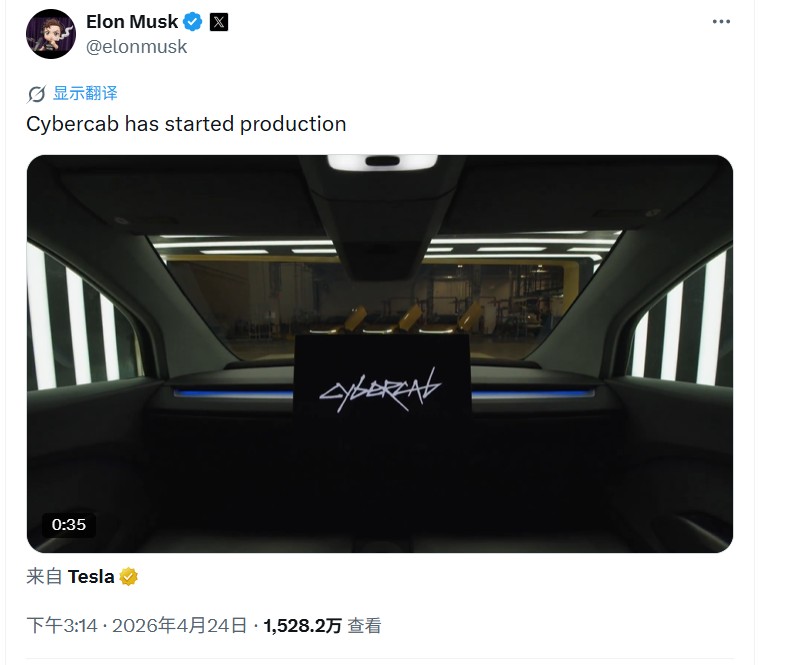
According to Zhitong Finance APP, Elon Musk, the co-founder and CEO of Tesla (TSLA.US) and the world's richest person, stated in a post on X on Friday that Tesla has begun production of its Robotaxi model—this highly anticipated fully autonomous taxi known as "Cybercab." As the American electric vehicle leader faces a continuous decline in global electric vehicle sales, Musk is fulfilling his long-standing commitment to the large-scale production plan for Cybercab since 2024.
From Tesla's latest financial report and its capital expenditure plan of over $25 billion, it is evident that Musk is elevating AI, Robotaxi, humanoid robots, and space AI data centers to higher priorities. The latest production dynamics of Robotaxi are undoubtedly a key force in the realization of Musk's "physical AI super blueprint."
"The Cybercab you have been waiting for has begun production," Elon Musk stated in a post on the X platform (formerly Twitter) and shared a related video.
Earlier this week, Musk emphasized the ongoing ramp-up process of Tesla's new product line and cautiously hinted at the production pace: "We are about to start producing Cybercab, and we will soon begin production of our Semi series trucks."
He also mentioned during the earnings call on Thursday that initial production will be slow because "whenever you have a brand new product with a completely new supply chain... you should expect the initial production process of Cybercab and Semi to be very slow, but then it will gradually ramp up... until the end of this year, and of course next year," Musk noted during the earnings meeting.
As the richest person in the world to date, Musk has accomplished what others deemed impossible—creating a commercially viable high-frequency rocket launch business through SpaceX, bringing electric vehicles into the mainstream market through the global electric vehicle leader Tesla, and providing internet connectivity infrastructure services from space through Starlink. However, some doubt whether Musk can truly build the "most epic" chip-making initiative he recently outlined in Austin and whether he can realize his envisioned "super blueprint" of artificial intelligence, autonomous driving, humanoid robots, and space AI data centers.
"Tech Maverick" Musk Ignites the "Physical AI" Revolution
The early production process of Cybercab signifies that Musk's long-cherished "physical AI super blueprint" is transitioning from concept demonstration to the engineering ramp-up stage, with hopes of entering the anticipated large-scale commercialization phase next year. The commencement of Cybercab production is a key milestone that can significantly enhance market credibility regarding Musk's grand narrative of "physical AI," thereby continuously boosting Tesla's fundamental outlook and stock price towards a new bull market trajectory But Musk also made it clear that the initial production of new supply chain products like Cybercab and Semi will be slow, and the expansion of Robotaxi is still constrained by strict safety validations. The goal of covering "about a dozen states" by the end of the year still requires the approval of transportation regulators in various countries, verification of safety data, operational efficiency of the fleet, and validation of the unit economic model. In other words, Tesla's stock price and high valuation are entering a phase of "high capital expenditure for physical AI options": short-term pressure is on free cash flow, mid-term focus is on the speed of Robotaxi deployment, and the long-term ceiling hinges on whether the Optimus humanoid robot can form a true commercial closed loop with space-grade AI computing infrastructure.
Under Musk's leadership, Tesla is currently making a more significant all-in bet on the "physical world AI super platform"—among which the Optimus humanoid robot is one of the most aggressive capacity bets, but not the only one. Tesla is not all-in on "the standalone Optimus robot," but rather on "a complete physical AI super platform driven by Tesla's AI supercomputing for FSD and Robotaxi autonomous vehicles at the front end, with Tesla's AI chip computing power as the core infrastructure, and Optimus as the ultimate growth form."
According to Jensen Huang, CEO of NVIDIA, "physical AI" emphasizes enabling robots/autonomous operating systems to perceive, reason, and complete a full set of actions in the real world, and an era where "physical AI" assists the evolution of human civilization is about to arrive. "Physical AI" emphasizes enabling robots/autonomous systems to perceive, reason, and act in the real world, and these three capabilities are the key toolchain that advances models from "only able to converse" to "able to work in the physical world."
From an industrial logic perspective, Tesla's long-term growth narrative is shifting from electric vehicle manufacturing to becoming a "super platform company at the level of physical AI." Once Tesla's expected growth engines transform into Robotaxi, Optimus, vehicle-side reasoning, robot reasoning, and the computing power chain for xAI/SpaceX's space training and deployment, the actual infrastructure bottleneck will no longer primarily be batteries and vehicle components, but rather high-end logic chips, advanced packaging of 2.5D/3D/3.5D, data center storage chips, large solar and energy storage systems, and core supply chain security under geopolitical war situations.
With the production of Cybercab, Tesla officially enters the "AI cash-burning period."
Currently, investors are undoubtedly focused on whether the expansion of Robotaxi can be scaled, the mass production/commercialization rhythm of the Optimus humanoid robot, capital expenditure on AI computing power, and the financing path for the epic chip manufacturing project named "Terafab"; in addition, SpaceX and its IPO plans, as well as the blueprint for space AI data centers, have seemingly entered the center of Tesla's earnings report discussions. The growth prospects of the commercial space sector led by SpaceX and the SpaceX IPO have become key marginal variables affecting Tesla's valuation premium and the "Musk premium." Tesla's latest financial report and the core signals released from the production of Cybercab undoubtedly indicate that the company is accelerating its transition from a traditional electric vehicle manufacturer to a physical AI super platform company focused on the "FSD/Robotaxi autonomous driving mobility system + Optimus humanoid robots + Terafab large chip manufacturing project + space AI computing infrastructure."
In the first quarter, Tesla's revenue was approximately $22.39 billion, achieving a year-on-year growth of 16%, with free cash flow unexpectedly recording a positive inflow of $1.44 billion, better than the market's original expectation of cash consumption. However, this seems more like a short-term improvement brought about by a shift in capital expenditure rhythm, as the company has significantly raised its 2026 capital expenditure plan from previously over $20 billion to over $25 billion. Tesla's CFO also clearly stated that there will be negative free cash flow for the remainder of this year. In other words, the real strategic shift led by Musk in the future lies in Tesla officially entering a heavy capital investment cycle driven by the AI supercomputing system for FSD, Robotaxi, Cybercab, Optimus, Semi, space AI computing infrastructure, and chip manufacturing ambitions.
Cybercab has begun preliminary production, which is a key move in Musk's "physical AI super blueprint," but the realization of the narrative and large-scale commercialization are two different matters. As Musk claimed, the initial production of Cybercab will be slow, followed by a faster ramp-up by the end of this year and into next year; he also stated that Robotaxi is expected to cover "about a dozen states" in the U.S. by the end of the year, but he acknowledged that expansion is limited by strict safety validations, and Robotaxi is unlikely to make a "super significant" contribution to finances this year, with a truly significant contribution likely to come next year.
Technically, this means that Tesla's core challenge is not just to produce Cybercab, but to prove that its fully unsupervised FSD full autonomous driving subscription software can achieve a level of safety that meets regulatory standards and is insurable and scalable in multiple cities, various climates, and cross-border scenarios. In terms of valuation, the production of Cybercab does indeed enhance the market's credibility in Tesla's Robotaxi growth narrative, but it has not fully resolved investors' most concerned issues of "scaled commercial operation data" and "unit economic model."
Whether Tesla can advance these grand narratives of AI, FSD, Robotaxi, humanoid robots, and even SpaceX's space AI data centers from long-term imagination to an execution phase that can be quickly validated by the capital market may be the strongest driving force pushing Tesla's stock price toward a new bull market trajectory. What the market needs in the medium to long term is not strong quarterly financial reports, but a narrative reset that can prove Tesla is moving from "AI options" to "milestone phased commercialization realization"; without clearer execution evidence, even if short-term financial report numbers are attractive, the stock price will struggle to escape the state of "strong financial reports, weak valuation."
