


Xiaomi Investor Day: AI Agents Possess Unique Advantages, Automotive Business Begins Overseas Expansion, Smartphone Price Hikes Are the Trend
Xiaomi's Investor Day released three core signals: a roughly fivefold surge in smartphone memory costs has become the new normal, making price hikes irreversible; the AI model MiMo-V2.5-Pro ranks first among global open-source models, with monetization paths covering hardware price increases, subscription services, and token economics; the timeline for electric vehicle expansion into Europe was clarified for the first time, with entry into the European market in the second half of 2027 and into right-hand drive markets in the first half of 2028, while the Munich R&D center is already fully operational
Soaring smartphone costs, AI models joining the global top tier, and a clearly defined timeline for overseas electric vehicle expansion—Xiaomi placed these three most critical narrative lines on the table simultaneously at its 2026 Investor Day.
On April 27, Xiaomi Corporation held its 2026 Investor Day in Beijing. Following the event, Goldman Sachs, JPMorgan, and Citigroup sequentially released research reports, interpreting the information from different perspectives. According to Zhuifeng Trading Desk, while ratings from the three institutions diverged, their judgments on several core facts were highly consistent:
-
Smartphone price hikes are inevitable: Smartphone BOM (Bill of Materials) costs have risen to over RMB 1,500.
-
AI layout exceeds expectations: Goldman Sachs believes that Xiaomi's full-stack self-research capabilities in the AI Agent era and the synergy of its "Human x Car x Home" ecosystem constitute core competitive barriers. Notably, the average age of Xiaomi's MiMo core team is 25, with 60% graduating from Tsinghua University or Peking University, and 55% holding doctoral degrees.
-
Electric vehicle overseas roadmap is more specific than before: Entry into the European market in the second half of 2027, and into right-hand drive markets in the first half of 2028.
Smartphone Price Hikes: Not a Strategy, but a Forced Response
This is the most direct concern for investors.
Memory and flash storage costs have surged approximately fivefold since early 2025. For an entry-level smartphone with 8GB of RAM and 128GB of storage, the BOM (Bill of Materials) cost alone has risen to over RMB 1,500, with DRAM/NAND chip costs exceeding $100, excluding corporate administrative expenses and channel fees. The cost pressure is even greater for high-end models (16GB+512GB).
Citigroup's research report pointed out that this cost compression became evident in the fourth quarter of 2025, narrowing the gross margin of the smartphone business to 8.3%. The retail pricing of entry-level models will be forced to approach the RMB 2,000 threshold.
Management's statement was direct: this is the industry's new normal, not a temporary phenomenon. JPMorgan expects limited possibility of significant cost relief in the next 2-3 years, with smartphone gross margins remaining in the high single digits in 2026 and 2027, below the low double-digit levels of the past three years.
Facing pressure, Xiaomi's response strategy is to redefine user needs rather than simply raising prices, promote premiumization (high-end smartphone shipments reached 13.35 million units in 2025, a 24% year-on-year increase from 2024), reduce memory usage through software optimization, and simultaneously enhance services and user retention. Management expects industry smartphone shipments to decline by at least 10% in 2026, but the increase in ASP (Average Selling Price) driven by premiumization can offset most of the revenue pressure from the shipment decline.
AI: From Catching Up to Running Side-by-Side, Three Monetization Paths
This was the most information-dense part of the Investor Day.
Model Capabilities
The average age of Xiaomi's MiMo core team is 25, with 60% graduating from Tsinghua University or Peking University, and 55% holding doctoral degrees. It took the team only about one year from formation to reach a global top-tier level.
The MiMo-V2.5-Pro released in April (with over 1 trillion parameters and a 1 million context window) ranked first among global open-source models in the Artificial Analysis Intelligence Index, tying with Kimi K2.6. Citigroup's research report added that the model ranked in the global top four in both basic intelligence and Agent capability metrics, with peak daily token consumption reaching 1 trillion.
Management believes that in the Agent AI era, the gap between Chinese models and leading US models is narrowing rapidly, with the capability gap expected to shrink to 2-3 months.
Ecosystem Advantages
Goldman Sachs particularly emphasized in its report that Xiaomi's competitive advantage in the Agent era comes from "full-stack self-research + cross-layer synergy"—forming a complete closed loop from underlying chips (self-developed XRING processors), data (EB-level private ecosystem data), models (MiMo), tool layers (miclaw, Miloco, Super Xiao Ai) to the application ecosystem ("Human x Car x Home" full-ecosystem device Agents). This is a structural advantage that other smartphone manufacturers find difficult to replicate.
Monetization Paths
Management clarified three AI monetization routes:
First is hardware price hikes, embedding AI capabilities into devices to expand product pricing space;
Second is subscription services, developing paid software for high-value scenarios centered around the MiClaw Agent. The conversion rate of paying users for MiMo-V2 has reached 35%, and Pro and Max token packages currently contribute half of the revenue for the MiMo Token plan;
Third is token economics, commercializing API calls to directly target developers and enterprise users in the Agent era.
JPMorgan holds a relatively cautious view on this, believing that these new businesses "still need more time to generate substantial financial contributions" and are unlikely to become stock price catalysts in the short term.
Embodied Intelligence
Xiaomi is also extending AI into the physical world. Its humanoid robots have been interning at Xiaomi's electric vehicle factory, capable of working continuously for 3 hours at a single station, performing precise operations such as screwing bolts, grabbing feathers, and throwing/catching balls. However, management admitted that achieving comprehensive, error-free deployment across multiple stations in factories will still take 3-5 years.
Electric Vehicles: Steady Domestic Orders, Countdown to Europe Begins
Domestic Progress
Over the past 24 months, Xiaomi has cumulatively delivered 655,000 electric vehicles, including 425,000 SU7 units and 230,000 YU7 units. As of April 26, the new SU7 facelift had received over 63,000 confirmed orders, with 26,000 units already delivered, demonstrating strong supply chain and delivery capabilities. Management reaffirmed the 2026 electric vehicle delivery target of 550,000 units (a 34% year-on-year increase), with current delivery cycles stable at 7-12 weeks.
Overseas Expansion Roadmap
This was the incremental information most watched by the market at this Investor Day.
Management clarified three principles: premium markets before mid-range markets, developed markets before emerging markets, and left-hand drive markets before right-hand drive markets. Specific timeline: enter the European market in the second half of 2027, and enter right-hand drive markets in the first half of 2028.
Supporting this plan is Xiaomi's European R&D and Design Center established in Munich (founded in September 2025), which has recruited over 100 engineers with an average experience of more than 15 years, led by former BMW M Division Technical Director Rudolf Dittrich—known for his work on the development of the BMW M4 GT3. The YU7 GT, scheduled for release in late May, is the first model shaped by this European team.
Management also stated that they visited more than 25 cities in 12 countries over the past year and engaged in in-depth communications with over 20 global partners. Partners generally recognized Xiaomi's brand positioning as a "unique technology company with a powerful ecosystem." Management also clarified that they would not launch electric vehicles priced below RMB 100,000 in the short term.
JPMorgan pointed out that the European expansion timeline is more specific than before and the direction is encouraging, but updates on the supply side are limited. If not resolved before the overseas launch, this could become a bottleneck for further growth in electric vehicles.
External Pressures: Triple Headwinds Arrive Simultaneously
Management also frankly addressed current operational challenges at the Investor Day:
Cost Side: Rising memory and commodity prices affect all three business lines: smartphones, AIoT, and electric vehicles;
Geopolitics: The situation in the Middle East has led to a decrease of approximately 20,000 units in daily smartphone sales in the region, with logistics costs rising simultaneously;
Exchange Rates: 50% of overseas business is settled in USD and 20% in EUR. The depreciation of the USD and EUR against the RMB directly compresses overseas financial performance.
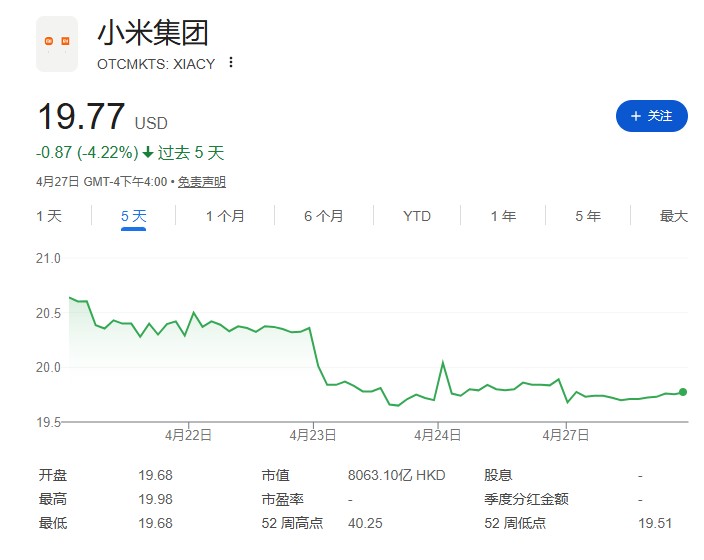
Despite multiple pressures, Goldman Sachs maintains a Buy rating with a 12-month target price of HKD 41, representing approximately 31% upside from the current share price (HKD 31.20). Goldman Sachs believes that Xiaomi's full-stack self-research capabilities in the AI Agent era and the synergy of its "Human x Car x Home" ecosystem are core competitive barriers. Citigroup also maintains a Buy rating with a target price of HKD 40, considering the focused AI strategy and clear path for overseas electric vehicle expansion as the two highlights of this Investor Day.
JPMorgan maintains a Neutral rating with a target price of HKD 35. Its core logic is: pressure on electric vehicle and smartphone gross margins, lack of a clear inflection point in core business growth, and new businesses such as AI and robotics are unlikely to contribute substantial financial returns in the short term.
In addition, key upcoming events for the company include: Q1 results (mid-to-late May), the summer launch event in late May (including the YU7 GT and products equipped with the new generation of XRING chips), performance during the 6.18 Shopping Festival, and the progress of MIIT declaration for the extended-range SUV model planned for launch in the third quarter.
