


The Sharper the Rise, the Greater the Danger: AI Rally Shows Signs of an "Upward Market Crash"!
Bank of America warns that with the Nasdaq rising for 13 consecutive trading days and realized volatility nearing 25%, bubble risk indicators for AI-related sectors have hit their highest levels since the launch of ChatGPT. This combination of "rising prices without declining volatility" has historically been a typical characteristic of bubble phases. Meanwhile, the five major tech giants are set to release earnings reports in quick succession this Friday, coinciding with the FOMC Meeting, signaling an impending market storm
The sharper the rally, the greater the danger—this is not the intuition of pessimists, but a warning from Bank of America's quantitative models.
The US stock market is at a rare juncture: indices are hitting new highs, but volatility is climbing in tandem. This combination of "rising prices without declining volatility" has historically been a typical characteristic of bubble phases.
This week, the market will face two concentrated tests: the FOMC interest rate decision and the earnings reports from five of the "Magnificent Seven" tech giants. The convergence of these events creates the most dense window of trading catalysts in recent times.
"Upward Market Crash": The Sharper the Rise, the Higher the Risk
According to Zhuifeng Trading Desk, the bank's derivatives strategy team (including analysts such as Nitin Saksena) presented a stark judgment in their latest report:
The Nasdaq has recorded 13 consecutive days of gains, with realized volatility approaching the historical high of 25%. The S&P 500's gains are even comparable to those during the pandemic, yet it did not experience the same level of market pressure beforehand. This 'Upward Market Crash' dynamic aligns closely with our 2026 forecast for a bubble-driven market.
What is an "Upward Market Crash"? Simply put, it is when prices rise rapidly while volatility increases instead of decreasing—the market is celebrating, but insurance premiums are rising simultaneously. This usually indicates that market participants are uneasy, with growing divergence in expectations.
Of particular concern is the AI sector. The report points out that the "bubble risk indicator" for AI-related assets, such as semiconductors, has risen to its highest level since the launch of ChatGPT. During last week's market surge, stock volatility did not retreat but instead found support—further evidence of bubble dynamics.
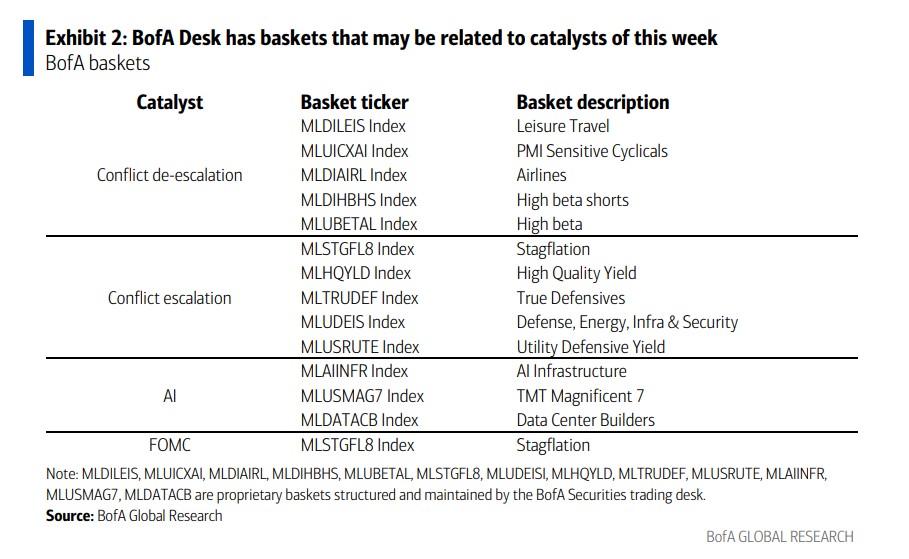
What Will Powell Say This Time?
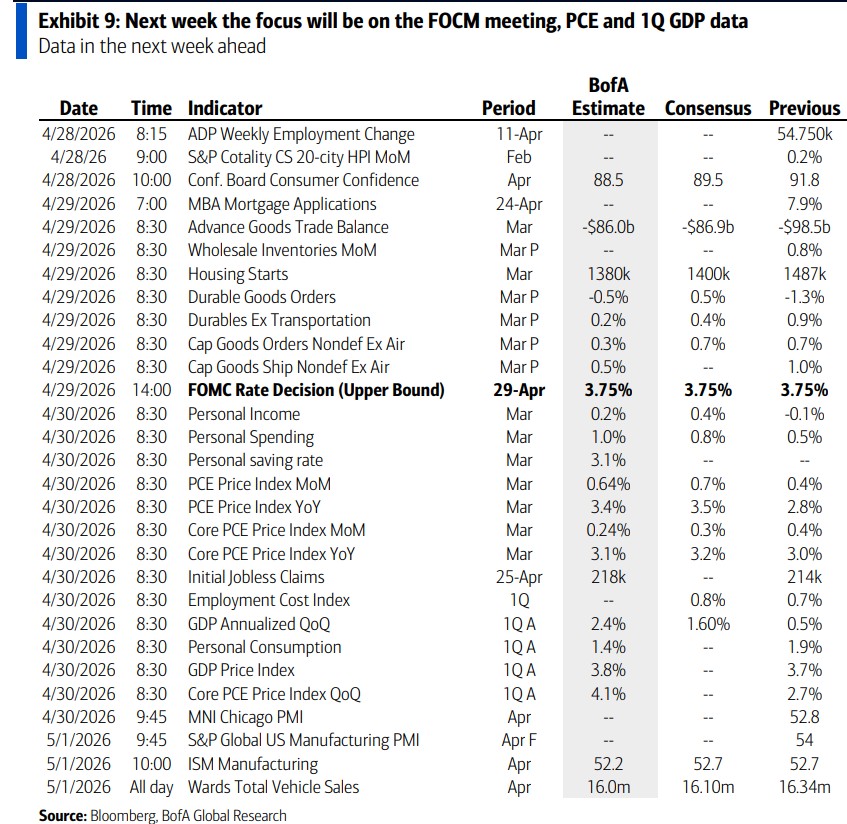
On Wednesday, April 29, the FOMC will announce its interest rate decision. Analysts wrote:
The Federal Reserve will firmly hold rates steady at the April meeting. The upside inflation risks brought by the Iran war have not dissipated, and labor market data has also improved. Powell is likely to send hawkish signals during the press conference.
Three key points to watch: First, whether he remains open to further rate hikes; second, how he assesses the impact of the war on the economy; and third, whether he will take the opportunity to emphasize the recent recovery in the labor market.
In terms of data, analysts predict that the annualized Q1 GDP growth rate to be released on April 30 will be 2.4% (market consensus is 1.6%), and the year-over-year core PCE is expected to be 3.1%. Inflation remains high, which is the fundamental reason why Powell finds it difficult to turn dovish.
Earnings of the Five Tech Giants: All Expected to Beat Estimates
The most closely watched event in the market this week is the concentrated release of earnings reports from five members of the "Magnificent Seven." Analysts' forecasts for all five companies exceed market consensus.
Meta Platforms (April 29) Analyst Justin Post expects Q1 revenue/EPS to be $56 billion/$7.44, higher than the market consensus of $55.4 billion/$6.64. The drivers are the empowerment of the core advertising business by AI and continued expense control. The biggest near-term risk is macro uncertainty affecting Q2 revenue guidance, or a further upward revision of AI infrastructure capital expenditures.
Amazon (April 29) Justin Post expects Q1 revenue/EBIT to be $178.4 billion/$21.4 billion, higher than the market consensus of $177.1 billion/$20.7 billion. The AWS growth forecast has been raised to 28% year-over-year, above the market consensus of 25%, partly driven by Anthropic-related revenue.
Alphabet (April 29) Justin Post expects Q1 revenue/EPS to be $92 billion/$2.69, slightly higher than the market consensus of $91.7 billion/$2.66. The integration of the Gemini model is expected to drive search and cloud businesses to beat expectations, with search revenue growth projected to reach 18%.
Microsoft (April 29) Analyst Tal Liani expects EPS to be $4.05, slightly higher than the market consensus of $4.04. Key focuses include Azure revenue growth (as AI computing power comes online sequentially), the expansion of Copilot paid seats, and the stability of non-AI businesses.
Apple (April 30) Analyst Wamsi Mohan expects Q2 revenue/EPS to be $113 billion/$2.00, higher than the market consensus of $109 billion/$1.93, mainly supported by strong iPhone sales.

This Week's Market Calendar: Highest Volatility Expected on Thursday
Based on SPX implied volatility data, the market's expected volatility for each trading day this week is as follows:
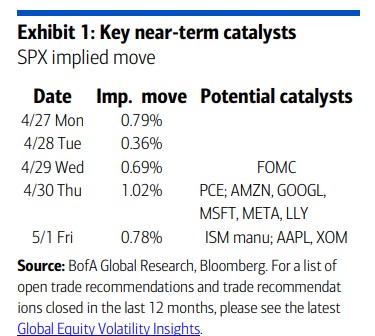
Thursday (April 30) is expected to be the day with the highest volatility this week—the PCE inflation data and earnings reports from multiple tech giants will be released on the same day, creating a massive information load.
Faced with the market environment of an "Upward Market Crash," the analyst team provided specific hedging strategies:
QQQ call spreads and VIX call spreads benefit from currently attractive skew entry points, respectively hedging against recent right-tail and left-tail risks.
The logic is that the current option skew structure offers relatively cheap entry opportunities—using QQQ call spreads to hedge against the risk of the rally continuing, and VIX call spreads to hedge against the risk of a sudden market crash. Preparation is needed on both fronts.
