


US Tech "Big Four" Set Record $725 Billion AI Spending This Year, but at a High Cost: Chip Price Hikes and Capacity Constraints
US tech giants Amazon, Meta Platforms, Microsoft, and Alphabet have planned capital expenditures of $725 billion on artificial intelligence infrastructure this year, a record high representing a 77% increase from last year. Although all four companies reported first-quarter earnings that exceeded market expectations, with Google's net profit surging 81% year-over-year, rising memory chip prices and data center capacity bottlenecks have become focal points for investors. Microsoft's CFO warned that cloud computing capacity would remain constrained, while Meta raised its spending guidance due to rising component costs
US tech giants are pushing investment in artificial intelligence infrastructure to historic highs. The four hyperscale cloud service providers—Amazon, Meta Platforms, Microsoft, and Alphabet—have planned combined capital expenditures of $725 billion this year, a sharp 77% increase from last year's record $410 billion. However, soaring memory chip prices and data center capacity bottlenecks are becoming unavoidable costs in this unprecedented gamble.
The four companies released their first-quarter earnings reports on Wednesday, with overall performance exceeding market expectations. Google stood out the most, with net profit jumping 81% year-over-year to $62.6 billion, and Google Cloud revenue surging 63% to $20 billion, leading the industry. Amazon AWS revenue grew 28% to $37.6 billion, while Microsoft's total revenue hit a record $82.9 billion. Although Meta's revenue increased 33% to $56.3 billion, a significant upward revision in capital expenditures and an unclear timeline for AI model releases dragged its after-hours stock price down by about 6% to 7%, wiping out an estimated $113 billion in market value.
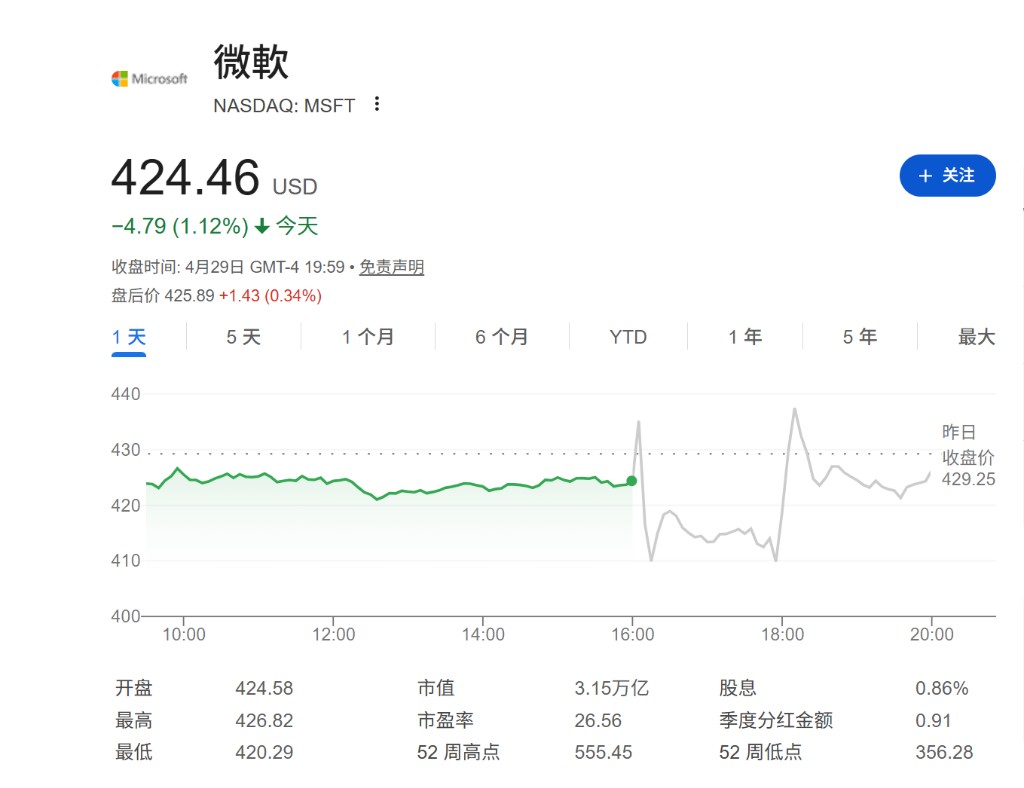
Following the earnings releases, Alphabet's after-hours stock price rose 7%, with its market value briefly pointing toward a record $4.3 trillion; Amazon rose about 3%; and Microsoft remained largely flat. Jefferies analyst Brent Thill stated, "The AI economy is healthy," recent revenue growth demonstrates large tech companies' ability to bear huge capital expenditures, "the bearish argument untenable."
However, persistently rising infrastructure costs leave investors far from fully reassured. Microsoft Chief Financial Officer Amy Hood disclosed that $25 billion of its $190 billion capital expenditure budget for the year stems from price increases in components such as memory chips, explicitly warning that even with continued additional investment, cloud computing capacity "will remain constrained at least through the end of this year." Meta similarly attributed its spending increase to "higher component prices" and intensifying competition for land, electricity, and data center technical talent.
Vertical Integration Becomes Competitive Divide, Comprehensive Supply Constraints Raise Costs
This round of earnings reports reveals a clear competitive dividing line among large tech companies: companies with deep layouts across AI chip design, cloud services, and foundational models significantly outperform those relying on external partners.
John Belton, portfolio manager of the $1.4 billion Gabelli Growth Fund, with about 30% of its holdings concentrated in Alphabet, Amazon, Meta, and Microsoft, pointed out:
Vertically integrated players show particularly strong advantages—if you are a cloud service company with a complete technology stack from chips to models to applications, your performance will be much better than if you are merely building data centers and running more third-party models.
Citing Morgan Stanley estimates, The Wall Street Journal reported that tech companies will collectively invest $2.9 trillion in chips, servers, and other data center infrastructure between 2025 and 2028. Brent Thill also warned that hyperscale cloud providers face comprehensive supply bottlenecks in their scramble for resources—from fiber optic cables to electricity, cooling water, and undeveloped land, all are in short supply.
Hyperscale cloud providers are all trying to enter the gold mine—they have to wait, or spend more money to get in. This is beneficial for (equipment and material) suppliers, but not so friendly for those responsible for integrating various resources.
Microsoft: Component Price Hikes Erode Profits, Capacity Bottlenecks to Persist at Least Until Year-End
Microsoft's total revenue in the first quarter hit a record $82.9 billion, with net profit of $32 billion. Its Intelligent Cloud segment, which includes Azure, saw revenue grow 40% year-over-year to $34.7 billion, with overall performance exceeding Wall Street expectations. However, the operating profit of the Intelligent Cloud segment was $13.2 billion, lower than the analyst expectation of $14.1 billion, reflecting obvious pressure on the cost side.
Amy Hood disclosed that $25 billion of the $190 billion capital expenditure plan for 2026 comes from price increases in components such as memory chips, issuing a clear warning: "Even with these additional investments and continued efforts to deploy GPU, CPU, and storage capacity faster, we expect to face capacity constraints at least through the end of this year." She also stated that cloud business growth rates would accelerate in the second half of the year as more data centers come online.
Microsoft's stock price has cumulatively fallen about 20% over the past six months, with investors continuing to harbor doubts about the company's dependence on its relationship with OpenAI and its fluctuations. This week, Microsoft announced the termination of its exclusive cooperation agreement with OpenAI, a move CEO Satya Nadella viewed positively. He stated, "We now hold a frontier model, royalty-free, with full intellectual property rights, and access extending to 2032; we fully plan to leverage it."
Google Leads Peers, Cloud Business Accelerates Market Share Grab
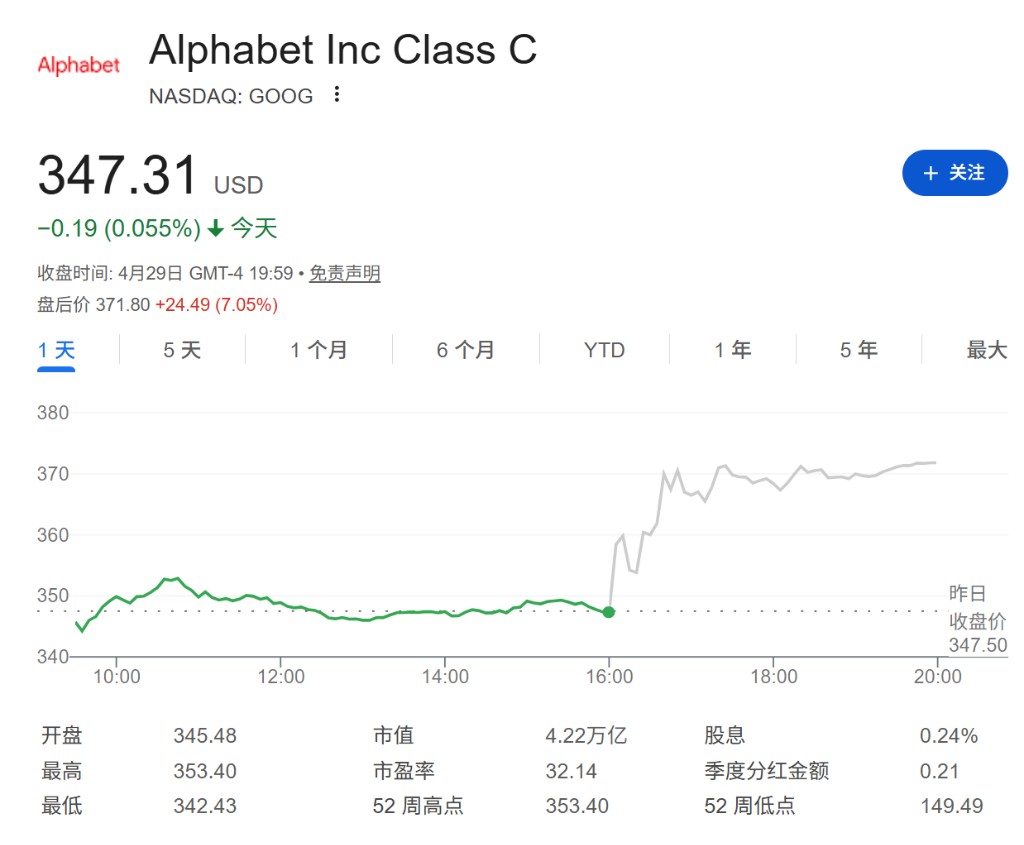
Google's earnings this quarter significantly outperformed rivals. First-quarter revenue grew 22% year-over-year to $110 billion, with search advertising revenue increasing 19% to $60.4 billion; Google Cloud revenue jumped by $7.7 billion from the same period last year to $20 billion, a growth rate far exceeding Amazon and Microsoft. CEO Sundar Pichai stated that AI is "lighting up every corner of the business." UBS analyst Stephen Ju said this result "will help investors build confidence in the issue of continuous return on investment."
In the approximately $500 billion cloud computing market, Google is further encroaching on competitors' shares. Amazon added $8.3 billion in quarterly cloud business revenue to reach $37.6 billion, while the business unit housing Microsoft Azure added $7.9 billion to reach $34.7 billion, with Google adding a similarly substantial amount during the same period. Melissa Otto, research director at S&P Global's Visible Alpha, stated that the results show "Google Cloud is beginning to capture some market share... it may be catching up to its rivals' heels." Nevertheless, the scale of Google's cloud business remains significantly smaller than that of Amazon and Microsoft.
Google also disclosed that its contract backlog reached $460 billion, nearly a five-fold year-over-year increase, mainly benefiting from the strong performance of its cloud business, which helped the market digest the news of a $5 billion upward revision in capital expenditure guidance, raising it to the $180–190 billion range. CFO Anat Ashkenazi stated that spending in 2027 would "increase substantially." Meanwhile, Pichai announced that Google would directly sell its self-developed Tensor Processing Units (TPUs) to select external customers for the first time, marking an important step in the commercialization of its chips.
Thomas Kurian, head of Google Cloud, previously attributed these developments in an interview with the Financial Times to the company's long-term strategy of independently developing AI chips, foundational models, and products, stating that this gives Google greater cost and R&D advantages over peers relying on external partners.
Meta Under Pressure: Spending Hike Combined with Unclear Timeline Wipes Out Over $100 Billion in After-Hours Market Value
Meta's revenue this quarter grew 33% year-over-year to $56.3 billion, exceeding analyst expectations, which the company primarily attributed to AI-driven improvements in ad pricing and user engagement. However, the significant upward revision in capital expenditures and uncertainty regarding the AI model release roadmap disappointed the market—after-hours stock price fell about 6% to 7%, with market value expected to wipe out over $113 billion at Thursday's open.
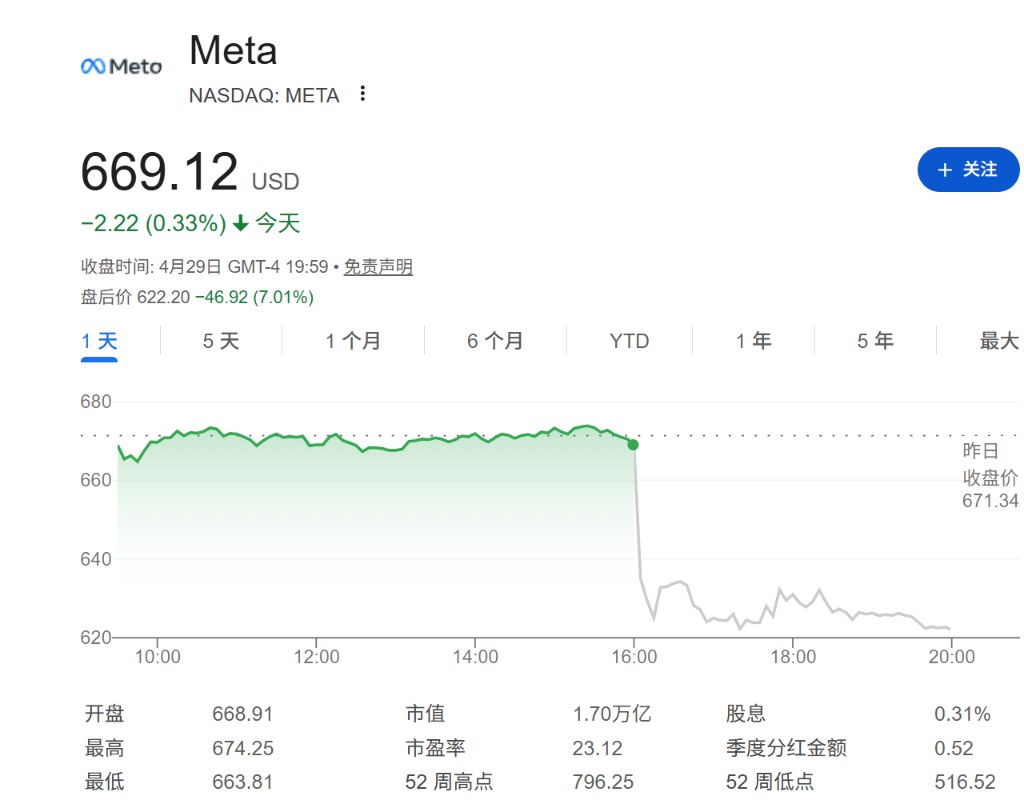
Meta raised its capital expenditure expectation for the year by about $10 billion to the $125–145 billion range, citing "higher component prices (especially memory prices)" and increasingly fierce competition for land, electricity, and skilled data center workers. When pressed on the release plans for its series of text, image, and video AI models, CEO Mark Zuckerberg stated he values "quality" over deadlines, a vague response that further exacerbated investor concerns. He said, "There are many AI agents on the market, but not many that I would introduce to my mother for use."
Dec Mullarkey, Managing Director at SLC Management, pointed out, "Investors remain concerned that Zuckerberg's once capital-light cash cow may now be transforming into a capital-intensive money burner. They are not buying into growth at any cost."
Amazon: Contract Backlog Hits New High, but Free Cash Flow Plummets
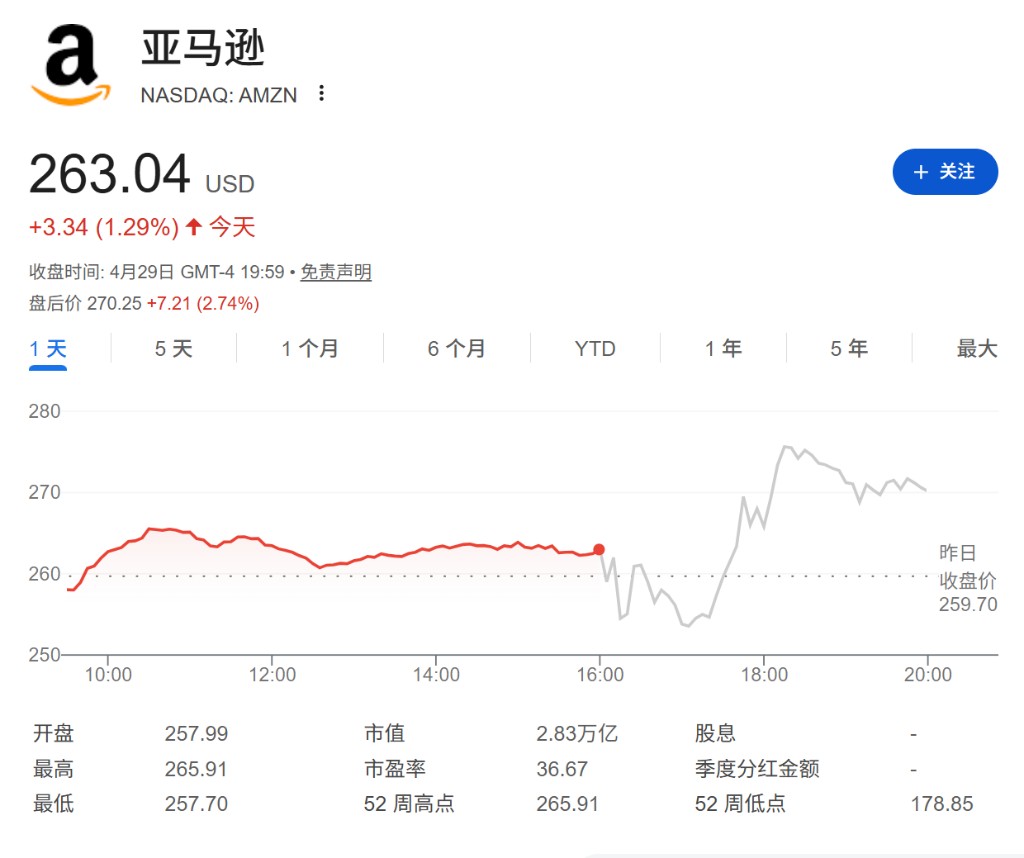
Amazon AWS revenue in the first quarter grew 28% year-over-year to $37.6 billion. The company disclosed that its contract backlog reached $364 billion as of the end of March and expects the recent $10 billion computing power contract with Anthropic to further expand this figure. CEO Andy Jassy stated, "The customer base has considerable breadth, not just one or two customers," adding that cooperation with OpenAI will also bring more revenue. He pointed out, "No single AI tool dominates everything; customers need choices."
Despite strong momentum in the cloud business, Amazon's spending on property and equipment this quarter increased by $59.3 billion compared to the same period last year. This massive AI investment caused the annual free cash flow of the company, valued at approximately $2.8 trillion, to plummet to just $1.2 billion, far below historical levels before the AI boom.
Risk Warning and Disclaimer
The market carries risks; investment requires caution. This article does not constitute personal investment advice, nor does it take into account the specific investment objectives, financial status, or needs of individual users. Users should consider whether any opinions, views, or conclusions in this article align with their specific circumstances. Investment based on this content is at the user's own risk.
