


"The Buffett Premium" halo fades! Berkshire (BRK) stock price lags behind, new leader faces shareholders' meeting in crisis
Berkshire Hathaway (BRK.)'s stock price has significantly declined after Buffett stepped down, underperforming the S&P 500 index by more than 37 percentage points over the past 12 months, marking its worst performance since 2000. The new CEO Greg Abel will face the challenge of the sluggish stock price at the upcoming shareholders' meeting, as the market's expectations and trust in his investment strategy need to be restored. The poor performance of some holdings and the high valuation environment have made it difficult for Berkshire to find suitable investment opportunities
According to the Zhitong Finance APP, Greg Abel is about to hold the shareholder meeting for the first time as the CEO of Berkshire Hathaway (BRK.A.US, BRK.B.US), but he is facing a challenge that legendary former CEO Warren Buffett has rarely encountered: the company's stock price continues to weaken.
Berkshire's market value has reached one trillion dollars and has historically been known for outperforming the market over the long term. However, since Buffett announced his retirement and handed over management to Abel a year ago, the company's stock price has significantly lagged behind the market. As of this Wednesday, Berkshire's Class B shares have underperformed the S&P 500 index by more than 37 percentage points over the past 12 months, marking the worst annual performance since 2000.
The poor performance of some holdings, such as Kraft Heinz (KHC.US), is partly responsible for Berkshire's stock price slump. At the same time, the current stock market's enthusiasm for artificial intelligence and overall high valuations make it difficult for Berkshire, which holds a massive cash reserve of $373 billion, to find suitable deep value investment opportunities. Abel is likely to address these issues at the shareholder meeting this Saturday, but there is a deeper reason for the stock price slump that is harder to resolve: with the retirement of "Oracle of Omaha" Buffett, investors are no longer tolerant of Berkshire's shortcomings. The 63-year-old new CEO still needs time to regain the trust that Buffett and Charlie Munger built in the market.
Christopher Davis, a fund manager at Hudson Value Partners, stated, "As investors, we appreciate Abel's adherence to the original investment strategy. However, the market hopes to see him replicate a classic Berkshire-style investment to prove that this investment system can still operate smoothly under new leadership." Hudson Value Partners has held Berkshire stock since 2019.
"Buffett Premium" aura fades, Berkshire stock loses luster
Abel, who officially took over as CEO in January this year, is facing a major challenge: the giant he leads has long been deeply imprinted with the legacy of 95-year-old investment legend Buffett.
Thanks to Buffett's unique stock-picking vision and prudent capital allocation ability, Berkshire Hathaway has historically outperformed the S&P 500 index over its 61-year development. Although excess returns have narrowed in recent decades, overall performance remains impressive: since Buffett took the helm in 1997, Berkshire's Class B shares have averaged an annual increase of 11%, exceeding the annualized total return of the S&P 500 by a full percentage point.
Because of this, investors have been willing to pay a "Buffett premium" for Berkshire, resulting in the company's valuation being consistently above the market average. Abel has promised to continue Buffett's investment logic and risk management approach, and this shareholder meeting is themed "Legacy Continuation." However, shareholders may need several more years to be convinced that Abel can reach the investment level of his predecessor.
"Buffett created a sense of mystery for the company, a psychological aura," said Lawrence Cunningham, a long-time holder of Berkshire shares and author of several books about Buffett. "Now that he is no longer at the helm, this aura will inevitably fade over time, ultimately reflecting directly in the stock price." Market concerns are also reflected in Berkshire's price-to-book ratio. Over the past year, the company's price-to-book ratio has continued to decline, currently around 1.4 times, compared to nearly 1.8 times before last year's shareholder meeting.
UBS Group insurance analyst Brian Meredith stated that given Berkshire Hathaway's valuation, Buffett's departure "has somewhat prompted some shareholders to sell their stocks."
Berkshire's price-to-book ratio declines

Analysts also pointed out that Abel has outstanding operational capabilities and has turned Berkshire's energy business into a core profit segment, but he lacks a background in asset management, which is one of the core responsibilities of the Berkshire CEO.
CFRA research analyst Cathy Seifert bluntly stated: "Abel has solid operational experience but has never professionally managed investment funds."
Market patience is wearing thin, and the new leader is under immense pressure
After Buffett's departure, long-standing hidden dangers have become increasingly prominent.
Berkshire's insurance business has seen sluggish revenue growth and profits falling short of expectations, continuously dampening market sentiment. In the fourth quarter of last year, Berkshire's insurance underwriting profits plummeted over 54%, while most peers exceeded expectations.
Seifert pointed out that last year the company recorded a total of $8.3 billion in asset impairments for Kraft Heinz and Occidental Petroleum, damaging its reputation as a successful acquirer. Overall operating profits for the company fell by 6% last year.
Insufficient information disclosure is another major pain point. Among such a large publicly traded company, only Berkshire lacks a dedicated investor relations department and never holds any investor day events apart from the annual shareholder meeting held in Omaha every May. During the sixty years under Buffett and Munger's leadership, the market was willing to tolerate this characteristic, but Berkshire Hathaway's sluggish stock price indicates that shareholders have not yet given Abel the same level of trust.
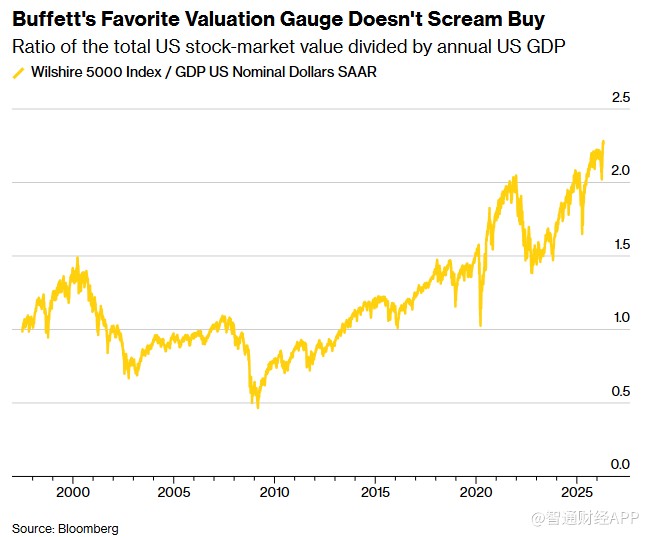
Additionally, overall market valuations are high, and value investing is in trouble. Amid tensions in the Middle East, the AI boom continues to push U.S. stocks to new highs, with several valuation indicators at elevated levels. Even the market capitalization to GDP ratio favored by Buffett has currently surpassed 220%, nearing historical peaks.
The valuation indicators favored by Buffett do not signal a "buy"
Bloomberg industry research analyst Matthew Palazzola stated: "The market may not expect Abel to make long-term heavyweight investments like Buffett, but it does expect to see him independently uncover value targets, which in itself takes time." For shareholders hoping for positive news, Abel's small actions have already brought confidence. Berkshire restarted its stock buyback in early March, which immediately boosted the stock price, after the company had not paid any dividends to shareholders for a year.
Abel is also adjusting the management team, adding a new general counsel, while two core executives are leaving. This Saturday's shareholder meeting will further showcase Berkshire's executive reserve strength.
However, for loyal value investors, overly fixating on short-term stock prices goes against Berkshire's investment philosophy. They continue to believe in the teachings of Buffett's mentor, Graham: in the long run, stock prices will ultimately return to the fundamentals of the business.
But at present, all investors are looking forward to Abel maintaining the fundamental foundation of Berkshire.
KBW analyst Meyer Shields stated that Buffett enjoys extremely high market trust and reputation. Now that Abel has taken the helm, the road ahead is destined to be challenging
