


Buffett: Unprecedented Market Gambling Sentiment, Lack of Ideal Investment Environment; Waiting for When No One Answers the Phone, Powell Provides Greater Reassurance (Full Text Included)
In an exclusive interview during the 2026 Berkshire Hathaway Annual General Meeting, Buffett likened the current market to a "church with a casino attached," warning that a collapse in trust in currency would be tragic. Facing a cash reserve of $380 billion, he admitted that valuations are too high and targets are scarce, stating that the best time to buy is when "no one else answers the phone." He concluded by offering shareholders the ultimate message of the Golden Rule: "Do unto others as you would have them do unto you."
Stepping back from the spotlight, Buffett stated in an exclusive interview that the current environment lacks ideal investment conditions, and the true buying opportunity will only arrive when market panic reaches the point where "no one answers the phone."
On Saturday, May 2, local time, during the 2026 Berkshire Hathaway Annual General Meeting, Buffett gave an exclusive interview to CNBC anchor Becky Quick.
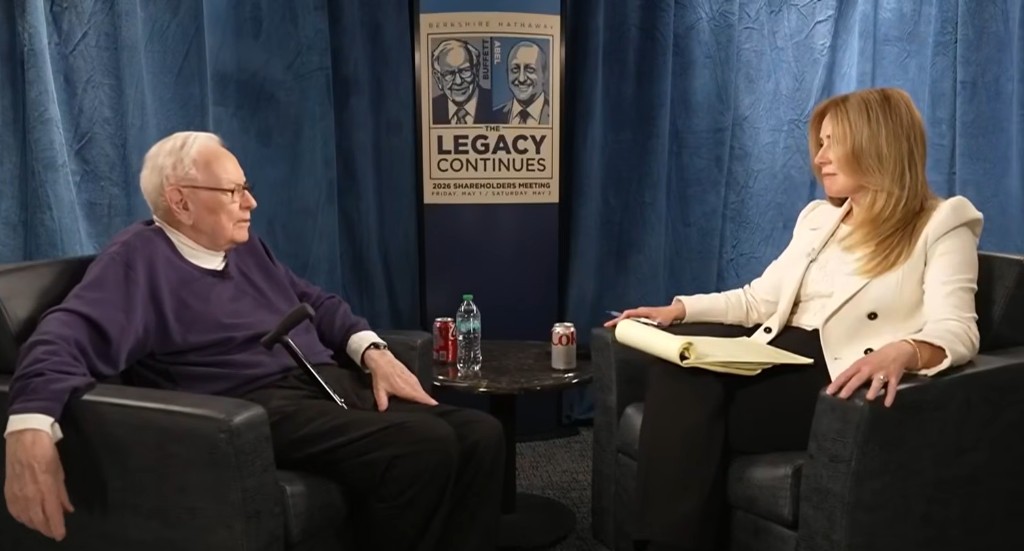
Buffett stated plainly that the current market is not an ideal environment for deploying cash, while criticizing single-day options trading as "pure gambling," and expressed that only when the market crashes and "no one answers the phone" will it be a genuine buying opportunity.
Buffett admitted that the proportion of companies in the overall market that he can truly understand is smaller than it was ten years ago. However, he also emphasized that while Berkshire Hathaway may appear inactive at times, it acts swiftly at others.
This year marks the first time Buffett has attended the annual meeting as an audience member. Just one year prior, at the same event, he announced his resignation as CEO, handing over power to his successor, Greg Abel.
Market Speculative Frenzy: "The Current Market is Like a Church with a Casino Attached"
Berkshire Hathaway currently holds a massive cash reserve of approximately $380 billion, drawing significant market attention to why it has delayed large-scale mergers, acquisitions, or investments. Buffett responded that prices are too high and targets are too few.
Buffett stated:
As for deploying cash for Berkshire, this is not an ideal environment for us.
He emphasized that the company has the right management team and can be selective in choosing opportunities:
Sometimes we do nothing, but sometimes we are very active.
When discussing the current macro stock market environment, Buffett used a vivid metaphor to describe the speculative atmosphere on Wall Street.
I liken the current market to a church with a casino attached. People can shuttle between the church and the casino. I would say there are still more people in the church than in the casino, but the casino has become very attractive to people.
Buffett pointed out sharply:
If you buy and sell single-day options, that is not investing, nor is it speculating; it is outright gambling.
Referencing a recent case where a U.S. soldier profited $400,000 in prediction markets using classified information about military operations in Venezuela, he said:
Unless one knows when we will strike Venezuela like that individual did, no one can explain why they would buy one-day options. The volume of such activities is astonishing.
Buffett lamented:
We have never encountered a crowd with a heavier 'gambling instinct' than now.
Buffett added that the surge in gambling enthusiasm does not necessarily mean the market will crash, but it will cause the prices of many assets to remain at high levels for a long time.
The True Buying Opportunity: "When No One Else Answers the Phone"
Facing Berkshire Hathaway's cash reserve of approximately $380 billion, Buffett admitted that the current investment environment is not ideal, with elevated market prices being one of the main reasons for his inaction.
He also acknowledged that as he ages, the proportion of industries he deeply understands is smaller than it was 10 years ago—he no longer expects to have an advantage in areas where young people who grew up with new technologies excel.
Nevertheless, he emphasized that Berkshire Hathaway possesses the ability to make quick decisions and can handle transactions of any scale, but is simply waiting for the right moment. Buffett claimed:
The most likely buying opportunity is when everyone else is not answering the phone.
Buffett admitted that in his 60-year career, there were perhaps only five years that were truly "lucrative." He recalled the real ecosystem of Wall Street during market crashes:
Everyone boasts about their excellent trading desks. But when the market crashes, try calling them—they don't answer the phone at all. Even if they do, the bids and asks come with various conditions, and the bid-ask spreads are huge... It feels like walking into a slaughterhouse; you won't want to eat a hot dog for a while.
Regarding "black swan" events that could trigger a sharp drop, Buffett maintained his usual openness. He stated:
Things people discuss and worry about usually do not happen; instead, it is sudden black swans that shake the market.
But he emphasized:
Worrying about these things is useless; we just need to maintain awareness.
The Ultimate Weapon Against Inflation and AI Risks
When asked about the tenure of Federal Reserve Chair Powell, Buffett stated clearly:
I feel more reassured when he is in place.
He emphasized that runaway inflation is one of the most severe threats any economy faces, with countless countries having paid a heavy price historically.
Addressing the current persistent inflation environment exceeding 3%, Buffett recalled the history of hyperinflation during the era of Paul Volcker (former Federal Reserve Chair).
He pointed out that once currency loses trust, it will be a tragedy for many people.
Facing inflation, Berkshire Hathaway cannot influence the direction of macro interest rates, but Buffett reiterated his classic micro-defense logic:
If you are the best doctor in town, or the best lawyer in town, you can make money in any economic environment.
Beyond macroeconomics, Buffett also expressed deep concern about AI deepfake technology during the interview. During the Annual General Meeting, a realistic "fake Buffett" video even appeared.
It is terrifying. It is especially terrifying when you have about nine countries possessing nuclear weapons, and people are researching this kind of (deepfake) technology.
Buffett compared the destructive power of believing false information to the panic caused by the classic "War of the Worlds" radio broadcast.
Ultimate Message to Shareholders: Follow the "Golden Rule"
When asked for a message to thousands of long-term shareholders and partners, Buffett did not discuss investment strategies but returned to life philosophy.
He said:
The first rule I give them is the Golden Rule—do unto others as you would have them do unto you.
If the whole world followed this Golden Rule, society would become incredibly beautiful, Buffett said with a smile:
From being a parent to being a boss, it applies to everything. It doesn't cost you a penny. In fact, it earns you better treatment from others. In a sense, it is even an extremely 'selfish' approach, but I have never seen anyone who acted in this way and was unhappy.
Below is the full text of Buffett's interview (AI-assisted translation):
2026 Berkshire Hathaway Annual General Meeting – Warren Buffett Interview
Host: We are now sitting down for an exclusive interview with Warren Buffett, Chairman of Berkshire Hathaway. For the first time in 60 years, he is sitting in the audience watching the entire proceedings, rather than being on stage. Warren, just this time last year, you unexpectedly announced that you would step down as CEO. A year has passed; looking back now, what are your thoughts?
Buffett: I think everything is running smoothly, indeed. As for allocating capital for Berkshire, the current external environment is hardly ideal. But regarding internal management, we have the right management team and reasonable arrangements. We can choose when to act on our own; no one can give us orders. So sometimes we remain inactive, but at other times we are quite active.
Host: A speaker on stage today mentioned that a core principle in his insurance underwriting is "remaining inactive"—this is exactly in line with the philosophy you have always discussed regarding investment decisions.
Buffett: In this world, there are always people constantly selling you various opportunities. The question is which ones are truly worth acting on. Perhaps there are twenty thousand opportunities that seem reasonable, but if you don't understand them, just let them go and don't touch them.
Host: You said the current external environment is not ideal. This might point to a question—the company sits on nearly $400 billion in cash, although Greg explained with some effort that it is actually around $380 billion. Regardless, that is a considerable amount of cash. You are still involved in managing the investment portfolio and continue to observe the stock market, but it seems you haven't found many targets you want to buy?
Buffett: Then we do nothing. I have been in this business for about 60 years, and there were only about five years with truly "plump" opportunities. I remember old Thomas Watson of IBM was once asked about the secret to success. He said, "I only act in areas where I am proficient, and I always stay near those areas." That is the whole story. IBM was involved in three different businesses at the time, including punch card machines, and two of them ultimately proved unworkable, so they focused on the one that worked.
Host: When you look around, do you feel valuations are too high? I suppose there are still some businesses you like, just at the wrong price—Greg mentioned this on stage as well.
Buffett: I would say that compared to ten years ago, the proportion of businesses I truly understand within the overall market has become smaller. I haven't learned new industries for several years, so I won't force myself to learn, nor will I claim to have an advantage over young people who grew up with these products and witnessed their evolution firsthand. Like Apple, you don't need to understand too much; understanding one thing is enough.
Host: I would like to hear your views on the macro level, as this may not be a topic Greg would comment on directly. From the perspective of the macro stock market environment, how do you feel? Do you think it is expensive, or do you see opportunities?
Buffett: I have likened the stock market to a church with a casino attached, where people can move freely between the two. I would say that nowadays, the number of people in both the church and the casino is increasing, but the casino is becoming increasingly attractive to people.
If you are buying one-day options, that is not investing at all, nor is it speculating; it is gambling, pure gambling. No one can clearly explain why they would buy an option valid for only one day. The nature of such behavior is staggering.
We have never seen a market with a heavier gambling instinct than now, but this does not mean everything is hopeless. It does mean that the prices of many assets will remain at high levels for a considerable period and will not easily be squeezed out.
This phenomenon has existed for fifty years, but just in the past week, we have seen that despite increasing regulation, people are still trying hard to exploit loopholes in the rules rather than complying with them, which is a continuous challenge.
Host: With your investment style, you have said yourself that in your 60-year career, there were only about five years of truly "plump" opportunities. I assume this means you are always waiting for the next "plump" opportunity. What conditions do you think are needed to create such an opportunity?
Buffett: Often, it's a phone call. Last year, we completed an acquisition through a letter, but the scale was not large enough to be significantly meaningful for Berkshire.
Host: Bell Labs?
Buffett: No, not Bell Labs. Sometimes there are more zeros attached, sometimes fewer. Our size is sufficient to handle transactions of any scale, we make decisions faster than anyone else, and we keep our word. But the reality is that many people are in the reselling business, and sales skills are more valuable to them. You don't need to go door-to-door selling vacuum cleaners; other ways allow you to make more money. And there is more money in the market now than ever before.
Host: The best opportunities are most likely to appear when the macro environment is most chaotic, right?
Buffett: Very likely. The best time to buy things is often when no one else answers the phone. Usually, everyone boasts about how excellent their trading desks are, but when the market really crashes, you call, and no one answers. Even if they do, the quoted bid and ask prices are "TBD," and the bid-ask spread is ridiculously wide. Worse still, they will use the intentions they probed from you to turn around and rip you off in another way. That feeling is like walking into a slaughterhouse; you won't want to touch a hot dog for a long time afterward.
Host: I want to ask, do you see any signs currently indicating that such a moment might come again? Is panic accumulating anywhere in the market?
Buffett: If you could see it in advance, it wouldn't happen. Real crises always fall from the sky, surprising everyone. Someone might die suddenly, nuclear war might fall from the sky—who can say for sure?
Host: Then let's knock on wood for good luck.
Buffett: Knocking on wood is useless; that is exactly what I want to say.
Host: Yes, you are right.
Buffett: Just like that gunshot in Sarajevo in 1914, when the Archduke was assassinated, and then World War I broke out. Everything in life is like this. Things people are talking about and preventing often do not happen; what really happens are things that were never anticipated.
Using the phrase "falling from the sky" is particularly apt right now—things might really fall from the sky, and we simply do not know what will happen tomorrow.
I don't like speaking to people this way, because worry itself is not very meaningful. I think it is necessary to maintain clear awareness of these potential risks, but indulging in worry is useless and even harmful. I also do not like to sensationalize the feeling that the end is near.
Host: Greg told me yesterday that he has recently developed a habit of often saying, "I am not anxious, I am not worried," which might indeed be a good attitude towards life. Let's talk about a few practical issues at hand. Inflation is currently rising, and Berkshire has a large number of industrial businesses; how do you cope?
Buffett: There is very little we can do about runaway hyperinflation, or even just choose to avoid the areas most vulnerable to impact. Looking at my life since World War II, an astonishing number of countries have experienced hyperinflation. Once it gets out of control, the whole world changes. Weimar Germany is an extreme case, a consequence of World War I. But similar things have happened in dozens of countries, some of which have even experienced six or seven national bankruptcies. What people do in the financial sector is sometimes truly breathtaking.
Host: Let's talk about current inflation then. The situation is not extreme; the inflation rate is just over 3%, far below the nearly 9% level during the pandemic. What impact do rising energy prices have on business operations, and how does Berkshire respond?
Buffett: Before Volcker took action, the situation was quite critical—the feeling at the time was that "cash is trash," and people were losing confidence in currency. I remember that borrowing rates were as high as 12%, while the return on agriculture was only about 6%. As a result, a large number of farmers in Nebraska went bankrupt because they bought land at prices exceeding its earning capacity, bearing interest far beyond actual returns, simply because they believed the dollar would disappear but the land would not. This was a tragedy for many people.
Of course, if you are the best doctor, the best lawyer, or a top TV host in town, you can always make money regardless of how high inflation is. But once people lose confidence in currency, the entire country takes on a different appearance. I have always hoped that the United States would never reach that point, but we are not immune to it. We still have considerable control over interest rate fluctuations of half a percentage point, but if interest rates need to rise by 50 percentage points, that is another matter, and our control would be much weaker.
Host: You have long been a supporter of Jay Powell. He just presided over his last Federal Open Market Committee meeting as Federal Reserve Chair last week. He stated that, given the various threats faced, he will continue to stay at the Federal Reserve and remain in his current position for the foreseeable future.
Buffett: I feel more reassured with him in that position. Currency matters allow for no mistakes. Just like when Volcker was in office, I felt equally secure. To be honest, economists are not necessarily the best people to handle such issues. Pick up any economics textbook from the 1950s or 1970s—for example, the one written by Paul Samuelson, a remarkable man, extremely smart. That book was used as a standard textbook for 25 years, a full 900 pages—but if you search the entire book, you won't find a single entry on zero interest rates. Yet zero interest rates were one of the most important economic phenomena experienced by students of that era in their lifetimes. It is precisely those things you never expect that cause the greatest damage.
Host: Let's talk about CEO changes at several key holdings of Berkshire. You mentioned Tim Cook of Apple, thinking he has done an excellent job. But he is not the only departing CEO among your major holdings. James Quincey recently stepped down from Coca-Cola, and we just spoke with Vicki Hollub, who announced her retirement and departure from Occidental Petroleum.
Greg has repeatedly emphasized that the stability of this portfolio lies in his understanding of these companies and these managers. But now that these important holding companies are welcoming new management teams, is this concerning?
Buffett: On the Coca-Cola side, it has indeed been a problem for several years.
A very excellent company is actually the hardest to spot management problems in, because the company's inertia supports its continued operation—people buy its products every day, and mistakes made by management may not manifest in the short term. This is one of the major difficulties in investment. Tim Cook, I thought was excellent from the start. Most of our smaller-scale managers are also excellent and can handle daily problems, but they may not foresee those overwhelming major challenges—dealing with those challenges was previously my responsibility, and now it is Greg's responsibility.
Host: Do you still have confidence in these holdings? Have you met the new managers who are about to take over?
Buffett: They are all familiar faces.
Host: I mean the new CEOs who are about to take over, such as the person replacing Tim Cook.
Buffett: Of course, I have met relevant personnel from some companies we are in contact with. I enjoy the process of interacting with people, but judging character can indeed lead to errors. I have recently been looking at divorce rate data—this matter itself is more important than judging who is a suitable CEO. And after years of adjustment, the same mistakes are still being repeated. Think back to when I was young; many people decided to marry in their early twenties and just did it. Now people cohabit for five years before marrying, yet they still make the same mistakes.
Host: So you think we haven't improved in judgment?
Buffett: I can't say for sure. Perhaps people behave differently before and after marriage. I can only say that almost everyone feels that marriage is different from what they expected one month after getting married, but whether it is better or worse than expected, I don't know.
Host: Warren, let's talk about deepfakes. At the beginning of the conference today, a "fake Buffett" appeared, which was quite realistic—Greg even joked at the time that the first questioner was a "Warren" who claimed to live in Omaha and was sitting in the stands. You have previously expressed concern about AI deepfakes; what do you think this means for the world?
Buffett: This should worry everyone. The worst-case scenario is the emergence of a deepfake that perfectly mimics any current president. Imagine the consequences. This reminds me of something that happened a long time ago in New Jersey—a radio drama broadcast a program about "Martians invading Earth," causing mass panic.
Host: You mean the Orson Welles incident?
Buffett: Yes. When you can manipulate information so realistically, people will be easily deceived out of large amounts of money, and funds will flow to where they shouldn't, which is a very frightening thing. Especially in today's world, where about nine countries possess nuclear weapons, and people are developing even more destructive things, all of this is even more unsettling. We have dealt with some challenges, but what will happen in the future, I really don't know.
Host: Let's bring the topic back to Berkshire. I spoke with you the day before yesterday, and we talked about Greg Abel, saying he is a very good person, indeed an outstanding person. But you said something that impressed me deeply—you chose him not because he is a good person. So why did you choose him?
Buffett: Because he has very keen business judgment. By the way, he is currently preparing for naturalization and is about to officially become a U.S. citizen. He told me about the content he needs to study for naturalization. I have had contact with some people applying for naturalization in the past and have seen the pride on their faces when they swore to become U.S. citizens, as well as the constitutional knowledge they needed to learn.
I also felt this in Greg. His achievements and everything he possesses are already quite outstanding, but becoming a U.S. citizen means something of real weight to him. He told me that his youngest son is actually more familiar with some questions on the naturalization exam than he is, which I found interesting—a child knowing more about U.S. citizenship test questions than his father. Such a thing happening outside the United States is almost unimaginable.
The United States is a true miracle. Everything it has created is an absolute miracle. Of course, the unequal distribution of wealth is obvious, a flaw anyone would point out. But this country has its huge appeal, the existence of some "secret sauce." I have never been able to pinpoint exactly what it is, but when a country has operated for over two hundred years, and every year there are still people eager to come here, it shows there must be something special here.
Greg Abel is very much looking forward to becoming a U.S. citizen, which means a lot to him—it is something money cannot buy, not an emotion that can be packaged by any Madison Avenue advertisement. In my 95 years of life, I have witnessed this emotion time and time again. So when he voluntarily mentioned to me in the past two days that he is awaiting final approval for naturalization, I felt sincerely gratified.
Host: I didn't even know he wasn't a dual citizen yet. I knew he was Canadian, but I thought he already had dual citizenship.
Buffett: He is completing the full naturalization process. You might ask, is it necessary for him to do this? He lives well without naturalization. But he still wants it.
Host: Yes. This year we are celebrating the 250th anniversary of the founding of the United States, and you have experienced 95 years of it. Do you think that "secret sauce" will continue? What do we need to do to protect it and keep it working?
Buffett: We do have this "secret sauce." It is a good secret, so good that even I cannot clearly say what it is. But one thing I am sure of: given the choice, people will choose to come to the United States. Of course, you can list some small countries where people also live happily. But in this world, which other country has continuously attracted people from all over the world to immigrate for hundreds of years?
This country has attracted all kinds of people, including some less reputable ones; different ethnic groups have their own gangs. Yet that screening mechanism has never had the ability to specifically select the "highest quality people" to enter, but it just works, it functions.
However, the extreme wealth disparity it brings seems far from the design of an ideal society. If you were to design a perfect society from scratch, designing such a high GDP per capita, you probably wouldn't design such an inheritance system at the same time; you would make vastly different choices in many aspects. But somehow, it worked out. Of course, working out does not mean we cannot do better.
Host: Warren, at this moment, there are thousands of shareholders and partners sitting in this stadium, many of whom have walked with you for decades. I wonder, do you have any words for them? These partners who have been watching you and walking alongside you for so many years.
Buffett: I think the most important code of conduct for a person is the Golden Rule—"Do unto others as you would have them do unto you." I am not a religious believer, but no one has said it better in over two thousand years. This is probably one of the reasons it has survived to this day. Even now, far more people are reading a book written two thousand years ago about how to conduct oneself than any contemporary work. The Old Testament contains various stories with different perspectives, but if the whole world could practice the Golden Rule, this society would be much better.
Host: Treat others the way you wish to be treated.
Buffett: This applies to everything in life—being a parent, being a boss, and all other roles. And it requires no cost; conversely, it leads others to treat you better. In this sense, it is actually a very "self-interested" thing. And in my life, I have never seen anyone who truly practiced the Golden Rule and was unhappy. I have seen many people in many different situations, and it is always so.
Host: Warren, thank you very much for taking the time to accept our exclusive interview today. He is Warren Buffett, Chairman of Berkshire Hathaway. Greg Abel will take the stage shortly, and we will soon see his wonderful speech.
