


Demand Doubles but Guidance Remains Unchanged: What Is Arm Afraid of with Its AGI Chip?
Bidding farewell to the "blueprint seller" model, Arm enters the chip manufacturing arena! Demand for its first self-developed AGI chip doubled in six weeks, surpassing $2 billion, while data center royalties have doubled year over year. Transitioning from pure IP licensing to a dual-track "IP + Chip" model, Arm directly enters its customers' battlefield. Can this billion-dollar gamble on identity transformation persuade former customers to continue paying?
① The doubling of AGI chip demand in six weeks is the biggest news: Customer demand for Arm's first self-developed server chip, the AGI CPU, doubled from $1 billion in late March to over $2 billion (for FY27-28). However, management maintained the $1 billion guidance unchanged due to supply chain capacity constraints—demand is not the issue; capacity is.
② Data center royalties double for the second consecutive year: Data center royalties driven by Neoverse IP increased by over 100% year-over-year, with management expecting another doubling in FY2027. AWS Graviton, Google Axion, and NVIDIA Vera all run on the Arm architecture, and Arm's share among top supercomputing customers has approached 50%.
③ Licensing revenue growth masks slowdown in royalties: Q4 total revenue reached $1.49 billion, a 20% year-over-year increase that exceeded expectations. However, breaking it down reveals that licensing revenue of $819 million (+29%) was the main engine, while royalty revenue of $671 million (+11%) slowed due to weakness in the mobile market and a high base from MediaTek last year.
④ Non-GAAP operating margin hits a quarterly record high of 49%: However, the GAAP operating margin was only 29.4%. The discrepancy stems from $1.052 billion in stock-based compensation for the full year, accounting for 21.4% of revenue. This is the most easily overlooked cost in Arm's valuation narrative.
⑤ Business model restructuring has begun: Arm is transforming from the "Switzerland of the semiconductor industry"—a pure IP licensor—into a dual-track IP + chip company. The goal is $25 billion in revenue by FY2031 ($10 billion from IP + $15 billion from chips) and EPS exceeding $9. This is a high-stakes gamble on identity.
⑥ Q1 FY2027 guidance is robust: Revenue guidance is $1.26 billion ± $50 million (midpoint representing a 20% year-over-year increase), with Non-GAAP EPS of $0.40 ± $0.04, maintaining a pace of approximately 20% growth for both full-year royalties and licensing.
From SoftBank's $32 billion acquisition to the failed $40 billion acquisition by NVIDIA, and finally to its relisting at $54.5 billion in 2023, every identity shift for Arm has been accompanied by market skepticism. This time, it has chosen to manufacture chips itself, directly entering the battlefield of its own customers. This quarter's data illustrates two points: First, the old story of IP licensing remains on a trajectory of 20%+ growth. Second, the new story of AGI chips saw demand double within six weeks, a pace so fast that the supply chain cannot keep up.
However, Wall Street's reaction on the day was intriguing. Arm's stock surged about 13.6% intraday to $237, but gave back gains after hours, falling over 7% to around $219. The average target price from 24 covering analysts is approximately $180, meaning the stock price is far above consensus. This does not look like a lack of confidence, but rather a perfectly priced stock searching for its next catalyst.
Royalties: Data Center Strength Cannot Alone Offset Mobile Weakness
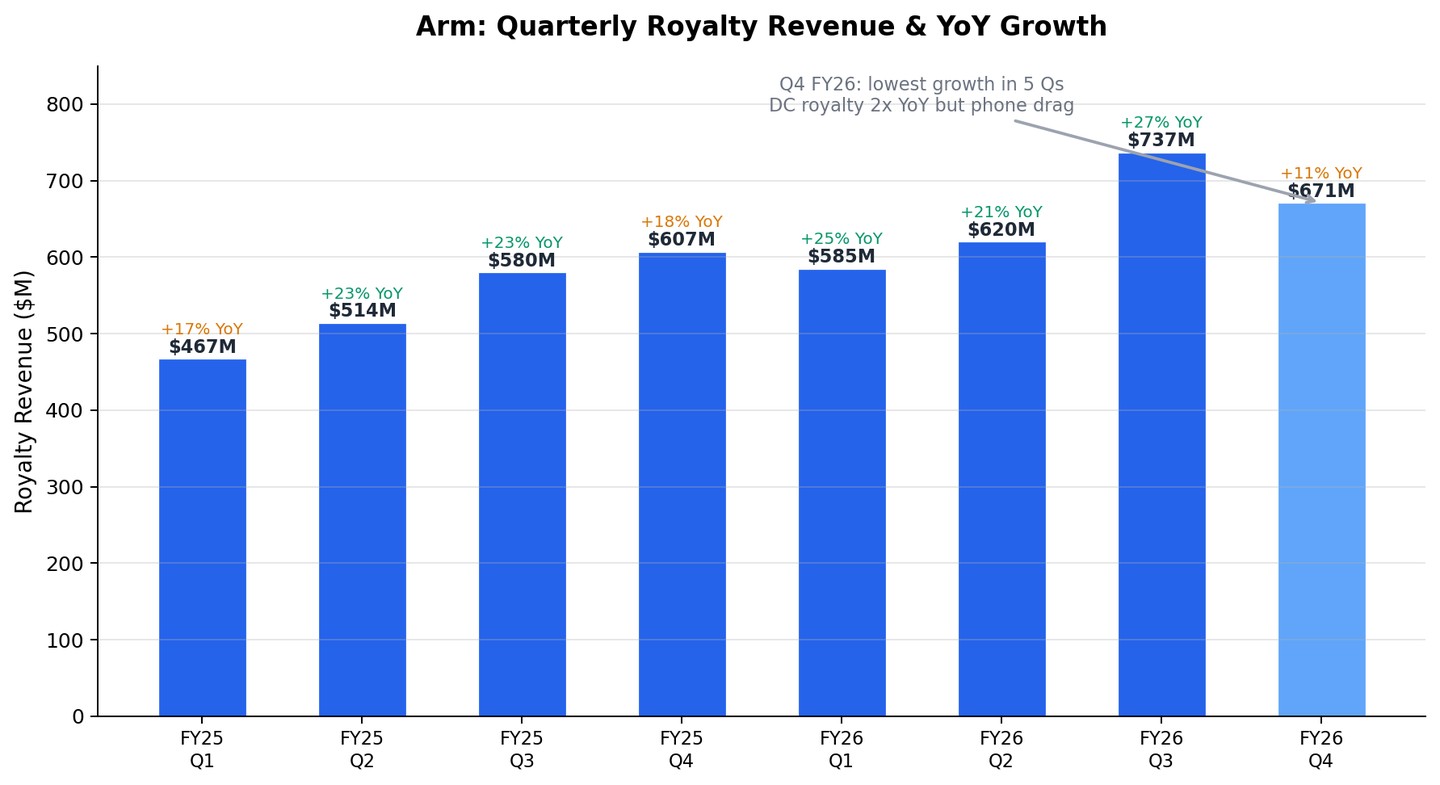
Q4 royalty revenue was $671 million, a 10.5% year-over-year increase, marking the lowest growth rate in the past five quarters. While this figure would be perfectly healthy for other companies, for Arm, which has maintained 20%+ growth in recent quarters, this deceleration signal warrants analysis.
The core drag came from the mobile market. CFO Jason Child admitted during the conference call that the strong volume ramp-up of MediaTek's Dimensity 9400 in the same period last year created a high base. Coupled with continued weakness in global smartphone shipments in the low-end market, this put pressure on mobile royalties. However, the penetration of the Armv9 architecture into high-end models is continuously increasing the per-chip royalty rate—a rise in price partially offsetting the decline in volume.
The real highlight lies in the data center. Data center royalties driven by the Neoverse architecture have doubled year-over-year for the second consecutive year, with management expecting another doubling in FY2027. At Cloud Next, Google announced that its TPU 8t and 8i training/inference chips would fully switch to the Arm-based Axion CPU, delivering an 80% performance improvement. AWS continues to expand Graviton deployment paired with Trainium, and NVIDIA's Vera CPU is also based on the Arm architecture. CEO Rene Haas made an even bolder judgment: By the end of this decade, Arm will hold the largest market share in the data center by CPU type.
However, it is important to recognize realistically that data center royalties still do not account for a large enough proportion of total royalties to completely offset the cyclical fluctuations in mobile and IoT. Management's full-year royalty growth guidance of approximately 20% implies that the data center segment will accelerate in Q1 to make up for the Q4 gap.
Licensing: 22% ACV Growth Reveals Long-Term Health
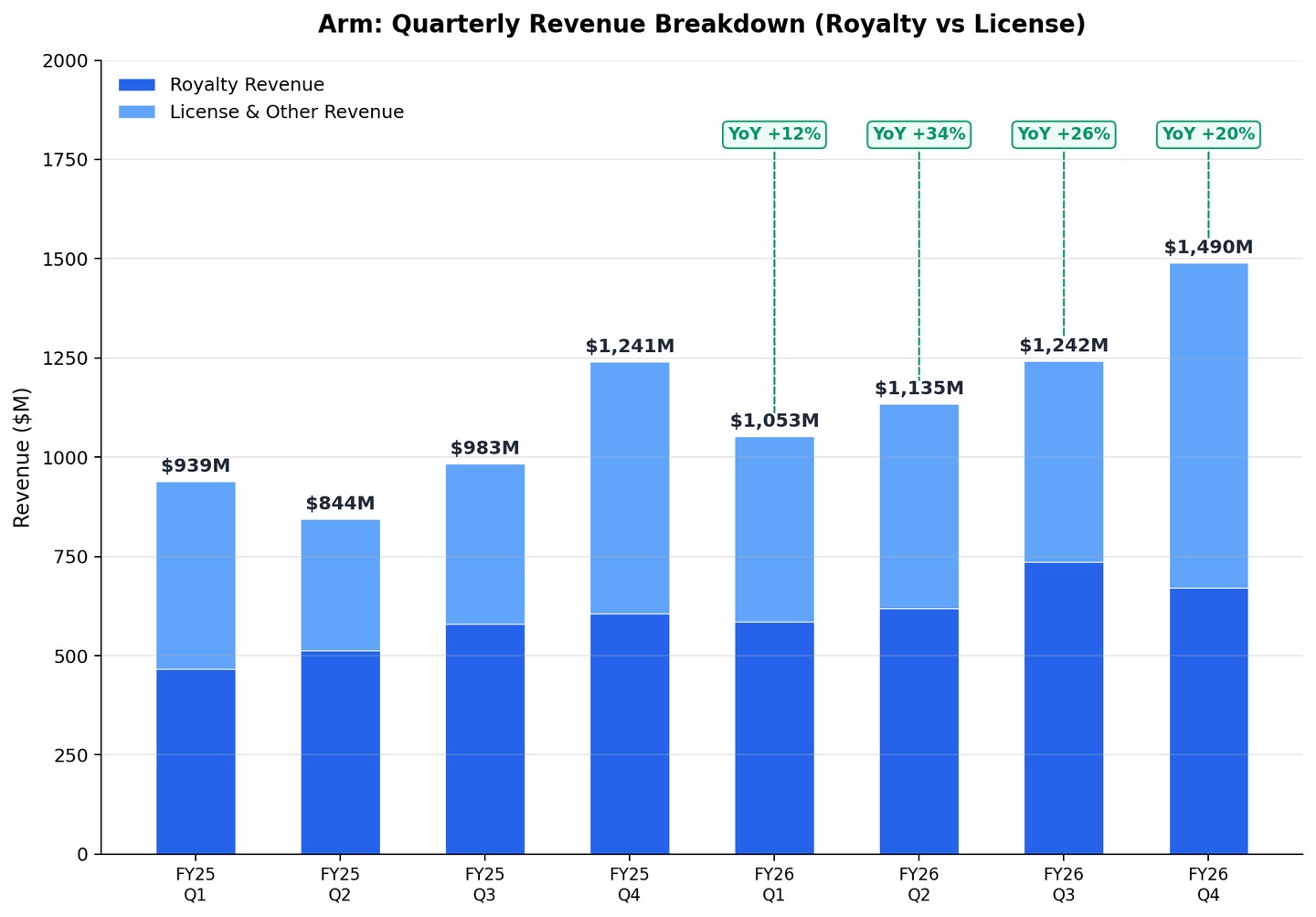
Q4 licensing and other revenue amounted to $819 million, a 29.2% year-over-year increase, of which SoftBank's technology licensing and design services contributed $200 million (flat compared to the previous quarter). Excluding the SoftBank portion, third-party licensing was approximately $619 million, indicating continued strong growth.
More important than the single-quarter figures is ACV (Annual Contract Value). This metric, which smooths out timing differences in large deals, reached $1.66 billion in Q4, a 22% year-over-year increase, remaining consistently above management's "long-term expectations." Two new next-generation CSS (Compute Subsystem) licenses—one for smartphone chips and one for data center network chips—as well as a strategic AI technology cooperation agreement signed with the Indonesian government, all point to the penetration of Arm's technology stack into more endpoints and regions.
RPO (Remaining Performance Obligations) decreased by 7% from $2.226 billion to $2.071 billion. This decline needs to be viewed in the context of Arm's revenue recognition rhythm: Large licensing contracts recognize one-time revenue upon signing, so RPO naturally decreases as it is consumed, which does not indicate weakening demand. The continuous upward trend in ACV is a better forward-looking indicator.
Profit Margins: The Gloss of Non-GAAP vs. The Truth of GAAP
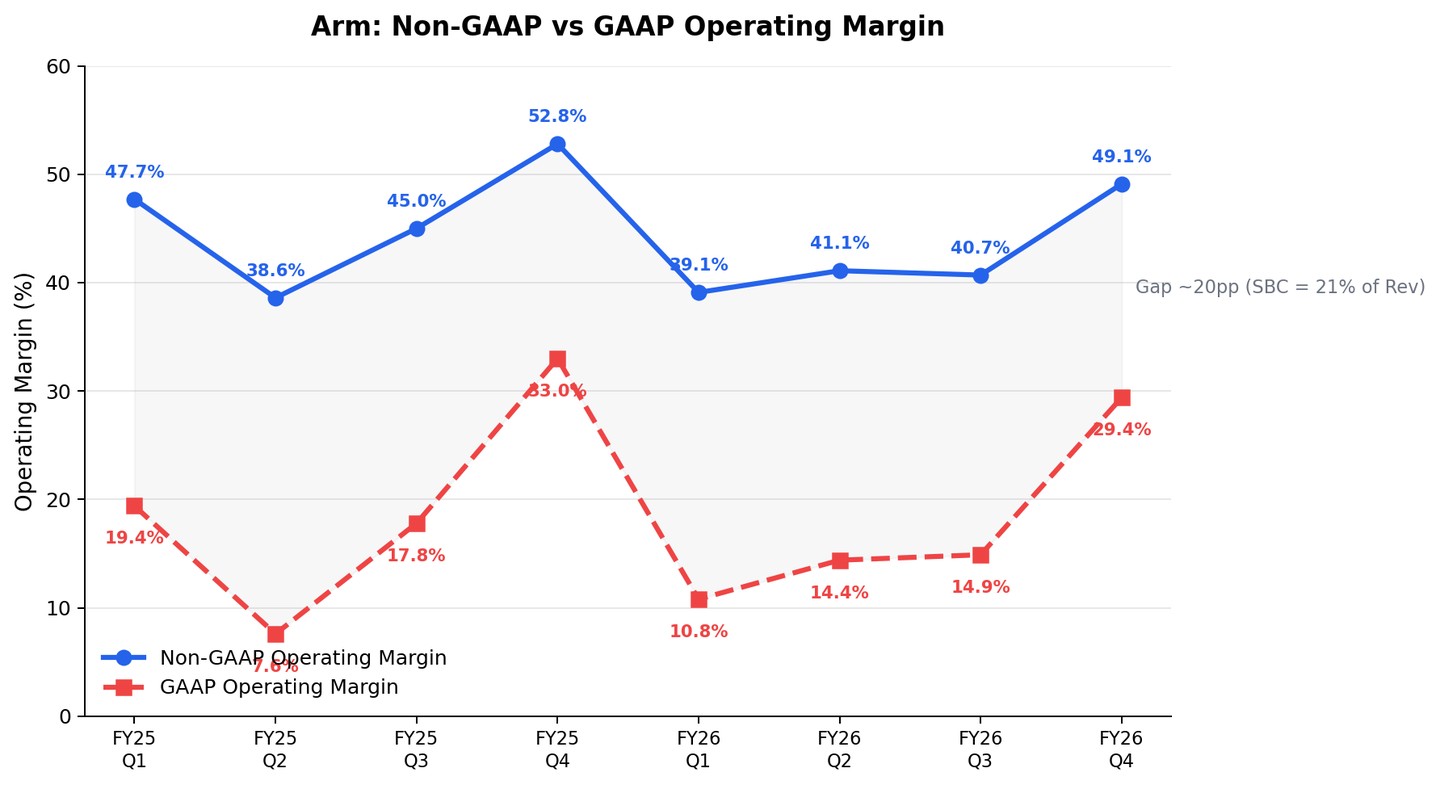
Q4 Non-GAAP operating margin hit a record high of 49.1% since listing, with Non-GAAP EPS at $0.60 (consensus expectation: $0.58). Full-year Non-GAAP operating margin improved from approximately 47% in FY2025 to about 43%—wait, why is the full year lower than Q4? Because margins in Q1-Q3 were only 39.1%, 41.1%, and 40.7% respectively, with heavy R&D expenses concentrated in the first three quarters.
However, the story under GAAP is entirely different. Q4 GAAP operating margin was 29.4%, and the full-year margin was only 18.3%. The core source of the gap is stock-based compensation (SBC): $261 million in Q4 alone, and $1.052 billion for the full year, accounting for 21.4% of annual revenue. For a company with a market capitalization exceeding $250 billion, this SBC intensity is rare in the semiconductor industry.
R&D expenditure is also expanding rapidly. Non-GAAP R&D expenses were $493 million in Q4, a 33% year-over-year increase; full-year expenses were $1.911 billion, up 43% year-over-year. Total employees increased to 9,584 (+15%), including 8,058 engineers (+16%), reflecting continuous investment in the AGI CPU product line and next-generation architectures. Management promised that by year-end, expense growth would fall below revenue growth, returning to a path of positive incremental margins.
Cash Flow: FY2025 "Anomaly" Finally Corrected
FY2026 operating cash flow was $1.524 billion, a significant improvement from $397 million in FY2025. Last year's abnormally low level was mainly due to large increases in contract assets and accounts receivable consuming cash; this year, changes in these items have normalized. Non-GAAP free cash flow was $882 million (only $99 million in FY2025), but capital expenditures soared from $219 million to $545 million—this is the true cost of AGI CPU and data center infrastructure construction.
The balance sheet remains clean: Cash plus short-term investments totaled $3.6 billion, with zero interest-bearing debt.
AGI CPU: Identity Leap from "Blueprint Seller" to "Home Builder"
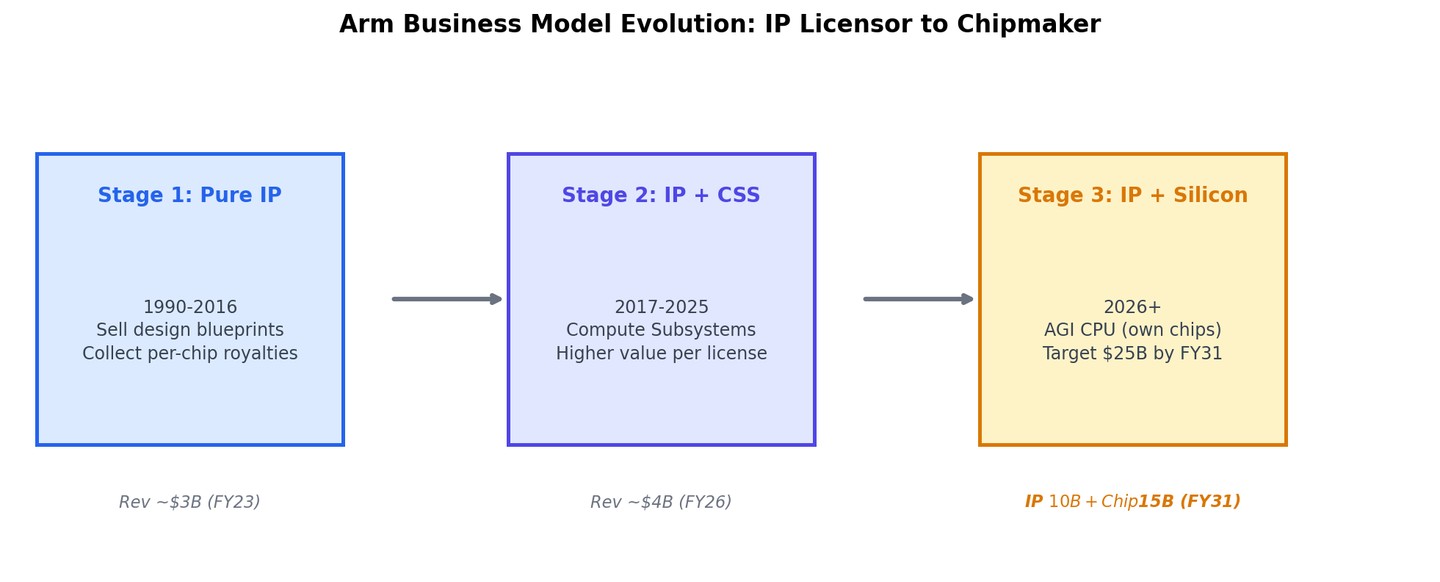
This is the most significant business model transformation in Arm's 35-year history. In the past, Arm was the "Switzerland of the semiconductor industry"—selling design blueprints to everyone, taking no sides, and competing with no one. Now, the AGI CPU allows Arm to sell finished chips directly to data center customers for the first time, placing it in the same track as its licensing customers AWS, Google, and NVIDIA.
Analysts directly asked this "sensitive question" during the conference call: How do existing IP customers view your move into chip manufacturing? Rene Haas responded that every partner was informed in advance, and each expressed support—because the expansion of the broader Arm software ecosystem benefits everyone. Over 50 partners publicly endorsed this move at the Arm Everywhere event.
In terms of figures, customer demand doubled from $1 billion in late March to over $2 billion within six weeks. Demand comes from two sources: First, additional orders from customers who had already announced partnerships, such as Meta; second, new customers—companies that need Arm computing power but do not wish to develop their own chips (such as SAP, Cloudflare, SK Telecom, OpenAI, etc.). These companies can directly purchase Arm racks produced by ODM partners like Lenovo and Supermicro.
However, management cautiously maintained the guidance at $1 billion (contributing ~$90 million in Q4 FY2027 and ~$910 million in FY2028) because wafer, memory, and packaging/test capacities have not yet been secured. More precise supply chain progress will be provided in the Q3 earnings conference call.
Long-term blueprint: $15 billion in chip revenue + $10 billion in IP revenue = $25 billion total revenue by FY2031, with EPS exceeding $9. The long-term operating margin target for the chip business is approximately 35%, and for the IP business, approximately 65%. Most development costs for chips can be shared with CSS IP R&D (as the compute core design is the same set), so the incremental team size is on the order of "dozens rather than hundreds." Management expects the chip business to achieve positive operating profit by FY2028.
Outlook: Can Two Growth Curves Coexist?
Two key variables face Arm that will determine its valuation path over the next three years.
First is the ramp-up speed of AGI CPU mass production. The bottleneck for converting $2 billion in demand into revenue lies in the supply chain, not the market. Allocation of TSMC's advanced process capacity, supply of HBM/DDR5 memory, and scheduling for advanced packaging like CoWoS could all become constraints. AMD faced similar GPU supply bottlenecks last year, which were only largely alleviated this year. Arm's AGI CPU features a 136-core design, creating extremely high demand for advanced packaging.
Second is the evolving attitude of licensing customers. The public support from 50+ partners is currently more in the "happy to see it succeed" stage. Whether this harmony can persist when Arm chips begin to substantially capture their data center revenue remains unknown. However, Rene Haas's argument holds some persuasiveness: AWS has already begun selling Graviton computing power to external customers, indicating that demand within the Arm ecosystem far exceeds the scale any single supplier can meet.
The average target price given by 24 analysts is approximately $180, with a high of $255. On earnings day, the stock price briefly surged to $237, trading above the bull case scenarios of most analysts. This means the market has already partially priced in the success of the AGI CPU—every subsequent update on supply chain progress will become either a catalyst or a risk point for the stock price.
AMD recently raised its 2030 data center CPU TAM estimate from $100 billion to $120 billion, aligning with Arm's previous judgment of over $100 billion. In this rapidly expanding market, Intel's share has dropped from over 90% to about 62%, while AMD holds 29% and continues to expand. Arm's share among supercomputing customers has approached 50%. All three companies claim they can capture 50% of the market—adding up to 150%, so clearly someone will be disappointed.
Arm's most unique advantage is that whether it is Graviton, Axion, Vera, or the AGI CPU, all these Arm-architecture chips contribute royalties to Arm. Even if it loses to its own customers in chip competition, royalty revenue remains Arm's moat. However, the ambition of the AGI CPU is clearly not satisfied with this—the $15 billion FY2031 target means Arm aims to establish an independent growth pole in the chip dimension, rather than continuing to be merely a "toll collector."
This earnings report is the final complete annual answer sheet for Arm as a pure IP company. The next time we examine Arm, it will carry an additional label: Chip Manufacturer. For the first time in 35 years, the designer of the blueprints has decided to build the house itself—the question is, will its tenants continue to pay rent, or will they seek another architect?
