


AI is rewriting the simulation chip cycle: this time it's not just about "inventory replenishment"
Morgan Stanley's latest research points out that the analog chip market is recovering from a slump, with inventory reduction, easing pricing pressure, and selective supply tightness. The construction of AI data centers is driving a shift in analog chip demand towards power and interconnect fields, bringing new investment opportunities. Unlike previous recoveries that relied on traditional terminal demand, this round of recovery benefits from the expansion of AI infrastructure. Inventory, pricing, and demand are improving in sync, with the proportion of analog chip pricing being stronger than usual significantly increasing, leading to an optimistic market outlook
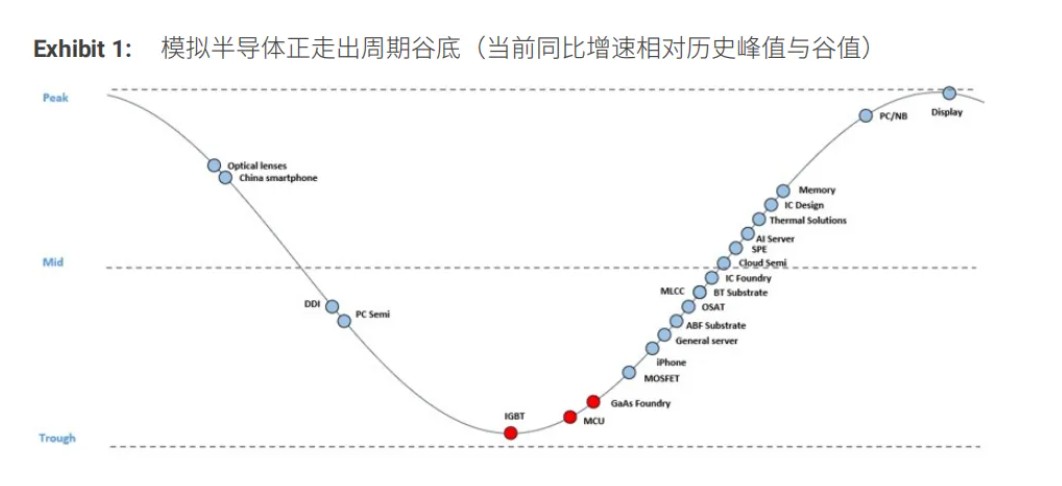
After more than three years of sluggishness, the analog semiconductor sector is re-entering the investors' radar. Morgan Stanley's latest research believes that the fundamentals of analog chips are transitioning from an "L-shaped bottom" towards recovery: channel inventories are becoming leaner, pricing pressures are easing, and there is a selective tightening in the supply of mature processes and power-related products. More importantly, the construction of AI data centers is pushing analog chips from traditional automotive and industrial cycle stories towards a new narrative of "increased power and interconnect content."
This is also the biggest difference between this round of market activity and previous cycles of analog chips. In the past, analog semiconductors relied more on the recovery of end demand from industries such as industrial, automotive, and consumer electronics, while this round of recovery is compounded by the expansion of AI infrastructure. Morgan Stanley pointed out in its report that AI computing and data centers are bringing new opportunities to areas such as rack power, digital power, storage interfaces, and optical interconnects, with related beneficiaries including 800V power architecture, power conversion, MCU, silicon photonics, optical interconnects, and low Earth orbit satellite communications.
Recovery Signals: Inventory, Pricing, and Demand Improving in Sync
From an industry cycle perspective, analog semiconductors have been under pressure for a long time, mainly due to inventory destocking, declining prices, and weak end demand. However, Morgan Stanley believes that the current inventory environment has reached an inflection point. Their distributor survey shows that customer and distributor inventories are becoming leaner, with some product lead times extending by 4 to 8 weeks, and the proportion of respondents planning to continue reducing inventory has significantly decreased, while the willingness to restock in the analog, MCU, and connector product lines has increased.
There has also been marginal improvement on the pricing front. Morgan Stanley's report indicates that the proportion of analog chip pricing stronger than usual among distributors has risen from 33% to 65%, and the proportion for MCU pricing has increased from 33% to 58%. Additionally, Analog Devices will implement a price increase in February 2026, and Renesas has also indicated that if raw material and logistics costs continue to rise, price adjustments may be made. The upward trend in wafer foundry prices for mature processes further enhances the ability of analog/MCU manufacturers to pass costs onto downstream customers.
AI Data Centers Bring Analog Chips "Into the Spotlight"
In the past, discussions about AI hardware typically focused on GPUs, HBM, and advanced packaging. However, as the scale of AI data centers expands, the importance of power management, signal chains, interface chips, and optical interconnects is rising. The U.S. stock investment website also mentioned in its analysis of Texas Instruments that AI data centers are elevating the demand for analog components, especially for power and signal chains, "to a new level"; compared to GPUs/HBM, data center analog devices are more likely to exhibit a "broader, more robust, and longer-cycle" recovery rhythm.
Morgan Stanley is particularly focused on the opportunities brought by the evolution of AI rack power architecture towards 800V. The report states that changes in AI rack power architecture over the next 12 to 24 months will become one of the most important structural variables in the field of analog chips Taking NVIDIA's related rack architecture as an example, the power side cabinet integrates functions such as traditional power supplies, rack-level battery backup units, and large-capacity capacitors, driving the demand for power semiconductors like SiC, GaN, and solid-state transformers. The report predicts that the content value of power semiconductors in each Rubin Ultra rack may exceed $20,000.
Company Insights: Texas Instruments, Renesas, NXP, etc. provide cross-validation
This round of recovery is not only a macro narrative but has also been validated at the company level. Morgan Stanley's report believes that Texas Instruments, as the most widely covered analog leader, has provided clearer signals regarding demand, pricing, and the prosperity of industrial and data centers. A report from 21st Century Business Herald also mentioned that Morgan Stanley raised Texas Instruments' target price from $180 to $221, reflecting institutional recognition of its improving data center and industrial demand.
Renesas Electronics reflects growth opportunities in digital power and storage interfaces. The report states that the company's short-term demand is strong and plans to increase channel inventory while investing 94 billion yen in capital expenditures to expand digital power capacity for data center applications. NXP has strengthened the logic of recovery in automotive and MCU, with its second-quarter revenue guidance indicating a quarter-on-quarter increase of 8.5% and a year-on-year increase of 18%, and it disclosed its exposure to data center-related revenues for the first time. STMicroelectronics has benefited from optics, low-orbit satellite communications, and gross margin recovery.
Reports from Juheng.com and Eastmoney.com also show that Morgan Stanley is recently raising the target prices of several semiconductor companies, shifting the logic from purely "AI concept-driven" to "AI and traditional cyclical demand jointly driving profit recovery." Among them, Microchip Technology, GlobalFoundries, and others are seen as beneficiaries of stable demand, improved capacity utilization, and silicon photonics opportunities.
Risks Remain: Don't Misinterpret Early Cycle Signals as a Full Reversal
However, Morgan Stanley has not defined this round of recovery as a risk-free market. The report warns that the biggest bearish argument is that analog semiconductors may just be normal restocking after a deep adjustment, rather than a sustained recovery in end-user demand. If distributors complete restocking and industrial orders weaken, automotive production declines, or intensified local competition in China leads to pricing deterioration, valuation reassessment may be hindered.
In addition, AI data centers themselves also face financing and execution risks. Futu NiuNiu once cited Morgan Stanley's views, stating that AI capital expenditures are rapidly expanding, with some large tech companies increasingly relying on debt financing for new spending; if the credit market tightens, the pace of AI infrastructure may slow down. Economic Times Enterprise AI reported that Morgan Stanley believes Agentic AI will drive chip spending from GPUs to CPUs, memory, and other broader hardware segments, which aligns with the logic of benefiting analog chips, but also means that related demand still depends on whether AI applications can continue to scale.
Overall, analog semiconductors are at the intersection of "cyclical bottom recovery + increased AI content." This round of market activity does not necessarily require a V-shaped rebound in industrial and automotive demand; as long as inventory normalizes, prices no longer deteriorate, capacity utilization improves, and the visibility of AI power and optical interconnect revenues increases, there is room for upward adjustment in the profit center and valuation multiples of some leading companies What really needs to be tracked is whether the inventory replenishment can be converted into end-user sales, and whether the tight supply and demand for AI data center power, interconnects, and mature processes can continue to be realized
