


Optical communication business surged by 36%! Corning secures billions from NVIDIA to "lock in production," Wall Street exclaims: A new king of AI optical communication is born
Fiber optic cable manufacturer Corning's stock price surged 10.84%, closing at $207.21, near its 52-week high. Bank of America analysts included it in the "U.S. No. 1 List" and noted continued growth due to a deal with NVIDIA. Corning plans to increase its optical connectivity capacity tenfold, expecting U.S. fiber optic production to grow by more than 50%. The two companies will build three new manufacturing plants, creating over 3,000 jobs. NVIDIA paid $500 million to purchase warrants from Corning, granting it the option to buy 15 million shares at a price of $180 per share
Zhitong Finance APP noted that fiber optic cable manufacturer Corning (GLW.US) saw its stock price surge 10.84% on Monday, closing at $207.21, approaching the 52-week high of $209. Previously, Bank of America analysts included this glass and fiber optic giant in their "U.S. No. 1 List" (i.e., the bank's preferred stock list), continuing the growth momentum generated last week due to a deal with NVIDIA.
Currently, it is not just chip manufacturers attracting investor attention. With a significant increase in AI infrastructure spending, companies like Corning that provide fiber optics and optical connectors are becoming the focus. These products ensure that data flow within large-scale AI data centers is both fast and scalable, while the processors within these data centers are handling massive information loads.
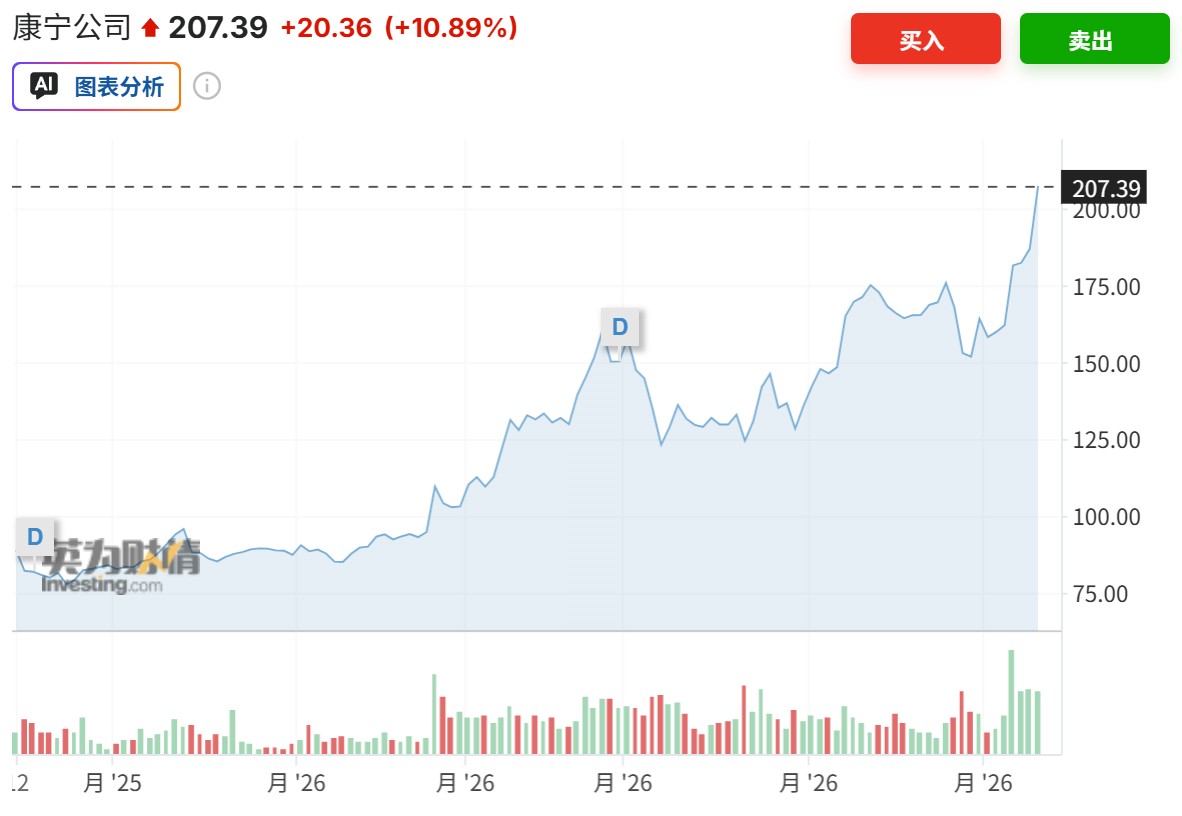
Corning's stock price has increased by over 130% in six months.
NVIDIA's stake in Corning: A "two-way rush" of AI computing power and optical communication.
Corning and NVIDIA disclosed a multi-year commercial and technical collaboration on May 6, aimed at expanding the manufacturing of advanced optical connectivity products for AI infrastructure in the U.S. Corning plans to increase its domestic optical connectivity capacity tenfold, while U.S. fiber optic production is expected to grow by more than 50%.
The two companies stated that they will build three advanced manufacturing plants (two in Texas and one in North Carolina), creating over 3,000 jobs. NVIDIA CEO Jensen Huang described AI as "the largest infrastructure build of our time." Corning's Wendell Weeks stated that it is not just a technology story, but also a "manufacturing story."
According to a securities filing, NVIDIA acquired warrants from Corning, paying a total of $500 million. This deal gives NVIDIA the option to purchase up to 15 million shares of Corning stock at a price of $180 per share, along with an additional 3 million shares settled at a nominal exercise price through pre-financing warrants.
Huang and Weeks told the media last week that the actual financial support may be larger than initially disclosed. In addition to equity-linked investments, NVIDIA has also invested billions of dollars to support Corning's factory construction.
AI Optical Communication "Gatekeeper" Gains Bullish Consensus on Wall Street
After the news of NVIDIA's stake in Corning was released, Wall Street analysts generally held a positive attitude, believing this is not only a turning point for Corning but also an important signal for the reshaping of the AI infrastructure supply chain.
Bank of America included Corning in its preferred list earlier on Monday. Prior to this, several Wall Street institutions had raised the target price for the stock, with Oppenheimer raising it to $210, UBS to $223, and Citigroup to $225 Currently, Wall Street's average target price for Corning is approximately $202, with a median of $210 and a high of $230. This collective bullish sentiment reflects institutions' strong recognition of Corning's transformation from a traditional glass manufacturer to a core supplier of AI optical communication infrastructure.
Oppenheimer analyst Martin Yang reiterated the "Outperform" rating, pointing out that Corning has successfully positioned itself as a key infrastructure provider in the construction of generative AI data centers through deep integration with ecosystem leaders such as NVIDIA, Broadcom, Meta, and Microsoft. He believes that the transition to Co-Packaged Optics (CPO) and scalable data center solutions is a core valuation driver, with the potential to expand the current enterprise business size by 2 to 3 times by 2030.
Citi analyst Asiya Merchant maintained a "Buy" rating, emphasizing that the value of each AI accelerator in terms of optical connectivity is about $500 to $1,000, with further upside as CPO deployment continues; she specifically mentioned Corning's collaboration with Microsoft in the hollow-core fiber space, as well as customers' clear commitments to invest in capacity expansion, both of which confirm strong and sustained demand.
Analysts generally believe that NVIDIA's billions of dollars in funding not only eliminate Corning's financial risks in expanding production but also ensure its monopolistic position in the optical communication market through "targeted production locking."
Despite the sluggish performance of consumer electronics businesses such as smartphones, the optical communication sector's growth rate of up to 36% and the raised annual sales target to $20 billion have become the core driving forces behind the stock price's push to historical highs. As AI computing clusters evolve to tens of thousands of units, Corning's value as the "gatekeeper" of the physical layer is being revalued by Wall Street.
Corning has raised its "Springboard" growth plan, now expecting an annual sales run rate of $20 billion by the end of 2026. The company's goals will further increase: reaching $30 billion by 2028 and $40 billion by 2030. The sales run rate refers to the level of annual sales that would be expected if current or anticipated quarterly data continues.
The performance in the first quarter provided confidence for the bulls. Corning reported core sales (its preferred non-GAAP metric) growth of 18%, reaching $4.35 billion. Core earnings per share (EPS) grew by 30% to $0.70. The optical communication business soared, growing by 36%, while the solar business surged by 80%.
This is not just about Corning. As the market chases the AI data center bandwidth concept, optical network stocks Lumentum and Coherent have also surged. Now, Corning is classified as an AI infrastructure supplier, rather than just being viewed as a traditional glass company.
Optical Communication Moat
Corning is not a new player in the optical communication field. This materials science giant, with over a century of history, invented low-loss optical fibers as early as the 1970s, laying the technological foundation for modern optical communication. Inside AI data centers, as thousands of GPUs process massive parameters simultaneously, the transmission distance and bandwidth of electrical signals are approaching physical limits, making optical interconnects the only viable solution Corning's core advantage lies precisely in its "from glass to systems" vertical integration capability: it not only produces optical fiber preforms and the fibers themselves but also manufactures key components such as optical connectors and couplers, enabling it to provide end-to-end optical connection solutions.
This full industry chain layout translates into significant capacity and cost advantages in the AI era. According to the cooperation plan disclosed by both parties, Corning will increase its optical connection capacity in the U.S. tenfold, with optical fiber output increasing by more than 50%, and will establish three advanced manufacturing plants in Texas and North Carolina. Such aggressive capacity expansion is built on Corning's deep accumulation of manufacturing processes—optical communication products require extremely high precision, which is not something new entrants can replicate in the short term.
More noteworthy is Corning's performance inflection point. In the first quarter of 2026, its optical communication business revenue surged 36% year-on-year, indicating that the demand for AI infrastructure has begun to materialize substantively. This means Corning is transforming from a traditional glass manufacturer into a core supplier of AI infrastructure.
Traditional Business May Hold Back Growth
However, there are still some obstacles. Corning's non-optical divisions are performing unevenly. Market news last month indicated that the slow upgrade of electronic products and weak smartphone demand continue to drag down some business segments. For the second quarter, Corning expects core sales of about $4.6 billion, slightly below analyst expectations.
In addition, Corning faces more risks, including the possibility that AI-driven orders may lag behind investor expectations, factory construction cycles may take longer than planned, or major cloud buyers may readjust their budgets. Factors such as demand, competition, supply chain fluctuations, government support, and shifts in capital expenditures—all of these could cause its performance to deviate from expectations
