


Cisco's Guidance for This Quarter and Full Year Beats Expectations Across the Board; AI Orders Significantly Raised; Plans to Restructure with a Focus on AI; Shares Surge Double-Digits in After-Hours Trading | Earnings Insights
In the previous fiscal quarter, Cisco's revenue and EPS slightly exceeded expectations. Revenue guidance for the current quarter is at least nearly 6% higher than analysts' expectations, while EPS Guidance is more than 8% above forecasts. The gross margin for the last quarter and the midpoint of the current quarter's guidance both stand at 66%, slightly below expectations. For fiscal year 2026, the revenue forecast was raised by over 2%, with orders from hyperscale cloud providers expected to reach $9 billion, an 80% increase from the previous estimate. To realign its focus for the AI era, Cisco plans to lay off nearly 4,000 employees, with estimated pre-tax charges of $1 billion. The stock price surged nearly 20% in after-hours trading
Cisco, the world's largest manufacturer of networking equipment, reported performance for the previous fiscal quarter that was slightly better than expected, along with a significant upward revision in future guidance. This reflects strong order growth driven by artificial intelligence (AI) demand. To adapt to the challenges and opportunities of the AI era, Cisco also plans to restructure and implement layoffs. Following the earnings release, the stock price surged double digits.
After the U.S. market closed on Wednesday, Eastern Time, on the 13th, Cisco announced that for its third quarter of fiscal year 2026, ended April 25, 2026, revenue increased by 12% year-over-year to $15.8 billion, and adjusted earnings per share (EPS) rose by 10% year-over-year to $1.06, both slightly exceeding market expectations.
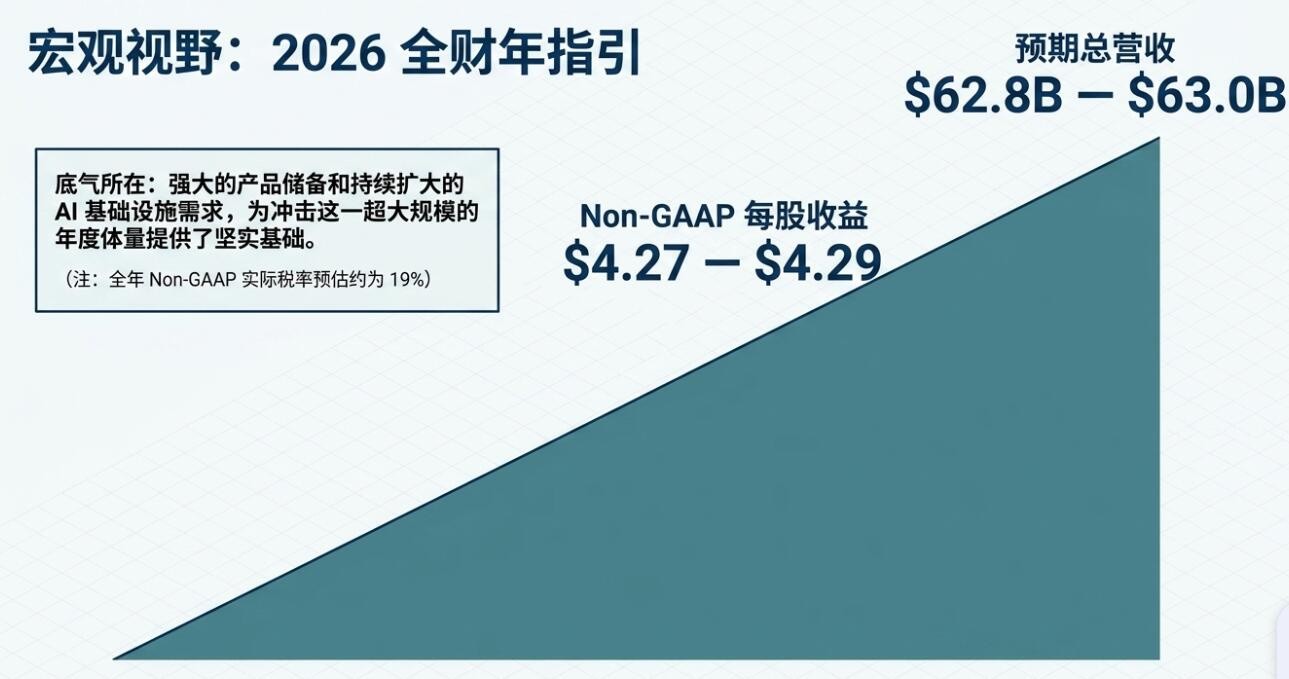
More exciting for the market was the guidance. Cisco expects fourth-quarter revenue to be between $16.7 billion and $16.9 billion, with the low and high ends of the guidance range approximately 5.6% to 6.8% higher than analysts' expectations, respectively. Adjusted EPS for the fourth quarter is projected to be between $1.16 and $1.18, representing an 8.4% to 10.3% beat against market expectations, respectively. The full-year revenue guidance has been raised to a range of $62.8 billion to $63.0 billion, with the low end raised by 2.6% and the high end by 2.1%.
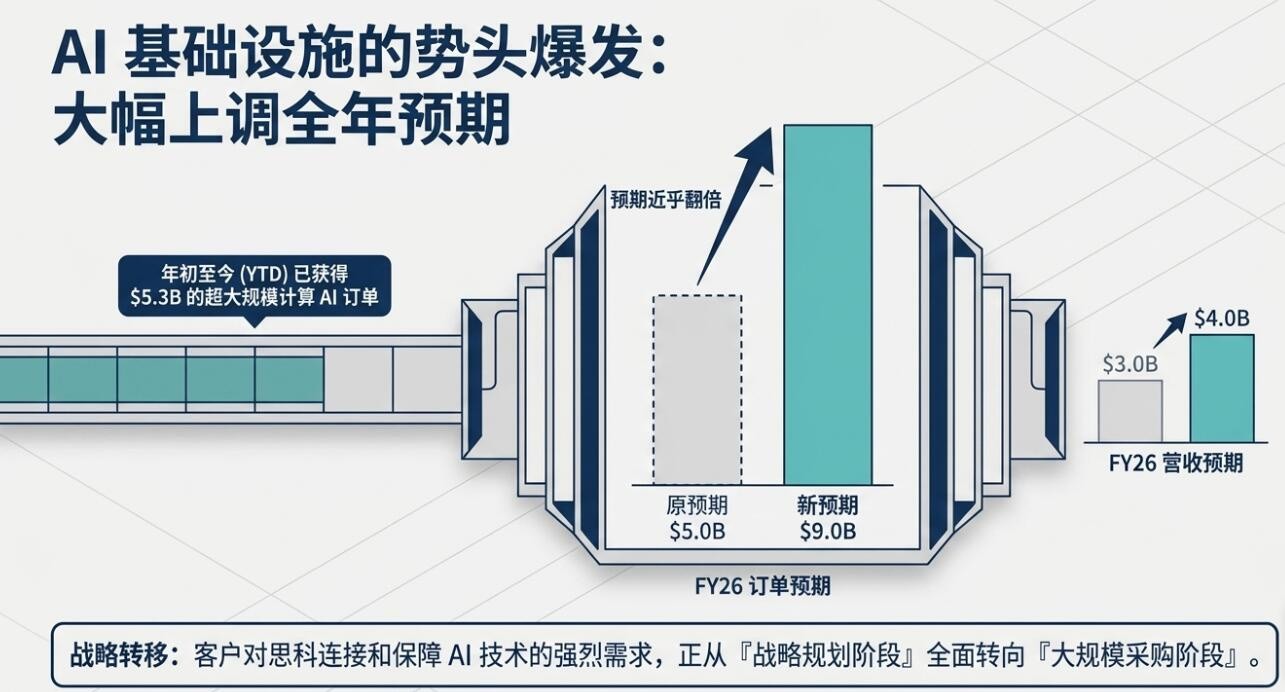
AI-related demand emerged as the highlight of this earnings report. Cisco expects orders from hyperscale cloud providers (Hyperscalers) to reach $9 billion for the entire fiscal year 2026, a substantial 80% increase from the previous estimate. To date, such orders have already reached $5.3 billion. This indicates that Cisco is diving deeper into the investment cycle for AI data centers and cloud infrastructure.
In addition to raising performance guidance, Cisco announced a restructuring plan that will involve laying off nearly 4,000 employees, aiming to shift its strategic focus toward the rapidly growing AI market. CEO Chuck Robbins stated that the layoffs are a necessary measure to help the company realign its strategic direction to adapt to the AI era.
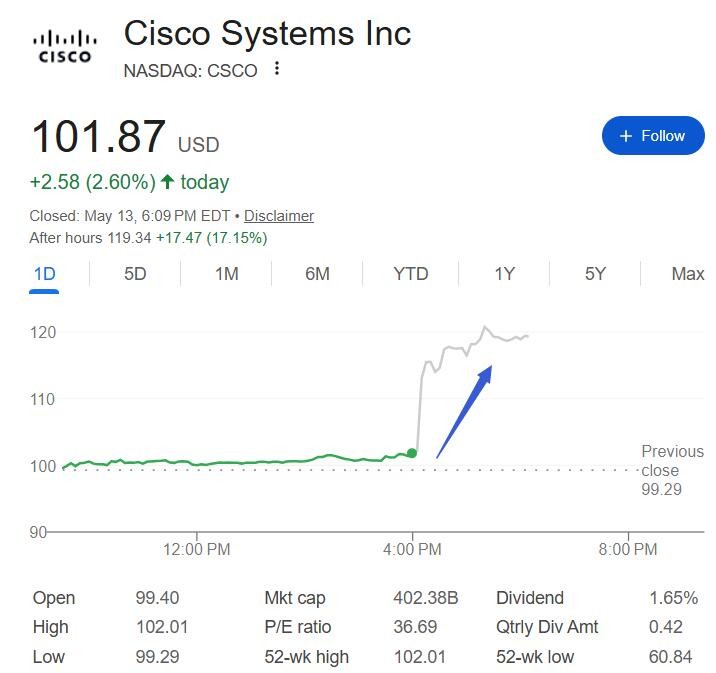
Following the announcement of the earnings and the layoff decision, Cisco's stock price, which had already closed up 2.6% on Wednesday, accelerated its gains in after-hours trading, with the after-hours surge approaching 20%. The market's reaction was not merely due to the third-quarter results slightly beating expectations, but because Cisco provided stronger guidance for future revenue and profits, while significantly raising AI orders, alleviating investors' concerns about slowing demand for traditional networking equipment.
Analysts believe that demand for AI data center networking is transitioning from concept to actual orders, bringing Cisco back into the beneficiary chain of AI infrastructure. Although the restructuring plan brings pre-tax charges of up to $1 billion, it strengthens cost discipline. The combination of raised revenue guidance and cost optimization suggests potentially stronger earnings elasticity in the future. Given that gross margins and their guidance are below market expectations, Cisco needs to prove that AI orders can not only drive revenue growth but also maintain healthy profit margins.
Third-Quarter Revenue and EPS Slightly Beat Expectations, Product Business Is the Main Support
Cisco's third-quarter revenue was $15.8 billion, higher than the analyst expectation of $15.57 billion, beating estimates by approximately $230 million. Adjusted EPS was $1.06, $0.02 higher than the market expectation.
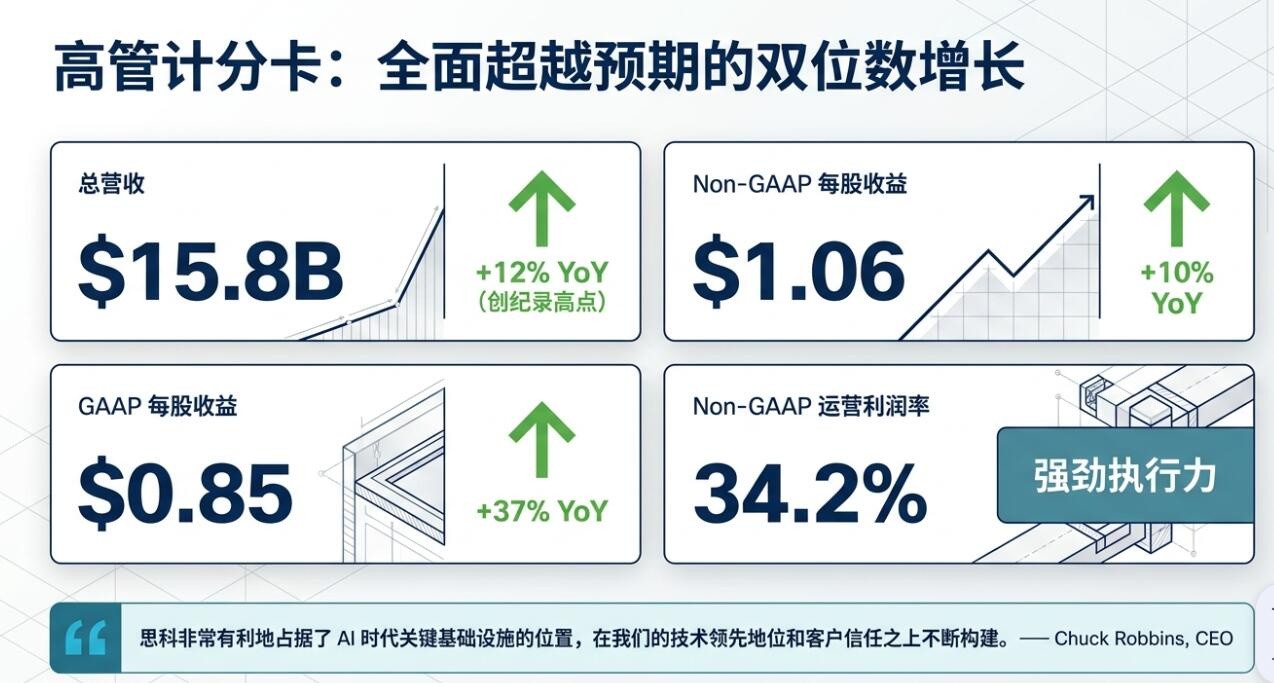
By business segment, product revenue was $12.12 billion, significantly higher than the analyst expectation of $11.79 billion, serving as the core source of the revenue beat for the quarter. In contrast, service revenue was $3.72 billion, slightly below the analyst expectation of $3.78 billion.
This indicates that Cisco's growth in the third quarter stemmed more from a recovery in demand for hardware, networking equipment, and related products, rather than being driven by the services business. For the networking equipment industry, which has undergone an order digestion cycle over the past few quarters, product revenue outperforming expectations again is a positive signal.
However, service revenue falling slightly short of expectations also reminds the market that Cisco's transformation toward software and subscription-based models within its business structure still requires continuous validation. Service businesses typically offer higher visibility and more stable profit characteristics; underperformance in the short term may limit further upward revisions by investors regarding revenue quality.
Gross Margin Slightly Below Expectations; AI and Cloud Customer Orders May Bring Structural Pressure
Cisco's gross margin for the third quarter was 66%, slightly below the analyst expectation of 66.2%. The company expects the adjusted gross margin for the fourth quarter to be between 65.5% and 66.5%, with a midpoint of approximately 66%, which is also below the analyst expectation of 66.6%.
While gross margin did not deteriorate significantly, the slight miss against expectations is worth noting. Reasons may include changes in product mix, an increased proportion of orders from AI and hyperscale cloud customers, and pricing pressure on large customer projects.
For Cisco, AI network orders from Hyperscalers are larger in scale and growing faster, but these customers have stronger bargaining power, and project-based revenue may carry lower gross margins compared to traditional enterprise networking equipment sales. Therefore, the market is currently more willing to pay for revenue growth and AI orders, but will continue to monitor whether AI orders can maintain sufficient profit margins while expanding revenue.
Full-Year Revenue Guidance Significantly Raised, Exceeding Previous Expectation Range
The most important part of this earnings report is the upward revision of the full-year guidance.
Cisco expects full-year revenue to be between $62.8 billion and $63.0 billion, whereas the company previously projected $61.2 billion to $61.7 billion. In other words, the company raised the midpoint of its full-year revenue guidance from approximately $61.45 billion to about $62.9 billion, an increase of roughly $1.45 billion, or nearly 2.4%.
At the same time, the company expects full-year adjusted EPS to be between $4.27 and $4.29, higher than the analyst expectation of $4.16. This indicates that the revenue upward revision did not come at the expense of profits; cost control and operating leverage are still playing a role.
This point is crucial for investors. The current U.S. stock market demands not just an "AI story" from tech companies, but also requires AI demand to translate into revenue and profits. By raising both full-year revenue and EPS guidance simultaneously, Cisco has shown the market that demand for AI infrastructure is practically entering the order and performance levels.
Fourth-Quarter Guidance Significantly Higher Than Expected, Direct Catalyst for After-Hours Surge
Compared to the third-quarter performance itself, the fourth-quarter guidance is stronger.
Cisco expects fourth-quarter revenue to be between $16.7 billion and $16.9 billion, with a midpoint of $16.8 billion, far exceeding the analyst expectation of $15.82 billion, a beat of nearly $1 billion. Adjusted EPS is projected to be between $1.16 and $1.18, with a midpoint of $1.17, also significantly higher than the market expectation of $1.07.
This means the company not only performed steadily in the third quarter but also has significantly stronger confidence in the upcoming quarter. Since stock prices usually reflect future expectations, the strong fourth-quarter guidance became the direct cause of the surge in after-hours trading.
From a market pricing perspective, investors were previously more concerned that Cisco was still in a cycle of inventory digestion among enterprise customers and slowing networking equipment upgrades. However, this guidance shows that the speed of demand recovery may be faster than expected, especially as cloud service providers and AI infrastructure customers are becoming new growth engines.
AI Network Demand Becomes the Biggest Highlight; Hyperscale Cloud Provider Order Expectations Raised to $9 Billion
The most "AI-heavy" data in this earnings report is Cisco's significant upward revision of orders from hyperscale cloud providers.
Cisco expects that for the full fiscal year 2026, orders from hyperscale cloud providers will reach $9 billion, whereas the previous estimate was only $5 billion. To date, orders in this area have already reached $5.3 billion, exceeding the previous full-year target.
This equates to the company raising its related full-year order expectation by 80% within a single quarter. For the market, this is not an ordinary order adjustment, but a signal that Cisco's AI data center networking business is being repriced.
AI infrastructure construction requires not only GPUs and servers but also high-speed switches, routers, optical interconnects, security, and data center network architecture. As large cloud vendors continue to invest in AI clusters, the network layer has become an important component of AI capital expenditure. Cisco's significant upward revision of the hyperscale cloud provider target means it is gaining more direct order conversion from the wave of AI infrastructure investment.
This is also the core logic behind the after-hours stock surge: the market had previously focused more on core AI hardware beneficiaries like Nvidia and Broadcom, but Cisco has now used order data to prove that AI network spending is also expanding, and that the company has the capacity to undertake this portion of demand.
Remaining Performance Obligations Better Than Expected, Enhancing Revenue Visibility
The remaining performance obligations (RPO) disclosed by the company for the third quarter amounted to $43.46 billion, higher than the analyst expectation of $43.27 billion. RPO typically represents the amount contracted for future delivery but not yet recognized as revenue, rather than debt in the traditional sense.
RPO being slightly higher than expected indicates that Cisco's subsequent revenue has strong visibility. For a tech infrastructure company that emphasizes both hardware and software services, RPO is an important indicator for observing order backlog, subscription revenue, and future revenue stability.
Although the extent of the beat on this metric was not large, combined with the raised full-year revenue guidance and the surge in orders from hyperscale cloud providers, the market finds it easier to believe that Cisco's revenue growth in the coming quarters is not a one-time fluctuation but is supported by an order foundation.
Cisco to Lay Off Nearly 4,000 Employees This Quarter; Estimated Pre-Tax Charges of $1 Billion
Along with the earnings release, Cisco announced a new round of layoffs starting May 14, cutting nearly 4,000 jobs this quarter, which is less than 5% of the company's total workforce. Cisco thus becomes the latest company to announce layoffs related to artificial intelligence (AI).
In regulatory filings, Cisco disclosed that due to severance compensation and other related expenses, the company will incur pre-tax charges of up to $1 billion, with approximately $450 million of these charges to be recorded in the fourth quarter.
In a blog post announcing the layoffs, Cisco CEO Chuck Robbins wrote that only by "investing in areas with the strongest demand and those that create the most long-term value" can enterprises win in the AI era. For Cisco to join the ranks of winners, it must make difficult choices, "including deciding where to invest, how to restructure its architecture, and how to adjust its cost structure to fit the opportunities before us."
Analysts believe that from a short-term financial impact perspective, the restructuring will bring one-time charges, putting pressure on the profit side. However, looking at the adjusted EPS guidance, Cisco still provided full-year and fourth-quarter profit targets higher than market expectations, indicating that management expects cost optimization to help support future profit margins.
Such layoffs and restructuring usually have two implications: on one hand, the company is cutting costs in low-growth or less efficient businesses; on the other hand, it may be shifting resources further toward high-priority directions such as AI, cloud networking, security, and software subscriptions.
Therefore, the market did not view the layoffs as a negative signal of weak demand, but rather tended to interpret them as Cisco reallocating resources and improving operational efficiency within the AI infrastructure cycle.
