


Stock Indices Surge with Highly Concentrated Gains as Bond Market Sounds Alarm; Goldman Sachs Warns "High Interest Rates Will Kill US Stocks"
The S&P 500 has repeatedly hit record highs, but undercurrents are stirring. This week's gains were almost entirely driven by the "Magnificent Seven" tech giants, including NVIDIA and Apple, while the remaining 495 constituent stocks contributed negatively in aggregate. The number of stocks hitting new lows within the index continues to exceed those hitting new highs, pushing market breadth to historic lows. Meanwhile, gamma squeezes are creating a false sense of prosperity, with the yield on US 30-year Treasury bonds firmly holding above 5%. Goldman Sachs stated bluntly: "Persistently high interest rates are a major trouble for the stock market."
Behind the repeated record highs of US stock indices, structural risks are accumulating. The extreme concentration of gains in a few tech giants, mechanical rebounds driven by gamma squeezes, and the continuous rise in global long-end interest rates together constitute the most dangerous combination in the current market.
The S&P 500 Index touched another record high on Wednesday local time, but nearly two-thirds of its stocks declined that day. This marks the seventh time in the past ten record highs that declining stocks outnumbered advancing ones. According to data from UBS trading desks, all of the index's gains so far this week have come from the "Magnificent Seven," with the remaining approximately 495 constituent stocks contributing negatively in aggregate.
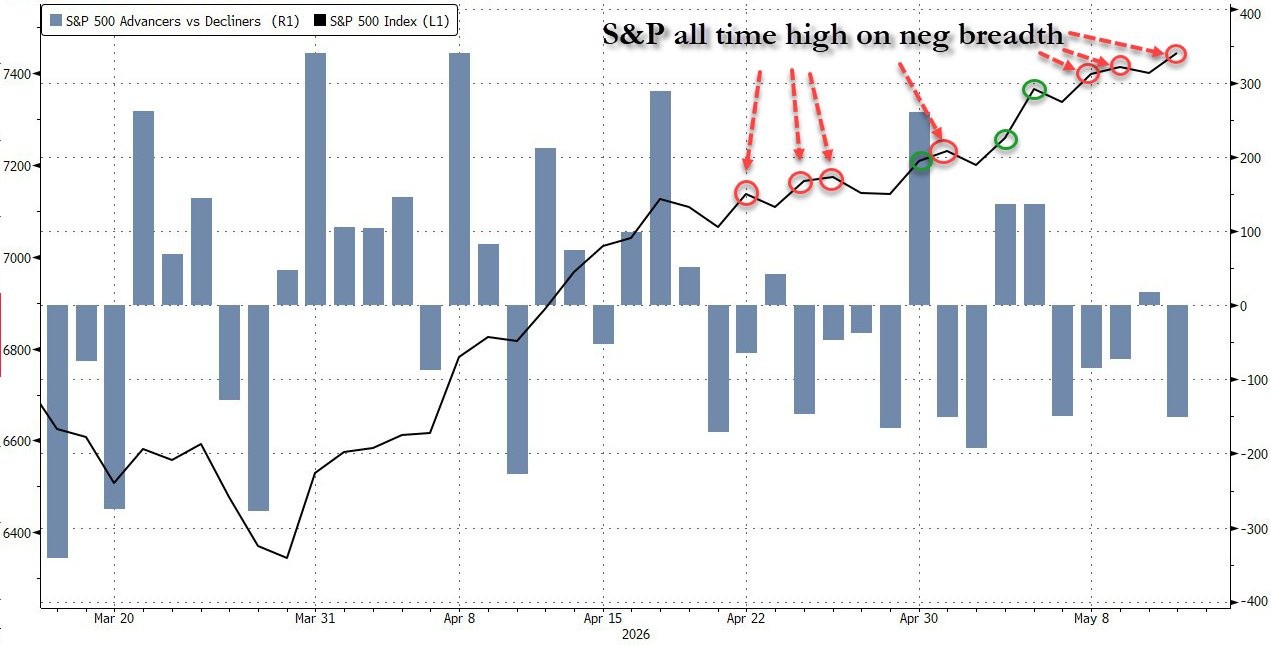
Meanwhile, Rich Privorotsky, head of Delta-One business at Goldman Sachs, warned that there are actually more stocks within the S&P 500 Index hitting new lows than new highs, indicating continued deterioration in market breadth. Faris Mourad, head of thematic investing at Goldman Sachs, stated bluntly in his latest report: "Persistently high interest rates are a major trouble for the stock market."
Signals from the bond market can no longer be ignored. The yield on US 30-year Treasury bonds has firmly held above 5%, while the yield on Japanese 30-year government bonds rose overnight to 3.885%, the highest level since their issuance in 1999. Goldman Sachs economists have pushed back their expectations for Federal Reserve rate cuts to December 2026 and March 2027, with each cut being 25 basis points.
Gains Extremely Concentrated, Breadth Hits Historic Lows
The rise of the S&P 500 Index this week was almost a "one-man show." According to statistics from UBS trading desks, from Monday's open to Wednesday's close, the S&P 500 cumulatively rose by 45.32 points, with the "Magnificent Seven" contributing 47.34 points, while the remaining approximately 495 constituent stocks collectively dragged the index down by 2 points.
NVIDIA was the largest single contributor, rising 4.94% during the week and contributing 22.66 points to the index's gain, accounting for nearly half of the total increase. Apple contributed 10.08 points, Alphabet contributed 9.74 points, while Tesla and Meta Platforms contributed 5.26 points and 4.63 points, respectively. Microsoft was the biggest drag, falling 1.81% and pulling the index down by 6.32 points.
At the sector level, Information Technology (+20.81 points) and Healthcare (+20.25 points) contributed all of the gains, while Consumer Discretionary (-7.52 points) and Financials (-5.45 points) were the main drags.
Goldman Sachs' Rich Privorotsky pointed out that while the index repeatedly hits new highs, the number of stocks hitting 52-week lows remains elevated. Across 4-week, 8-week, 12-week, 24-week, and 52-week timeframes, the number of stocks within the S&P 500 hitting new lows exceeds the number hitting new highs. UBS also warned, "Once capital flows out of NVIDIA or Apple, it will cause substantial damage to index performance in the absence of broad market support."
Gamma Squeeze Creates "False Prosperity," Feedback Loop Unsustainable
The current rally is largely not driven by spot buying, but by a historic gamma squeeze. According to Goldman Sachs data, the notional trading volume of call options in the options market approached $3 trillion last week. Hedge funds lagging in performance and retail investors flooded into call options in an attempt to catch up with benchmark performance, thereby forcing market makers to passively buy stocks, which further pushed up option prices, forming a positive momentum feedback loop.
Goldman Sachs data shows that the gamma exposure of the S&P 500 has surged to one of its highest levels since 2021, which mechanically makes it difficult for the index to experience a significant drop before expiration—unless an exogenous shock occurs.
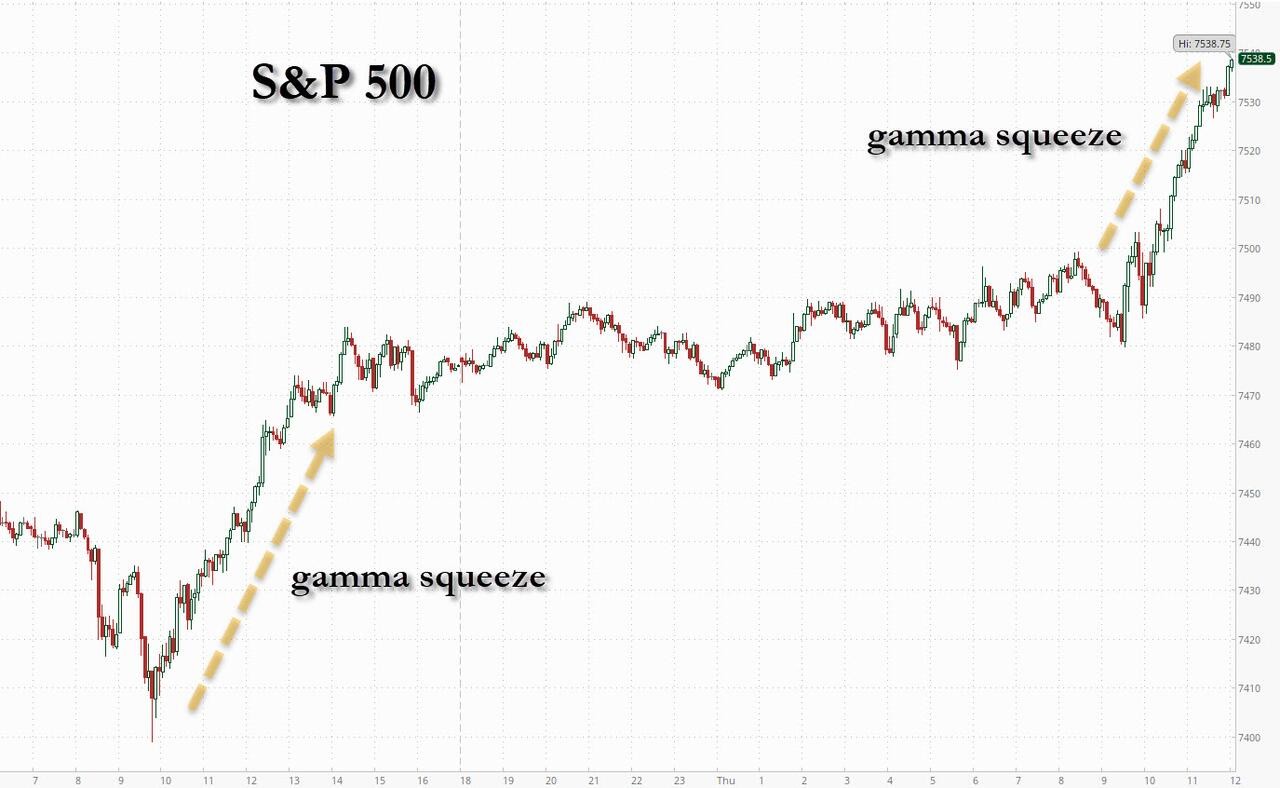
Rich Privorotsky summarized this phenomenon as: "Weak breadth is a symptom of what is happening inside the market—a few ultra-large-cap AI beneficiaries are propping up the entire market. It would take a significant drop in oil prices to lift the rest of the stocks. Once this narrative is disrupted in any way, correlations could spike suddenly."
Long-End Interest Rates Continue to Rise, Becoming the Biggest "Invisible Killer"
While the stock market parties, the global bond market is sending a completely different signal. The yield on US 30-year Treasury bonds has stabilized above 5%, and the 10-year Treasury yield has risen by 12 basis points since last Friday, approaching its highest level in the past year, driven by geopolitical pressures combined with CPI and PPI data exceeding expectations.
Developments in the Japanese bond market are equally alarming. The yield on Japanese 30-year government bonds rose overnight to 3.885%, the highest since their issuance in 1999, and the collapse in Japanese government bond prices has attracted widespread market attention.
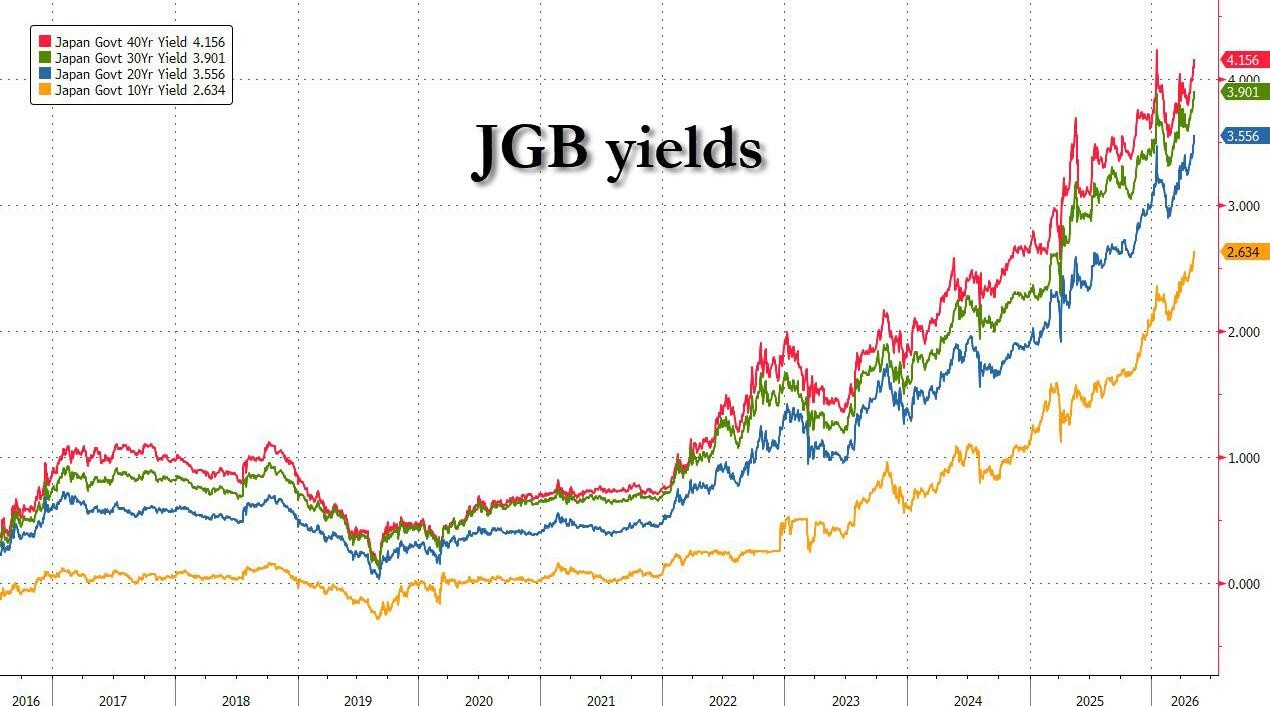
Faris Mourad of Goldman Sachs pointed out in his report that compared to the beginning of the year, the macro environment in 2026 has undergone fundamental changes: Goldman Sachs economists have pushed back expectations for Federal Reserve rate cuts to December 2026 and March 2027; oil prices are unlikely to fall back to January levels; inflation data is higher than expected; and growth optimism is declining. He explicitly stated, "Persistently high interest rates are a major trouble for the stock market."
Goldman Sachs Prescribes "Remedy": Short Low-Quality Stocks, Long Mega-Cap Cloud Computing
In the face of these risks, Goldman Sachs has provided specific trading strategies.
On the short side, Goldman Sachs recommends shorting non-profitable, non-long-term thematic tech stocks (GSCBNOPS). The bank divides non-profitable tech stocks into two subgroups: non-profitable tech with long-term thematic attributes (GSCBNOPL) and non-profitable tech without long-term thematic attributes (GSCBNOPS). Mourad believes that the latter still has about 14% downside potential relative to the S&P 500 ex-AI Index (SPXXAI) in a scenario where interest rates remain high.
Goldman Sachs is also bearish on the Low Quality Thematic Basket (GSXULOWQ), which integrates non-profitable tech, low-profit small-cap stocks, high-yield bond-sensitive companies, companies with high floating-rate debt, and companies considered at risk from AI disruption. Goldman Sachs estimates that this basket has about 20% downside potential relative to SPXXAI. Notably, when constructing this basket, Goldman Sachs excluded all companies with long-term thematic exposure to avoid passive losses in the next major short squeeze. The basket has average daily liquidity of approximately $1 billion, with no single stock weight exceeding 1%.
On the long side, Goldman Sachs recommends allocating to Hyperscale Cloud Computing enterprises (GSXUHYPR), believing that these companies have significantly underperformed in the AI boom and have room for catch-up growth. Goldman Sachs estimates that Hyperscale Cloud Computing enterprises have over 10% upside potential relative to the Low Quality Basket.
In addition, the Goldman Sachs derivatives team also recommends directly buying S&P 500 put options, citing that current option skew is unusually flat, making protection costs relatively cheap.
