


SanDisk and Micron Tech Getting Cheaper as They Rise? Stock Prices Soar Multiple Times, Yet Wall Street Assigns Only a 9x PE
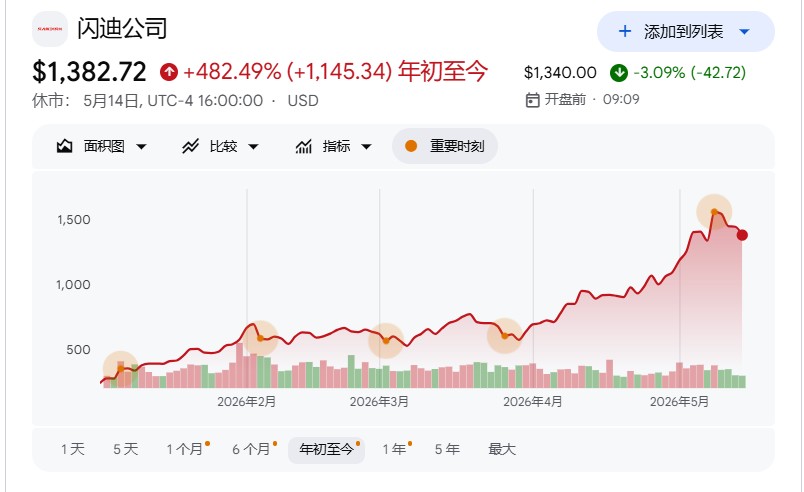
SanDisk's stock has surged 482% year-to-date, while Micron Tech has risen 172%, with both trading at forward P/E ratios below 9x. Over the trailing 12 months, consensus estimates for SanDisk's 2027 adjusted EPS have been revised upward by nearly 2000%, and Micron's by 768%
The explosive growth in demand for memory chips is upending traditional valuation logic—as stock prices rise, SanDisk and Micron Tech are actually becoming cheaper.
SanDisk's stock has surged 482% year-to-date, topping the S&P 500 leaderboard, yet its forward P/E ratio has plummeted from 23x just a few months ago to under 9x.
Micron Tech rose 172% over the same period, ranking fifth in the S&P 500, with its forward P/E ratio compressing from about 12x in February to under 9x.
By comparison, the broader S&P 500 trades at a forward P/E of approximately 21x. Behind this anomaly lies the fact that analysts have been raising earnings forecasts for these two companies at a pace far exceeding their stock price gains—over the trailing 12 months, consensus estimates for SanDisk's 2027 adjusted EPS have been revised upward by nearly 2000%, and Micron's by 768%. The market's bet on the AI infrastructure build-out cycle is reshaping the pricing framework for memory stocks, but the shadow of cyclical risk remains.
Supply-Demand Imbalance Drives Valuation Compression
The logic behind this valuation paradox is straightforward: demand for memory chips continues to climb, while supply shortages keep prices elevated, causing earnings expectations to outpace stock price gains by a wide margin.
Kim Forrest, Chief Investment Officer at Bokeh Capital Partners, who holds Micron stock, stated, "All high-bandwidth memory can command outrageously high prices due to supply and demand dynamics. As long as supply and demand operate this way, I am extremely excited. It's a wonderful thing. It isn't priced too high because people are buying, and it's already sold out. So people will think that if prices remain high, there could be more upside potential."
Rob Thummel, Senior Portfolio Manager at Tortoise Capital, holds both SanDisk and Micron stocks in his Tortoise AI Infrastructure ETF. He noted, "Unless there is a significant change in capital expenditure by hyperscale cloud providers—and what we are seeing now is an increase rather than a decrease—demand for storage and memory will continue to grow." The ETF has risen 70% year-to-date, while the Philadelphia Semiconductor Index gained 71% over the same period.
Bulls Bet the AI Build-Out Cycle Is Just Beginning
The core argument for bulls is that we are still in the early stages of a massive AI infrastructure construction cycle. The vast data consumption driven by AI technology means demand for memory chips and related products will remain high for years to come.
Jay Hatfield, CEO of Infrastructure Capital Management, said, "This is a full-blown boom, and we believe exiting at this point would be a mistake. Valuations provide support, which is precisely the condition we require to participate in such momentum trades."
Cyclical Risks Cannot Be Ignored
However, low valuations can also serve as a warning signal—they may indicate that the market is already pricing in a peak in earnings growth. Memory stocks have historically been highly cyclical: prices rise when demand is strong, prompting supply expansion; once orders slow down, excess supply suppresses prices and profits.
Randy Hare, Director of Equity Strategy at Huntington National Bank, who holds Micron stock, pointed out, "You cannot view these stocks in the same way you view companies with stable earnings growth. Typically, the best time to buy these stocks is when valuations are high and earnings are depressed, because you are betting on a future earnings growth cycle. But this is not intuitive for most investors." He stated that while he remains bullish on the upside potential of the memory sector, he does not recommend investors chase the rally at current levels. "I think the easy money has already been made in this stock, and volatility will increase from here."
Jed Ellerbroek, Portfolio Manager at Argent Capital Management, does not hold memory stocks due to cyclical concerns, bluntly stating, "Shortages ultimately lead to oversupply." He believes that given the current scale of capital investment, it may take several years for supply to catch up with demand, "but I think it will eventually happen."
Historical precedents are close at hand: In 2023, Micron reported an adjusted loss per share of $4.45; in 2022, as earnings expectations collapsed, its stock fell 46%, before rebounding in 2023 as a new cycle began.
Not All Memory Stocks Are "Getting Cheaper as They Rise"
It is worth noting that this valuation compression phenomenon is not universal across the entire memory industry.
Seagate Technology and Western Digital both trade at forward P/E ratios exceeding 30x, a significant increase from around 20x in late March. These two companies primarily focus on storage devices such as hard drives, which have weaker cyclicality compared to memory chips, resulting in a fundamentally different valuation logic.
