


US Government Announces $2 Billion Equity Investment in Nine Quantum Computing Companies, IBM Secures $1 Billion
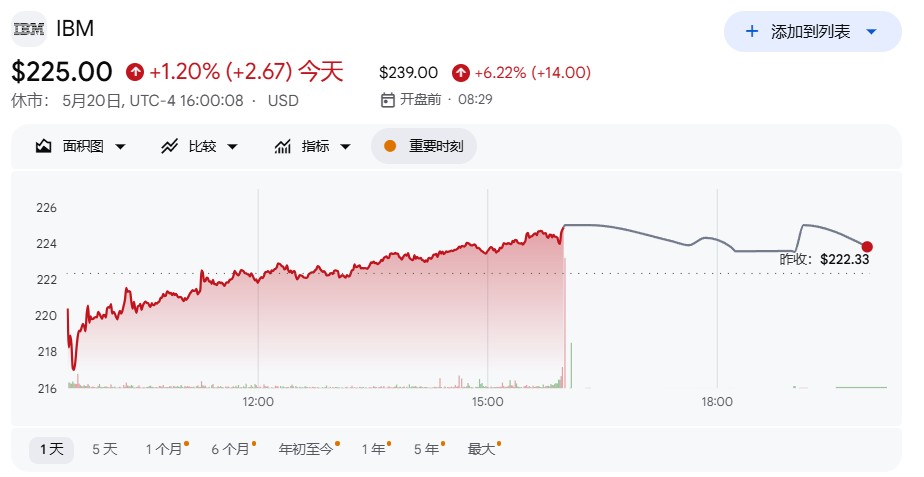
The Trump administration announced a $2 billion injection into the Quantum Computing industry, with IBM receiving $1 billion as the largest beneficiary. The funding comes from the 2022 CHIPS and Science Act, aiming to boost US innovation in Quantum Computing. Shares of related listed companies surged, with IBM rising approximately 6%. The government will hold minority stakes in the funded enterprises. IBM also plans to establish a dedicated quantum foundry and invest $1 billion to match the government funding on a 1:1 basis
The Trump administration announced a $2 billion injection into the Quantum Computing industry, exchanging equity for funding and designating this emerging technology as a priority for economic and national security.
The US Department of Commerce has reached agreements with nine Quantum Computing companies regarding the funding, with IBM receiving $1 billion, making it the largest beneficiary. Secretary of Commerce Howard Lutnick stated that this move aims to lead the United States into a "new era of innovation."
Following the announcement, shares of related listed companies surged in pre-market trading on Thursday. IBM rose by approximately 6%, while D-Wave Quantum, Rigetti Computing, and Infleqtion each gained 15% or more.
The government will hold minority stakes in each funded enterprise, continuing the equity investment model previously adopted by the Department of Commerce in projects involving Intel, rare-earth magnet manufacturer Vulcan Elements, and mining company MP Materials. These transactions are pending formal completion.
Funding Allocation: IBM Takes Half, Multiple Startups Benefit
According to the US Department of Commerce, the $2 billion in funding comes from special appropriations for early-stage technology projects under the 2022 CHIPS and Science Act.
IBM received $1 billion, making it the largest single beneficiary.
Chipmaker GlobalFoundries received $375 million. D-Wave Quantum, Rigetti Computing, and Infleqtion each received $100 million. Startup Diraq received $38 million. Other funded companies include Atom Computing, PsiQuantum, and Quantinuum, each expected to receive approximately $100 million.
IBM subsequently confirmed it would collaborate with the US government to establish the first dedicated quantum foundry in the United States. It announced the formation of an independent subsidiary, Anderon, headquartered in Albany, New York, which will operate a 300mm quantum foundry.
IBM stated it would contribute an additional $1 billion of its own funds, matching the government funding on a 1:1 basis. IBM CEO Arvind Krishna had previously compared the current stage of Quantum Computing to AI chips from a decade ago.
Equity for Funding: Department of Commerce Continues New Model
This Quantum Computing investment continues the equity investment strategy implemented since Howard Lutnick took charge of the Department of Commerce. The government will hold minority stakes in each funded quantum enterprise, though specific proportions and structures have not been fully disclosed.
D-Wave stated that its $100 million in funding would be injected entirely in the form of equity; the company's market capitalization recently exceeded $7 billion. Rigetti and Infleqtion indicated similar transaction structures. The Department of Commerce and some other companies did not disclose specific details regarding the scale of equity holdings.
Previously, the Department of Commerce acquired nearly a 10% stake in Intel through a similar arrangement, after which Intel's stock price rose significantly. A senior official at the Department of Commerce stated that spreading investments across multiple companies was intended to diversify risk, acknowledging that these investments might take years to yield results.
Strategic Significance Coexists with Market Divergence
The Trump administration has positioned Quantum Computing as a dual priority for both economic and national security. Quantum systems theoretically have the potential to break existing encryption frameworks, promote the development of post-quantum cybersecurity, and offer potential applications in secure communications, advanced sensing, and intelligence systems. Combined with artificial intelligence, Quantum Computing is also expected to accelerate research progress in materials science, drug discovery, and energy systems.
Citing informed sources, The Wall Street Journal reported that the Trump administration is currently drafting an executive order specifically targeting the quantum industry. Microsoft and Alphabet, Google's parent company, have also increased their investments in the field following recent breakthroughs in quantum technology.
However, there is significant divergence in the market regarding the prospects of Quantum Computing.
Dana Goward, Chairman of the Resilient Navigation and Timing Foundation, stated, "Everyone is excited about quantum because it is the next big thing, but many expectations and visions have yet to be realized." Some tech analysts believe that government equity investments in high-risk fields like Quantum Computing are controversial, but Lutnick insists that the relevant transaction structures will ultimately benefit taxpayers.
It is worth noting that Quantum Computing is still in its early stages, characterized by high technical difficulty and expensive costs. Senior officials at the Department of Commerce also admitted that returns on related investments may take several years to materialize.
Risk Warning and Disclaimer
Investment involves risks; please proceed with caution. This article does not constitute personal investment advice, nor does it take into account the specific investment objectives, financial status, or needs of individual users. Users should consider whether any opinions, views, or conclusions in this article align with their specific circumstances. Investors assume full responsibility for their decisions.
