


Another "Tesla-style" frenzy! SpaceX hasn't gone public yet, but space stocks have already collectively "lifted off."
With the highly anticipated SpaceX landing on the US stock market imminent, investors' enthusiasm for Elon Musk's rocket company inevitably brings to mind the frenzy that Tesla once sparked in the electric vehicle sector
According to Zhitong Finance APP, as the highly anticipated SpaceX prepares to land on the US stock market, investors' enthusiasm for Elon Musk's rocket company inevitably brings to mind the frenzy that Tesla (TSLA.US) once sparked in the electric vehicle sector.
During the COVID-19 pandemic, Tesla's stock price soared, bringing the electric vehicle industry into the public eye, and lesser-known car manufacturers also gained favor from capital. This Wednesday, SpaceX officially submitted its initial public offering application, reigniting a similar frenzy—space stocks have thus been propelled from the niche corners of the market to new heights. This enthusiasm has also put pressure on related companies, demanding that they deliver earnings performance sufficient to support soaring stock prices.
Wedbush analyst Dan Ives stated that SpaceX's IPO represents a "golden moment" for the entire space industry. He pointed out, "This is not just about one company. Just as Tesla defined electric vehicles, the space sector is also entering a breakthrough moment, opening up a whole new track."
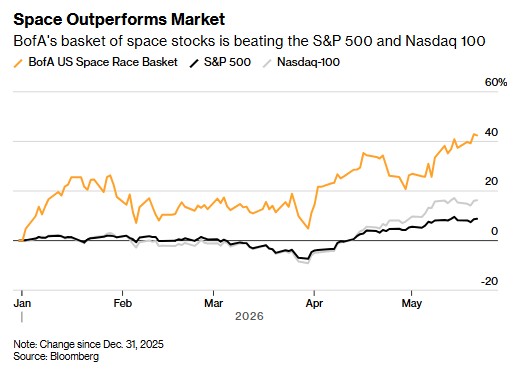
A basket of key participants and potential beneficiaries in the space race compiled by Bank of America—including Satellogic (SATL.US) and Iridium Communications (IRDM.US)—has surged 42% year-to-date, outperforming the S&P 500 and Nasdaq 100 indices. Space-themed ETFs have also performed impressively, with the Procure Space ETF (UFO.US) and Tema Space Innovators ETF (NASA.US) achieving double-digit returns this year.
Amid the hot market, SpaceX's grand vision also adds uncertainty: the company aims to establish a foothold in the AI sector while planning to deploy a constellation of orbital data centers. Similar to early Tesla, investors are beginning to question whether Musk can manage so many responsibilities simultaneously.
Columbia Law School professor Eric Talley stated, "Both retail and a significant portion of institutional investors have an irredeemable obsession with everything Musk does. Musk holds executive positions in multiple companies, and his attention is being pulled in many directions."
The impact of SpaceX's IPO on the overall market cannot be overstated. It will become another investable mega-cap stock and will also serve as a catalyst for a large number of other stocks. According to estimates from relevant institutions based on comparable publicly listed companies (excluding AI businesses), SpaceX's valuation ranges from $864 billion to $2.25 trillion. For reference, both Tesla and Meta (META.US) have market capitalizations of less than $1.6 trillion.
Tech entrepreneur and investor Brett Hurt stated, "This is a huge victory for the space economy, as it will elevate the valuations of other companies, thereby enhancing their ability to raise more funds." Andrew Chanin, co-founder and CEO of ProcureAM, the management company of the Procure Space ETF, believes that this IPO is helping to change the perception of the space industry—“In recent years, this industry has not been short of critics.”
However, it remains to be seen whether this momentum can be sustained after SpaceX officially begins trading.
Eric Diton, president and managing director of The Wealth Alliance, believes that smaller space companies need to prove the rationale for their high valuations on their own merits. He stated, “The market will scrutinize them one by one. My first question is: How do you compete with Elon Musk and SpaceX? Do you have a competitive advantage?”
Tesla's markedly different development trajectory compared to its peers provides investors with a glimpse of the landscape after the hype subsides. The stock prices of several electric vehicle companies have fallen from their peaks. Rivian (RIVN.US) has dropped 92% from its peak in November 2021; XPeng (XPEV.US) American Depositary Shares have declined 78% since their historical high in November 2020. Meanwhile, Tesla has successfully expanded its market capitalization to nearly $1.6 trillion, joining the ranks of the "Seven Giants."
Talley from Columbia University believes that SpaceX's early success may both inspire and deter other industry entrants. “The entry game in the field of space exploration is itself an interesting thing to observe.”
Chanin from ProcureAM also emphasized that the space race is not a "winner-takes-all" scenario. He stated, “Space is so vast, we have only just begun to scratch the surface, which may give rise to many successful companies, though some will certainly fail.”
