


CITIC Construction Investment: NVIDIA FY27Q1 performance exceeds market expectations, optimistic about the AI industry chain and computing network construction
CITIC Construction Investment released a research report stating that NVIDIA's FY27Q1 performance exceeded market expectations, with quarterly revenue reaching USD 81.62 billion, a year-on-year increase of 85%. It is expected that future AI infrastructure will undergo a comprehensive upgrade, with annual investment in computing power networks likely to exceed one trillion, covering multiple segments. It is recommended to pay attention to the investments of domestic internet giants and related industrial chains, especially in the AI applications of sub-sectors such as industry and healthcare
According to the Zhitong Finance APP, CITIC Construction Investment has released a research report stating that NVIDIA's FY27Q1 performance exceeded market expectations, and the prosperity of AI computing power continues. It is expected that the Vera Rubin cabinet products will begin mass delivery in the third quarter, with value increases in CPU, interconnection, and switching segments occurring simultaneously. Future upgrades to AI infrastructure will focus on all segments. The computing power network is positioned as a national-level infrastructure, with annual construction investment expected to exceed one trillion yuan, covering multiple segments of computing power construction, management, scheduling, and operation. Operators, as the main force in building the computing power network, have launched token packages to explore the implementation of token operations in the C-end. Google I/O 2026 shows that Google's AI industry layout has entered a full-stack phase of "computing power infrastructure + models + application entry + edge devices"—the TPU 8t/8i verification training and inference computing power demand is expected to rise long-term, while Gemini 3.5 Flash and Gemini Omni enhance model speed, cost, and multimodal capabilities.
- Emphasize the Capex investments of domestic internet giants represented by Alibaba/ByteDance and ecosystem players, including domestic chip chain companies, ISV vendors, and infrastructure service providers and computing power service providers that primarily serve large enterprises. 2) Pre-AI revenue is expected to land first. Domestic companies are relatively behind overseas in data governance, and AI applications require more preparatory work. 3) Some segmented vertical scenarios will see faster AI revenue growth, particularly in industrial, medical, educational, and marketing products. 4) Local inference is gradually increasing, benefiting service and cloud vendors. 5) Recommended focus on edge AI and related industrial chains.
CITIC Construction Investment's main viewpoints are as follows:
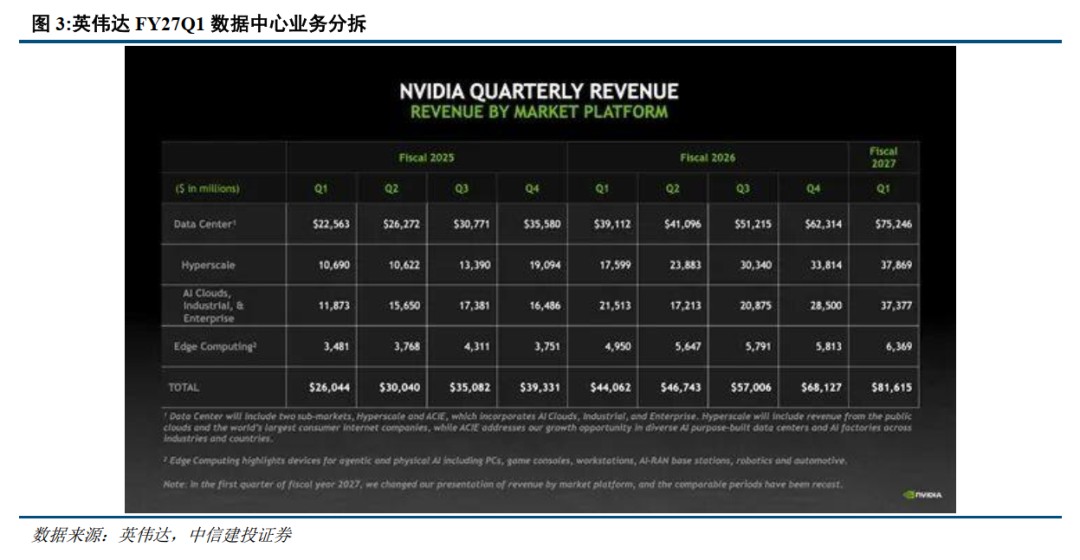
NVIDIA (NVDA.US) FY27Q1 performance exceeds expectations again, and the prosperity of AI computing power continues. NVIDIA released its FY27Q1 performance, achieving revenue of $81.62 billion in a single quarter (up 85% year-on-year; up 20% quarter-on-quarter), exceeding analysts' consensus expectations of $79.19 billion. Core business data center revenue reached $75.2 billion (up 92% year-on-year), with computing business around $60 billion and networking business around $15 billion (up 199% year-on-year), reflecting that customer demand has gradually shifted from pure GPU procurement to encompass full-stack segments including switching and interconnection, and for the first time, it has been split by hyperscale cloud services (Hyperscale) and AI cloud, industrial, and enterprise markets (ACIE). Looking ahead to the next quarter, the company has provided guidance of $91 billion (±2%), corresponding to a growth rate of approximately +95% year-on-year and +11% quarter-on-quarter, with gross margin remaining basically flat.
Company CEO Jensen Huang expressed confidence in the forecast that Blackwell and Rubin chips will achieve $1 trillion in revenue between 2025 and 2027. Previously, North American CSP vendors have successively raised their full-year capital expenditure guidance, with the four major vendors' total capital expenditure in the AI field for the year expected to be approximately $720.5 billion, reflecting strong downstream customer demand. In addition, NVIDIA's Vera Rubin complete cabinet products are expected to begin trial production in June and will be mass-produced in the third quarter, with the first batch delivered to leading cloud vendors. The memory proportion of its NVL72 cabinet has increased to about 26% compared to the previous generation GB300, with value increases in CPU, interconnection, and switching segments occurring simultaneously, and future upgrades to AI infrastructure will focus on all segments
The computing power network is positioned as a national-level infrastructure, with a broad market space for computing power construction and operation. On April 28, the Central Political Bureau meeting included the computing power network in the "six networks" statement for the first time, alongside the water network, new power grid, new generation communication network, urban underground pipeline network, and logistics network. Since May, the state has made frequent statements regarding the computing power network. On the 9th, at the State Council meeting, Premier Li Qiang stated the need to strengthen the planning and construction of the six networks. During the Two Sessions, the Director of the National Development and Reform Commission, Zheng Zhanjie, indicated that the total investment in the six networks would exceed 7 trillion yuan by 2026, further elevating the positioning of the computing power network. This week, Vice Premier Ding Xuexiang researched the computing power hubs in Beijing, Hebei, and Inner Mongolia, proposing to accelerate the national integrated computing power network according to the "14th Five-Year Plan," focusing on self-reliance and the synergy between computing and electricity, while also strengthening the safety baseline.
As of March 2026, China's daily average token call volume has surpassed 140 trillion, growing over 1000 times in two years, surpassing the United States to become the country with the highest call volume globally. However, there is still a mismatch between supply and demand in China's intelligent computing centers, with some computing power resources idle. The underlying reasons include a lack of computing power scheduling platforms, a lack of compatibility with heterogeneous computing power, and a lack of an integrated system for computing and electricity synergy. Therefore, the future construction of the computing power network will not only focus on investment in computing power infrastructure but also on the management, scheduling, operation of computing power resources, and the construction of synergy capabilities with the power grid.
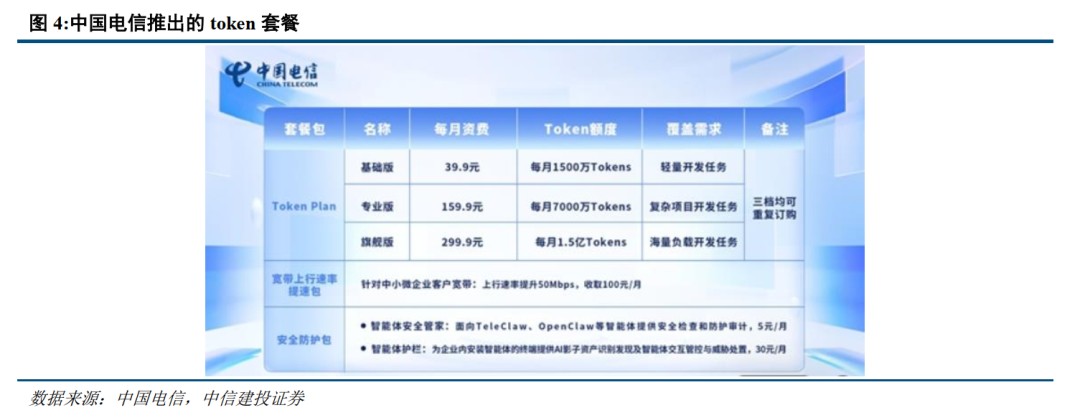
In addition, operators, as important participants in the construction of the computing power network, are strengthening infrastructure construction on one hand and innovating business models on the other. They are transforming the original traffic payment model to a token payment model. China Telecom launched a trial commercial token package on May 17, with a minimum of 9.9 yuan/month including 10 million tokens; China Mobile (600941.SH) and China Unicom (600050.SH) have also launched pilot programs in some provincial companies to accelerate the implementation of computing power operation services.
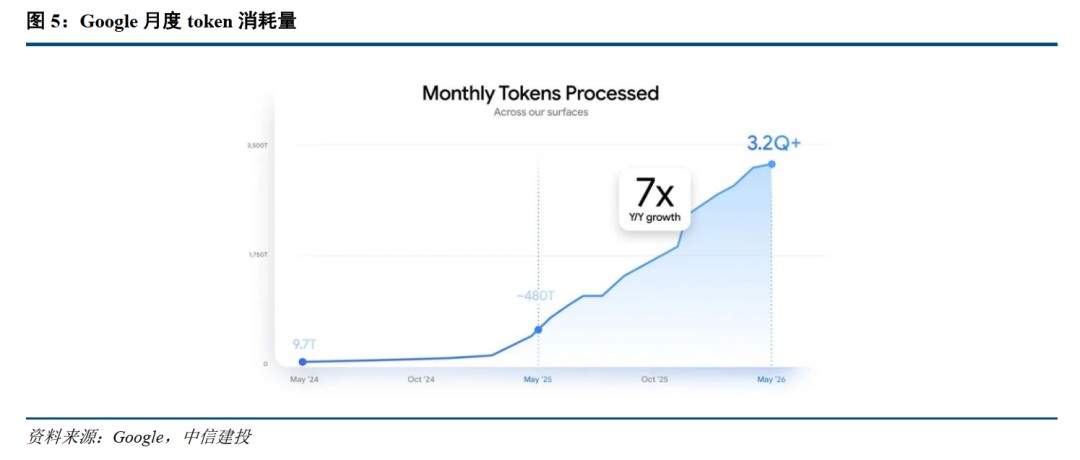
Google I/O 2026 intensively released TPU, Gemini models, application entrances for Search/Gemini/YouTube/Maps, and Android XR smart glasses, further clarifying the AI full-stack layout. On May 20, Beijing time, Google disclosed at the I/O conference that the current monthly processing token volume across all platforms has increased from 9.7 trillion in May 2024 and about 480 trillion during the 2025 I/O to over 32 trillion, approximately seven times that of the same period last year; the API processes over 19 billion tokens per minute, with over 8.5 million developers using Google AI models to build applications each month. On the user side, Google has 13 products with user numbers exceeding 1 billion, of which 5 exceed 3 billion; AI Overviews has over 2.5 billion monthly active users, and AI Mode has over 1 billion monthly active users; the monthly active users of the Gemini App have increased from 400 million last year at I/O to over 900 million, with daily request volume increasing more than 7 times year-on-year. AI is rapidly embedding itself into Google's existing search, video, maps, office, mobile, and hardware ecosystems from a single chat entry point.
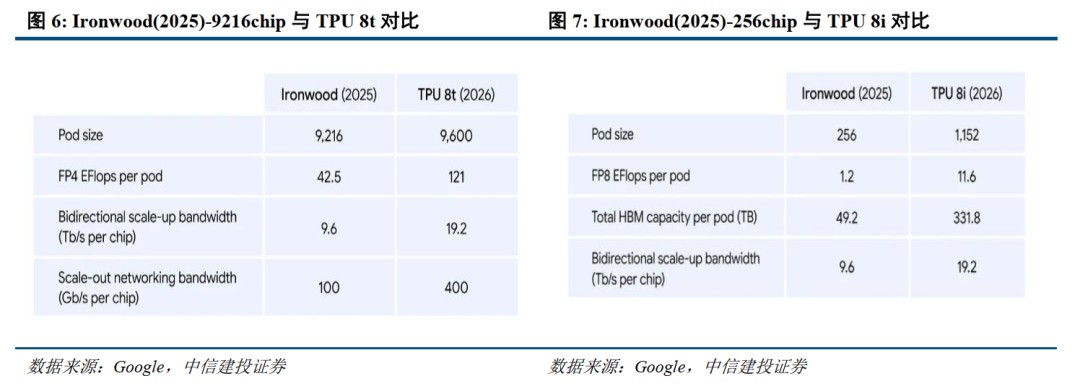
Computing Infrastructure Layer: The eighth-generation TPU adopts a dual-chip architecture for training and inference. TPU 8t is aimed at large-scale pre-training, with a single Superpod scalable to 9,600 chips and 2PB high-bandwidth shared memory, achieving nearly 3 times the computing performance of the previous generation. It can also achieve logic cluster expansion at the million-chip level through JAX, Pathways, and Virgo networks, compressing the training cycle of cutting-edge models from months to weeks. TPU 8i is focused on inference, addressing low latency and memory bottlenecks during multi-step reasoning and multi-agent collaboration, equipped with 288GB high-bandwidth memory and 384MB on-chip SRAM, with performance per dollar improved by 80% compared to the previous generation. The performance and power consumption of both TPUs have improved by up to 2 times compared to the previous generation, and they are expected to be officially available within the year. The split of TPU 8t/8i shows that AI infrastructure is shifting from training large models to balancing training, inference, and long-term operation of agents.
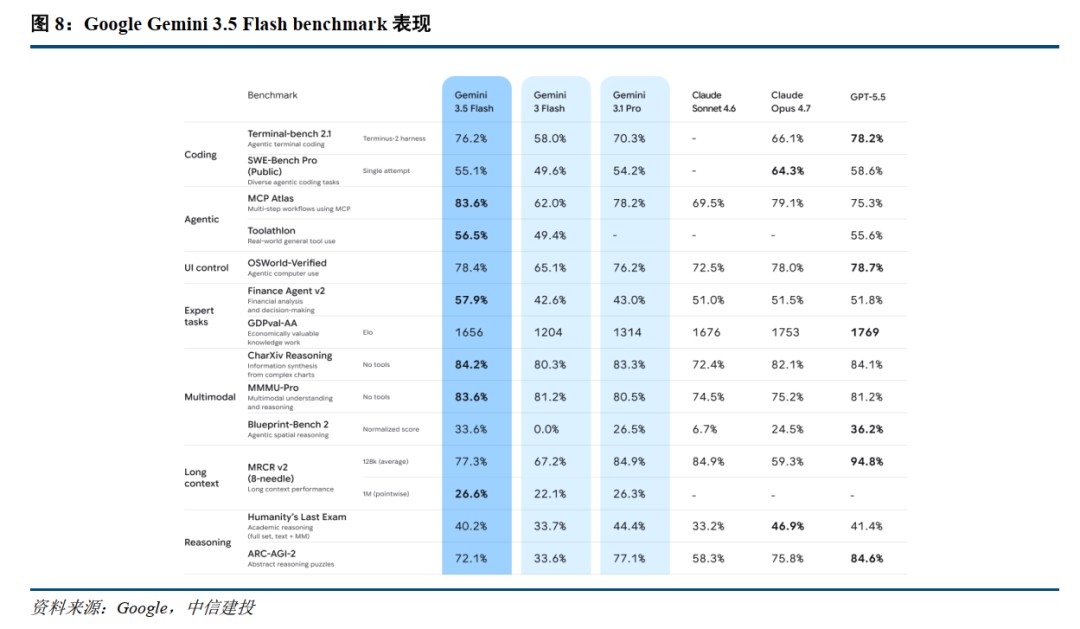
Model Layer: Gemini 3.5 Flash has been released, and Gemini 3.5 Pro will be launched in June. Gemini 3.5 Flash is positioned as a model that combines cutting-edge intelligence, low latency, and agent execution capabilities, and has become the default model for the Gemini App and Search AI Mode, open to Google Antigravity, Gemini API, Android Studio, and enterprise platforms. According to Google, Gemini 3.5 Flash outperforms Gemini 3.1 Pro in several programming and agentic tasks, with an output speed approximately 4 times that of other cutting-edge models, while also having cost advantages that help enterprises reduce token usage costs. If an enterprise's annual token consumption reaches trillions, it is expected to migrate 80% of workflows originally running on other cutting-edge models to Gemini 3.5 Flash, potentially saving $1 billion in token costs annually. The simultaneously updated Gemini Omni Flash model further enhances multimodal generation capabilities, allowing for the integration of text, images, video, and audio inputs to generate high-quality videos, and supports multi-round video editing through natural language, advancing multimodal models from content generation to interactive creation
Application Layer: Google’s “search box” upgraded to a natural language entry point across multiple applications. The Search AI Mode has been upgraded to Gemini 3.5 Flash, supporting multimodal inputs such as text, images, files, videos, and Chrome tabs, and introducing capabilities like Information Agents, generative UI, and shopping Agents. YouTube launched Ask YouTube, allowing users to pose complex questions in natural language, with the system returning structured answers and corresponding video clips; Maps previously launched Ask Maps, enabling users to search for real-world locations, routes, and nearby services using natural language. In terms of the Gemini App, Google introduced features like Neural Expressive design language, Daily Brief, Gemini Spark, Gemini Omni, and macOS App, with Gemini Spark able to connect to Workspace tools like Gmail, Docs, and Slides to perform long-term tasks with user authorization. Google’s AI application deployment path is no longer limited to standalone apps but is reconstructing user search, office, creation, and consumption paths through existing high-frequency entry points.
Device Layer: Android XR and AI glasses became important highlights of this I/O. Google announced the co-construction of the Android XR platform with Samsung and Qualcomm, and collaborated with Gentle Monster and Warby Parker to launch smart glasses designs. The product forms include audio glasses that will be released first and subsequent display glasses, with audio glasses expected to launch this fall, allowing users to invoke Gemini through “Hey Google” or touch controls on the temples, supporting recognition of content in front of them, navigation, phone messages, photo and video capture, real-time translation, background task execution, and applications like Uber and DoorDash, while being able to pair with both Android and iOS phones. As a lightweight, all-day, first-person entry point, AI glasses are expected to promote the collaborative development of edge multimodal perception, low-power chips, camera/acoustic/display modules, and application ecosystems.
Risk Warning: Accounts receivable bad debt risk; intensified industry competition; impact of changes in the international environment
