


After the Trump administration's investment, the largest quantum computing IPO in the US stock market has arrived!
Honeywell-supported quantum computing company Quantinuum plans to raise $1.05 billion through an initial public offering, issuing approximately 21 million shares, priced between $45 and $50 per share. This IPO will become the largest listing in the field of quantum computing, with an overall market value expected to reach $12.7 billion. This event occurs against the backdrop of the Trump administration's announcement to invest over $2 billion in the quantum computing industry, reflecting the ongoing enthusiasm in the quantum computing sector and the impact of policy catalysis
According to Zhitong Finance APP, Quantinuum (QNT.US), a leading quantum computing company supported by Honeywell (HON.US), officially submitted its pricing terms document for an initial public offering (IPO) to the U.S. Securities and Exchange Commission (SEC) this Tuesday. The company plans to issue approximately 21 million shares at a price of $45 to $50 per share, with a fundraising scale of up to $1.05 billion. If calculated at the upper limit of the issuance range, the company's overall market value will reach approximately $12.7 billion, making it the largest IPO in the history of the quantum computing field.
This is not an ordinary technology company listing. Quantinuum's IPO occurs at a highly symbolic time window: the quantum computing sector has entered a period of volatility and differentiation after two years of explosive growth, the Trump administration has just announced an investment of over $2 billion in the quantum computing industry, and the "integration of AI and quantum computing" is being highly anticipated by the global tech community. Under multiple narratives, this IPO has become a key window to observe the technological realization, valuation logic evolution, and capital exit paths of the entire quantum computing industry.
Quantinuum completed a $600 million equity financing in September 2025, with a valuation of $10 billion at that time. From last fall's $10 billion to this IPO's upper valuation of $12.7 billion, the valuation has increased by approximately 27% in just eight months. This leap reflects the continued enthusiasm for the quantum computing sector and is closely related to recent policy catalysts.
Particular attention should be paid to the equity structure and governance framework. According to the S-1 document, Honeywell currently holds about 55% of Quantinuum's shares, Cambridge Quantum-related entities hold about 36%, and a few investors hold the remaining 11%. After the IPO, Honeywell will retain approximately 49.1% of the combined voting rights, effectively remaining the controlling shareholder.
The company has adopted an "Up-C" listing structure: the listing entity, Quantinuum Inc., acts as the holding company, with its only asset being the management rights to the operating entity, Quantinuum Holdings, LLC. This structure also includes a "Tax Receivable Agreement" (TRA), which requires the listed company to pay 85% of the actual cash tax savings generated from the IPO and future share exchanges to "continuing common shareholders" (mainly Honeywell and Cambridge Quantum-related parties). The document indicates that this payment will be "substantial."
In addition, the company has established a "Transaction Committee," which requires the committee's recommendation for the board to approve acquisitions, significant debt financing, or changes in business scope exceeding $10 million, and the committee must include at least one vote from a Honeywell-designated director. Honeywell CEO Vimal Kapur personally serves as the chairman of Quantinuum's board, while the CEO is Rajeeb Hazra, who previously worked for many years at Intel.
These institutional arrangements mean that post-IPO, Quantinuum will be a typical "controlled company"—Honeywell maintains a profound influence through voting rights and governance structure, while the voice of external public shareholders is relatively limited In addition, the fundraising of approximately $1 billion corresponds to a valuation of about $12.7 billion, indicating a relatively small market free float. Some analysts point out that when control is concentrated and the free float is thin, investors typically demand a certain discount, and the stock price is prone to significant fluctuations due to news.
Technical Roadmap: The "2029 Commitment" of the Apollo System
As of March 31, the company reported a net loss of $136.6 million for the three months, with revenue of $5.2 million, compared to a net loss of $30.5 million and revenue of $19.1 million in the same period last year. However, the core story that Quantinuum tells investors is not about current revenue and profits, but a clear roadmap towards a "fully fault-tolerant quantum computer."
The company outlines a three-generation technology evolution path: Helios (2025, 98 physical qubits) → Apollo (2029, hundreds of logical qubits) → Lumos (2033, utility-scale). CEO Rajeeb Hazra explicitly stated in a letter to investors: "We believe we are executing a roadmap aimed at launching the first commercially scalable, fully fault-tolerant quantum computer—the Apollo system—before the end of this decade."
Among them, Apollo is positioned as a full-stack fault-tolerant quantum computer, aiming to achieve a "commercial tipping point" in the field of material discovery with a million-gate operation capability. Lumos is designed as a utility-grade system with over 1 million physical qubits. Whether Apollo can be delivered on schedule in 2029 will become an industry benchmark for evaluating ion trap technology routes.
The core technology route adopted by Quantinuum is the "Quantum Charge Coupled Device (QCCD) ion trap architecture," which currently leads the world in two-qubit gate fidelity. The company has already demonstrated 48 fully error-corrected logical qubits on the Helios system (using the Iceberg encoding scheme), achieving a fidelity of 99.99% and an encoding rate close to 2:1—by comparison, Google's 2024 Willow chip has an error correction encoding rate of about 100:1. This means that approximately 2 physical qubits can encode 1 logical qubit, far exceeding its peers in efficiency.
In terms of commercialization, Quantinuum has accumulated several notable collaboration cases. The company has signed a multi-year commercial agreement with BMW Group, making BMW a long-term strategic customer in the automotive industry, with priority access to subsequent generations of quantum computers. The collaboration focuses on accelerating the development of advanced materials such as fuel cell catalysts through high-fidelity molecular simulations. Additionally, companies like Amgen and Mitsui & Co. have also become early users and partners. The company's commercial strategy is clear—before the Apollo commercial fault-tolerant system is ready, it aims to validate its technological capabilities, accumulate industry know-how, and build ecological barriers through cutting-edge collaborations with industrial giants.
In the risk factors section, the company admits several key challenges: the manufacturing process has not yet reached large-scale production levels, and it currently relies on a single supplier for various critical materials and systems. Furthermore, three of the four commercial quantum computing systems are located within the Colorado campus, while the fourth is deployed in Japan, and the fifth is planned to be deployed in Singapore later this year—high geographical concentration implies potential geopolitical and operational risks
Industry Ecology: The "Roller Coaster" Market of Quantum Stocks, the "Triple Narrative" of Bubbles, AI, and Government Equity Participation
Quantinuum's IPO is not an isolated event, but rather occurs after the quantum computing sector has experienced significant volatility. In 2025, D-Wave Quantum (QBTS.US) saw its stock price soar over 200%, continuing an astonishing increase of over 800% from the previous year. Rigetti Computing (RGTI.US) rose nearly 3000% from the beginning of 2023 to the end of 2025. The quantum computing sector entered a correction after reaching a peak in October 2025.
However, as 2026 began, the sector faced significant selling pressure. The stock prices of IonQ, Rigetti, and D-Wave fell by more than 30% at the start of 2026. As of the latest data, D-Wave's market capitalization is approximately $10.8 billion, Rigetti's is about $8.8 billion, while Quantum Computing (QUBT.US), with revenues only in the millions, has a market cap of $2.78 billion. These companies share common characteristics of high valuations, low revenues, and ongoing losses, with their valuation logic heavily reliant on technological narrative rather than current financial performance.
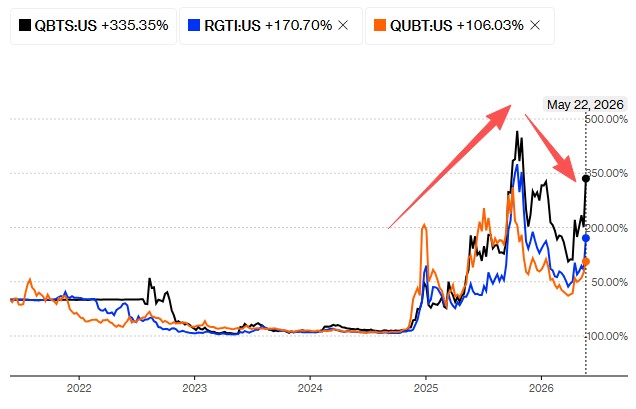
In this context, Quantinuum's IPO at a valuation of $12.7 billion is essentially a "re-pricing" in a sector that has already been fully hyped. Based on projected revenues of $30.93 million in 2025, its price-to-sales ratio (P/S) exceeds 400 times—this level far surpasses that of most AI software companies.
One of the key logical supports for the high valuation of quantum computing is its deep integration prospects with artificial intelligence.
NVIDIA CEO Jensen Huang stated at the 2026 GTC conference that "the turning point for quantum computing has arrived," and released the world's first open-source quantum AI model series, Ising, claiming that "AI is crucial for achieving practical quantum computing." Liu Qingfeng, Chairman of iFlytek, stated at the 2026 Intelligent Quantum Summit that AI will drive quantum computing to new heights in the next five years, and quantum computing will also feed back into AI, marking the true beginning of the "AI + quantum deep integration era."
Two main lines are intertwining and evolving: "AI for quantum computing"—using AI technology to optimize qubit control, dynamic error correction, and system calibration to accelerate the engineering process of quantum hardware; "Quantum computing for AI"—against the backdrop of AI training and inference facing computational power and energy consumption bottlenecks, quantum computing is expected to fundamentally break through the performance limits of traditional computing. This narrative of "intelligent integration" provides quantum computing companies with a value imagination space that transcends the hardware itself.
The Trump Administration's "National-Level Venture Capital" The most milestone policy event occurred in the same week that Quantinuum submitted its IPO pricing terms. On May 21, the Trump administration announced that the Department of Commerce would distribute over $2 billion in support funds to nine quantum computing companies, funded by a special allocation for early technology projects in the 2022 CHIPS Act.
The most notable feature of this funding allocation is that the U.S. government has adopted a "funding for equity" model for the first time in technology support—using non-controlling minority equity as a condition for funding distribution, ensuring that taxpayers can share in the returns when the technology matures and the companies grow. The Department of Commerce stated that the "structure of these transactions will ultimately benefit taxpayers."
The funding distribution is as follows: IBM received $1 billion (the largest single allocation) to establish the first U.S. subsidiary focused on quantum chip manufacturing in Albany, New York; GlobalFoundries received $375 million; six companies including Quantinuum, Rigetti, D-Wave, Atom Computing, Infleqtion, and PsiQuantum each received $100 million, while the startup Diraq received $38 million. This distribution plan shows that the U.S. government is pursuing both "key breakthroughs" (placing a heavy bet on IBM's quantum chip manufacturing capabilities) and "diversity" (broadly covering various technological routes such as superconducting, ion traps, neutral atoms, silicon spin, and photonics).
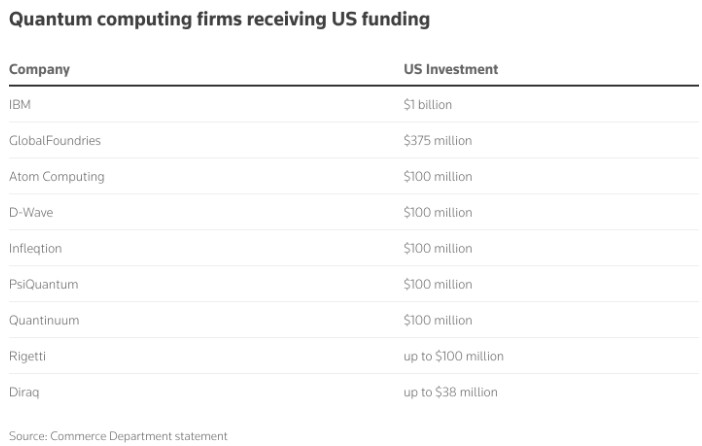
Viewing Quantinuum's IPO in this policy context highlights its strategic significance— the company is not only one of the core quantum computing enterprises supported by the government but is also about to become a pure quantum target that public investors can directly participate in. This dual identity of "national team endorsement + market pricing" may provide an additional safety net for its IPO pricing and post-listing performance.
Quantinuum's IPO will become the most concentrated pricing event in the quantum computing investment theme of 2026. This IPO ultimately tests "patient capital"—whether the capital market is willing to pay a valuation in the tens of billions of dollars for a deep technology that may take ten years to fulfill its core promises. With the afterglow of the AI bull market still present and favorable policies in play, the short-term answer may lean towards optimism. But as the old saying on Wall Street goes: the market is a voting machine in the short term and a weighing machine in the long term. The true IPO story of Quantinuum may only come to light on the day the Apollo system is truly activated, leading to a final valuation reassessment
