


AI Agents Ignite CPU War: NVIDIA Enters the Fray, Intel Loses Ground, AMD Poised to Capture Half the Market
Barclays has raised its forecast for the 2030 server CPU market size to nearly $200 billion, believing AMD will capture the majority share, with its CPU business alone driving a doubling of its EPS. Meanwhile, NVIDIA has made a high-profile entry into the CPU arena, where the sales value ratio of CPUs to GPUs is approaching 1:1, directly impacting the traditional turf of Intel and AMD. Under pressure from continuous market share losses and the lack of a regained manufacturing advantage, Intel has become the most passive player
A reshuffling of the CPU market is accelerating, driven by the wave of AI agents.
Yesterday, Jensen Huang officially confirmed at NVIDIA's GTC conference in Taipei that Vera CPU has entered mass production. The company had previously announced that revenue visibility for its CPU business this year is close to $20 billion. Huang stated directly, "In the era of AI agents, the CPU has become a bottleneck restricting GPU performance."
Regarding this battle for the CPU market, sources from Zhuifeng Trading Desk report that Barclays' latest semiconductor industry report systematically outlines the market landscape and the odds for each party. The bank believes that this is a hundred-billion-dollar market being re-priced, with AMD as the biggest winner, Intel as the biggest loser, and NVIDIA as the most dangerous new entrant.
CPUs Have Become Hot Commodities; The 2030 Market Is Larger Than Anyone Expected
In recent years, the focus of the semiconductor market has always been on GPUs. However, over the past six months, AI applications have quietly shifted—from model training to inference and agentic AI.
This change has directly boosted CPU demand. The reason is simple: GPUs excel at large-scale matrix operations, but AI agents need to execute tasks, call tools, route sub-agent traffic, and track task completion—all of which are CPU jobs. GPUs "compute," while CPUs "manage."
ARM provided a set of data at its "ARM Everywhere" event: Current AI data centers with a capacity of 1 GW require approximately 30 million CPU cores, a figure expected to rise to 120 million in the future. Based on 136 cores per ARM CPU, each GW of data center capacity requires approximately 221,000 CPUs. NVIDIA CEO Jensen Huang estimates that each GW requires about 300,000 Rubin GPUs, leading to a new CPU-to-GPU ratio of approximately 1:1.4—significantly elevating the status of CPUs compared to the GPU-dominated era of the past.
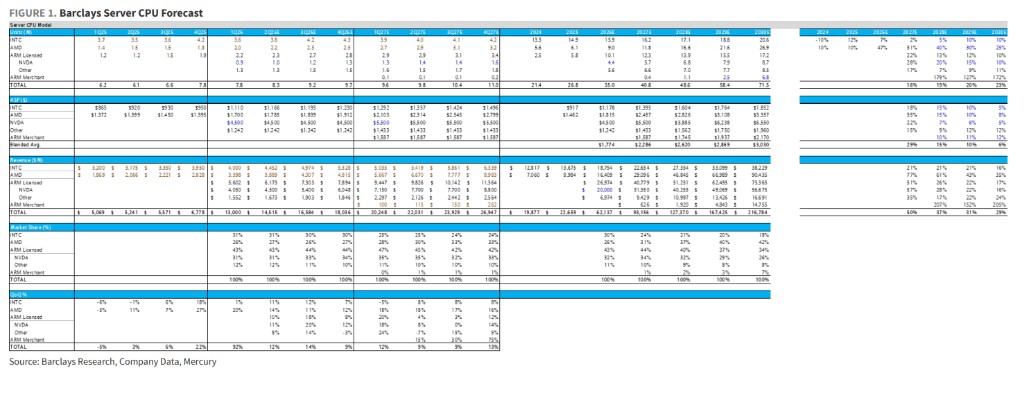
Forecasts for the CPU market size are being rapidly revised upward:
-
NVIDIA: Expects its own CPU demand to reach $20 billion by 2026, with the industry TAM reaching $200 billion by 2030
-
ARM: Expects the AGI CPU market to exceed $100 billion by 2030
-
AMD: Has raised its server CPU market forecast to $120 billion by 2030 and expects its share to exceed 50%
After synthesizing Mercury industry data and bottom-up forecasts from various companies, analysts offered a more aggressive judgment: The CPU market size will approach $200 billion by 2030, surpassing AMD's own forecast of $120 billion. The report noted, "Market forecasts have doubled in the past six months, showing how fast this market is changing."
NVIDIA: The Most Dangerous New Variable, But Its Pricing Model Is Obscure
NVIDIA's CPU ambitions are no longer a secret. Previously, CFO Colette Kress stated directly on an earnings call that Vera CPU opens up a potential market worth up to $200 billion that NVIDIA had "never ventured into before", with nearly $20 billion in revenue visibility for the CPU business this year, and Vera is "driving us to become the world's leading CPU supplier."
At the GTC conference, Huang further characterized the situation: "In the era of AI agents, the CPU has become a bottleneck restricting GPU performance." Vera CPU offers a 3x performance improvement in SQL operations compared to x86 competitors, a 6x improvement in data processing, and an overall performance boost of about 1.8x for common agent tools like Python and code analysis. Anthropic and OpenAI are already early adopters.
How should we view this $20 billion? Analysts admit that almost all of NVIDIA's CPU sales are bundled within NVL systems (i.e., NVIDIA's rack-level supercomputing systems), with no independent Average Selling Price (ASP) data points. We can only back-calculate the unit price from the $20 billion figure—the results show that NVIDIA's CPU ASP is far higher than that of its peers. If calculated using an ASP similar to peers, AMD's market share would be closer to its own claimed 50% target.
NVIDIA's entry changes not just market share, but the entire market's ratio logic. Analysts point out that historically, one CPU was sold for every two GPUs, but this ratio is now approaching 1:1. NVIDIA has launched independent CPU racks composed of 256 CPUs, with Anthropic and OpenAI as early customers.
Notably, NVIDIA's CPU revenue is "embedded" in the NVL rack calculations in Barclays' modeling and is not listed separately—meaning the market's pricing of NVIDIA's CPU scale may not yet be fully reflected.
AMD: The Biggest Winner, With Target Price Jumping 33%
Analysts believe AMD is the "most underpriced" beneficiary in this CPU war, meaning the market has not yet fully reflected its potential.
AMD's advantages lie in several overlapping layers:
On the product side, AMD's Venice and Verano series will be the first to migrate to the 2nm process, potentially further expanding its performance lead. Its Chiplet architecture offers high flexibility, allowing for customization with base cores plus IO, paired with 25%-30% differentiated variants for different application scenarios, without requiring a full design cycle. AMD is already shipping agent-style rack CPU systems.
On the supply side, AMD's deep ties with TSMC and the replaceability of its Chiplet platform allow for flexible allocation of wafer capacity—shifting capacity from gaming and client businesses to data centers. Management explicitly stated that the narrative that "supply constraints prevent recent upward revisions" is a "false narrative." AMD has also committed to investing $10 billion in the Taiwan ecosystem to develop EFB (Elevated Fan-out Bridge) and panel-level packaging technologies, collaborating with ASE, SPIL, and PTI to diversify future packaging demand.
In terms of market structure, AMD breaks down the server CPU market into three segments: 20% is general-purpose enterprise CPUs (low core count); 30%-35% is head-node CPUs (high-frequency single-thread); and the remaining 45%-50% is high-core-count CPUs for agentic AI, which may be deployed in independent racks or separately in data centers. AMD's product line covers all three 细分 scenarios.
Analysts predict AMD's CPU revenue will reach approximately $29 billion by 2027. The CPU business alone is expected to contribute about $19 per share in earnings by 2030, equivalent to more than doubling the company's overall EPS.
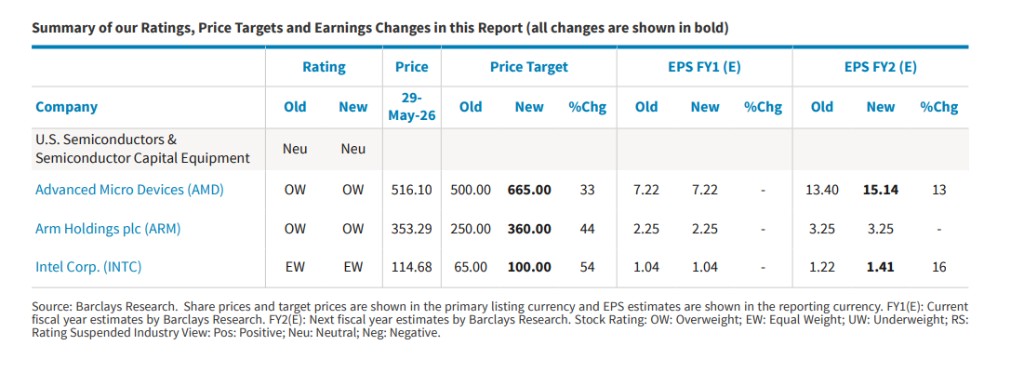
Based on this, analysts raised AMD's target price from $500 to $665, corresponding to a 44x valuation based on 2027 EPS of $15.14 (previously 37x based on $13.40). The rating remains "Overweight."
Intel: Passive and Under Pressure, Target Price Raised But Logic Questionable
In comparison, Intel's position is the most passive.
Analysts maintain an Equal Weight rating for Intel, raising the target price from $65 to $100 (mainly reflecting valuation repair due to ASP increases, rather than share improvement). Their judgment on Intel is straightforward: "Core market share continues to erode, revenue and profitability are structurally suppressed, and there is no evidence of a return to manufacturing leadership."
In the EPS contribution estimates for the 2030 CPU market, Intel is estimated at around $1.5, while AMD is around $19 and ARM around $7—the gap is clear.
Intel's problems cannot be solved by a single product cycle: the efficiency disadvantage of the x86 architecture in AI agent workloads, the continued lag in manufacturing processes, and the pressure on market share from the double squeeze of AMD and NVIDIA together constitute a structural dilemma that is difficult to reverse quickly.
ARM: Collecting Royalties, But Limited Upside
ARM's logic is relatively simple: Regardless of who makes the CPU, as long as they use the ARM architecture, ARM collects royalties. NVIDIA's Vera uses the ARM architecture, and some of AMD's products are also migrating to ARM.
Analysts predict ARM's CPU business will contribute about $7 per share in earnings by 2030, raising the target price from $250 to $360, corresponding to a 115x valuation based on 2027 EPS of $3.13 (previously 80x). The rating remains "Overweight."
The logic for raising the valuation multiple is that the expansion of the CPU market significantly raises the ceiling for ARM's royalty income, but ARM itself does not directly participate in the competition for market share, making its benefit method more stable.
In This Battle, Who Is Still Underpriced by the Market?
Barclays' conclusion is that AMD's CPU upside is the most underpriced among the three.
There are three reasons: First, NVIDIA's CPU revenue is partially embedded in the market's pricing of NVL systems; second, ARM's high valuation already reflects considerable optimistic expectations; third, AMD's CPU share growth, process node leadership, and supply flexibility are not yet fully priced into its stock.
A CPU market restructuring triggered by AI agents is rapidly changing the competitive landscape of the semiconductor industry. In the past, this market was a duopoly between Intel and AMD; now NVIDIA has entered the field, and the market pie itself is growing at an unprecedented speed.
