


Powerful Chips, Steep Prices: NVIDIA Spark Laptops Arrive This Fall, Starting Price May Exceed $2,500
NVIDIA enters the consumer laptop market with RTX Spark, featuring 128GB of memory, a 20-core CPU, and GPU performance equivalent to the RTX 5070. Over 30 models from Microsoft, Dell, Lenovo, and others will launch this fall. However, starting prices are expected to range from $2,000 to over $2,500. This high-end strategy targets the MacBook Pro while bypassing the mass market—bringing a performance revolution, but requiring deep pockets
NVIDIA has officially entered the consumer laptop chip market, bringing not only a performance revolution but also a price tag that may deter most consumers.
At Computex in Taipei, NVIDIA unveiled the RTX Spark "super chip." Major manufacturers including Microsoft, Dell, ASUS, HP, Lenovo, and MSI have announced plans to launch laptop lines powered by this chip this fall. During his two-hour keynote address, NVIDIA CEO Jensen Huang highlighted AI agents as a "new key growth engine" and positioned the RTX Spark as "the most efficient PC chip ever created." Microsoft described its upcoming Surface Laptop Ultra as "the most powerful Surface ever."
However, there is a clear gap between technological ambition and market reality. Based on the pricing ranges of similar products in the currently announced lineup, the starting price for RTX Spark laptops is expected to be $2,000 to $2,500 or higher, with some flagship configurations potentially far exceeding this level. This comes at a time when consumer purchasing power is under pressure and overall PC prices are rising.
Chip Specifications: Directly Targeting the MacBook Pro
The RTX Spark features aggressive hardware specifications: the flagship version boasts 20 CPU cores, 6,144 GPU CUDA cores, and 128GB of LPDDR5X unified memory, with integrated graphics performance reportedly equivalent to an RTX 5070 laptop GPU. According to The Verge, the chip is essentially very similar to the GB10 chip found in NVIDIA's DGX Spark mini PC.
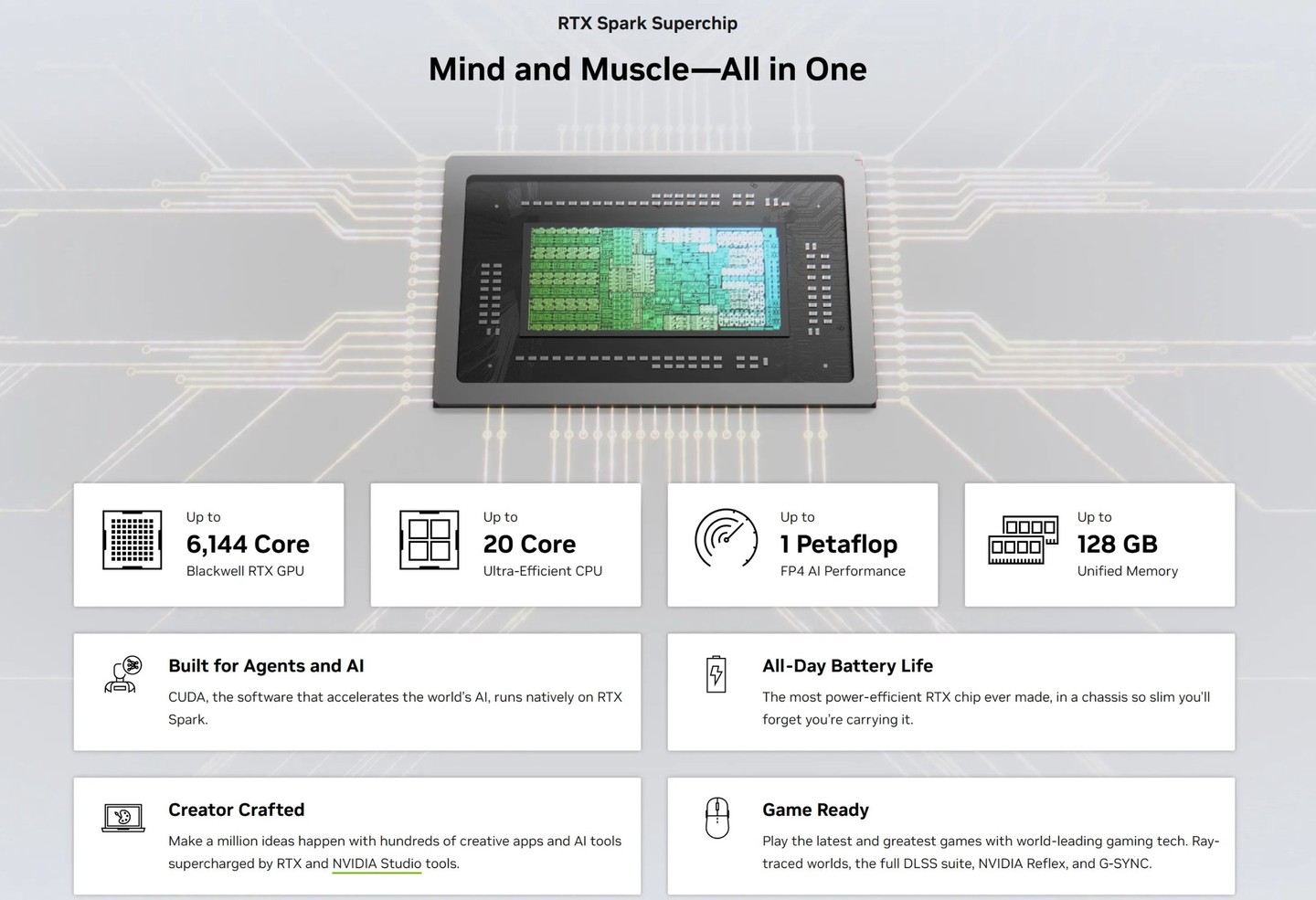
NVIDIA stated that the RTX Spark targets both local AI computing and creative professionals, with Adobe already announcing optimized versions of Photoshop and Premiere for the chip. NVIDIA also claimed that all RTX Spark laptops will support "all-day battery life" and feature chassis thicknesses as slim as 14 millimeters.
Notably, NVIDIA has not yet released any actual performance benchmarks or test data.
Price Pressure: High Configurations Raise the Barrier
The 128GB memory specification directly determines the price ceiling.
Looking at existing market products: ASUS ROG Flow Z13 models equipped with 128GB memory using the AMD Strix Halo APU solution are officially priced at $3,300, while the ProArt PX13 GoPro Edition sells for $3,000. Meanwhile, the desktop version of the DGX Spark, on which the RTX Spark is based, costs approximately $4,700 per unit.
When adding the hardware costs of keyboards, touchpads, batteries, and 15-inch Mini LED touchscreens, the final price for flagship configuration laptops is bound to be even higher.
NVIDIA stated it will launch lower-spec versions with 16GB and 32GB of memory, but currently, prices for some low-memory configuration laptops in the market are also rising due to supply chain pressures.
Fall Lineup: Multiple Brands Enter the Fray
Brands and models confirmed to launch RTX Spark laptops include: Microsoft Surface Laptop Ultra (15-inch Mini LED touchscreen, peak HDR brightness of 2,000 nits), Dell XPS 16, ASUS ProArt P16 and ProArt P14, Lenovo Yoga Pro 9n, MSI Prestige N16 Flip AI Plus (16-inch convertible 2-in-1 form factor), HP OmniBook Ultra 16 and OmniBook X 14, as well as pending models from Acer and Gigabyte. NVIDIA stated that more than 30 RTX Spark laptop models will hit the market this fall.
Currently, no brand has announced final pricing or complete specifications. HP stated it would provide detailed information "around the time of launch," and other manufacturers are expected to follow a similar timeline.
Strategic Intent: Competing for the MacBook Pro Market, but the Path Is Uncertain
Outsiders have compared this launch to the "historic moment" when Apple introduced the M1 chip in 2020, but there are fundamental differences. Apple's breakthrough strategy with the M1 was to first enter the Mac Mini, MacBook Air, and entry-level MacBook Pro markets at affordable prices, allowing a large number of ordinary users to experience performance improvements immediately, while rapidly building a foundation for the developer ecosystem.
NVIDIA's strategy this time is markedly different—starting directly with high-end flagships, targeting the MacBook Pro (M5, M5 Pro, or M5 Max levels) rather than the mass market. This means the initial buyer base will be highly concentrated among professional users and high-net-worth individuals, posing higher barriers to cultivating the developer ecosystem and achieving widespread adoption.
In the Windows laptop chip market, NVIDIA's entry means consumers will face a diverse choice of four chip solutions from Intel, AMD, Qualcomm, and NVIDIA this fall.
Regarding the software ecosystem, Microsoft and NVIDIA have partnered with Riot Games to port its anti-cheat software to the Arm architecture, supporting games such as Valorant and League of Legends. They are simultaneously advancing Arm compatibility for mainstream anti-cheat systems like Easy Anti-Cheat, BattlEye, and Denuvo, alleviating to some extent the long-standing game compatibility shortcomings of Windows on Arm.
However, against the backdrop of shrinking consumer spending power and overall pressure on PC market prices, whether NVIDIA can convince enough buyers to pay a high premium based on performance advantages remains the biggest unknown in this high-stakes gamble.
