


U.S. Stock Market Outlook | The three major stock index futures are mixed ahead of the non-farm payroll report, with shares of AI semiconductor giants like Micron all falling
On June 5th, before the US stock market opened, the three major stock index futures showed mixed results. Non-farm payroll data is about to be released, and the market is concerned that regardless of whether the results are strong or weak, they will pose a negative impact on the stock market. In addition, negotiations between the US and Iran have stalled, with Iran demanding that Israel withdraw from southern Lebanon as a precondition for a ceasefire, increasing uncertainty in regional conflicts
Pre-Market Market Trends
- As of June 5th (Friday) pre-market, the three major U.S. stock index futures are mixed. At the time of publication, Dow futures are up 0.17%, S&P 500 futures are down 0.47%, and Nasdaq futures are down 1.12%.

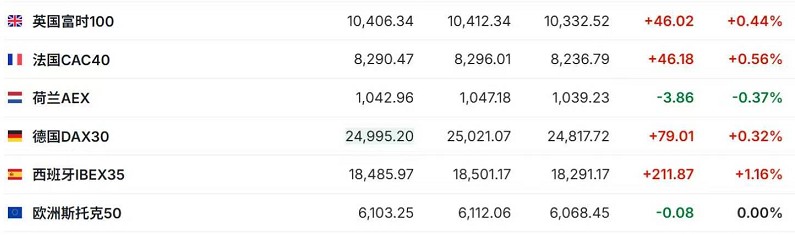
- As of the time of publication, the German DAX index is up 0.32%, the UK FTSE 100 index is up 0.44%, the French CAC40 index is up 0.58%, and the Euro Stoxx 50 index is flat.
- As of the time of publication, WTI crude oil is down 0.33%, priced at $92.71 per barrel. Brent crude oil is down 0.07%, priced at $94.96 per barrel.

Market News
Non-Farm Payrolls Are Coming! Is it bad news for U.S. stocks regardless of whether May's non-farm employment data is strong? The market consensus expects about 88,000 new non-farm jobs in May, a slowdown from 115,000 in April. JPMorgan believes tonight's data will create a dilemma of "any outcome is wrong": if the data is weak, fears of stagflation will resurface, posing a clear risk signal; if the data is strong, inflation expectations will drive bond yields and volatility up, which is also unfavorable for the U.S. stock market. However, there are significant discrepancies among institutions—Goldman Sachs predicts only 60,000 jobs, far below consensus; Bank of America predicts 95,000 jobs and believes the upside risk is more pronounced. ADP data shows that 122,000 jobs were added in the private sector in May, the strongest since January 2025, but analysts warn that the average deviation between ADP estimates and official Bureau of Labor Statistics (BLS) data can be as high as 83,000, making it of limited reference value.
U.S.-Iran Negotiations Hit a Stalemate Again! Iran Voices Support for Hezbollah, Supreme Leader's Advisor Says Enough is Enough. Iran has reiterated its support for its Lebanese ally Hezbollah, demanding Israel withdraw from southern Lebanon, which has increased the uncertainty surrounding the temporary ceasefire agreement negotiations aimed at ending the extensive U.S.-Iran conflict. Iran has clearly defined its negotiation red lines: a ceasefire between Israel and Hezbollah is a hard prerequisite for reaching a ceasefire agreement with the U.S. and restarting shipping in the Strait of Hormuz. This regional conflict has now entered its fourth month. Iran's Supreme Leader's military advisor Rezaei warned in an interview broadcast on Iranian state television on the 4th local time that Iran's "tolerance for Israel's aggressive actions in Lebanon is over," and all of Iran's missiles are ready Rezaei warned that if the Israeli military advances one step further, northern Israel will become a "miserable hell." Rezaei emphasized that Iran views the ceasefire in Lebanon as an inseparable part of the U.S.-Iran ceasefire and hopes that the United States will wake up soon to restore peace in Lebanon.
The new Federal Reserve Chairman Kevin Walsh plans to initiate reforms to the Federal Reserve's communication framework starting from the June FOMC meeting, which may include the elimination of the dot plot and the removal of forward guidance. According to the Financial Times, several former senior officials of the Federal Reserve expect Walsh to launch the reforms as early as the FOMC meeting in mid-month. Specific measures include refusing to submit individual interest rate forecasts in the quarterly "dot plot" and removing language in the policy statement that implies a direction for the next action, such as "easing" or "tightening." This series of changes will fundamentally alter the communication logic between the Federal Reserve and Wall Street. Overall, the new Federal Reserve Chairman Kevin Walsh is preparing to implement the most profound institutional reshaping of the world's most influential central bank in decades, with a core focus on its communication with the market.
Jensen Huang visits South Korea again, proclaiming that AI infrastructure will be busier in the second half of the year. After arriving at Gimpo International Airport in Seoul from Taiwan on Friday, Jensen Huang told the media that he has arranged meetings with Hyundai Motor, LG, SK Hynix, Samsung Electronics, and Naver, with the core purpose of ensuring that supply chain partners "stay in sync and are well-prepared." In a media interview, he clearly stated that the construction of artificial intelligence infrastructure is accelerating, with the scale in the second half of 2026 expected to far exceed that of the first half, and a significant growth anticipated in 2027. He described himself as bringing "huge business" to South Korea and hinted at "surprises" yet to be announced, but refused to disclose specific details. Regarding the market's most concerned issue of memory supply, Huang refuted rumors that NVIDIA would reduce the use of high-bandwidth memory (HBM) due to supply constraints, clearly stating that the company will use "a large amount of high-speed memory." This statement is directly beneficial to key suppliers such as Samsung Electronics and SK Hynix, which together account for about 70% of the memory supply for NVIDIA's AI chips.
S&P strictly adheres to the "profit rule": SpaceX is excluded from the S&P 500 index, and passive funds miss out on trillion-dollar buying opportunities. S&P Global stated on Thursday that it will not modify the inclusion criteria for its major indices, effectively rejecting the request for Elon Musk's SpaceX, the largest IPO in history, to quickly enter the benchmark S&P 500 index. This decision is undoubtedly a significant setback for SpaceX, which is attempting to rewrite IPO rules in unprecedented ways. According to a core rule maintained by S&P Global, companies seeking inclusion in the S&P 500 index must meet strict profitability requirements: both the most recent quarter and the cumulative net profit over the last four quarters must be positive and calculated according to Generally Accepted Accounting Principles (GAAP). However, SpaceX's financial data clearly does not meet the standards—despite a 33% revenue growth to $18.67 billion in 2025, the company reported a net loss of $4.94 billion The S&P 500 Index is the most widely tracked benchmark index on Wall Street, covering the core representatives of large-cap stocks in the United States.
Individual Stock News
The "AI bubble" rhetoric sweeps the market again, popular AI semiconductor stocks fall in pre-market trading. As Broadcom's latest disclosure of AI semiconductor performance growth prospects fell short of Wall Street expectations, signs of a cooling investment frenzy in the AI computing power industry chain have recently emerged, with value and defensive stocks rebounding strongly. On Thursday, AI-related popular tech stocks corrected, especially Broadcom, ARM Holdings, and Micron Technology, whose stock prices plummeted, dragging down the Nasdaq and pushing some risk-averse funds into value/defensive sectors like healthcare and finance. Several analysts have recently pointed out that the rapid rise in the Nikkei 225 Index, the Nasdaq 100 Index, the Philadelphia Semiconductor Index, and the South Korean KOSPI Composite Index has raised caution and concerns among some market participants about the overly heated AI investment frenzy in the global stock market, prompting them to lock in profits significantly. As of the time of writing, Micron (MU.US) is down 3.8% in pre-market trading, Nvidia (NVDA.US) is down 2%, AMD (AMD.US) is down 3.10%, ARM Holdings (ARM.US) is down 5.3%, Broadcom (AVGO.US) is down 2%, and Marvell Technology (MRVL.US) is down 4.5% in pre-market trading.
Target price skyrockets by 227%! Morgan Stanley shifts to neutral rating, Wall Street sparks a re-evaluation of Tesla's (TSLA.US) "AI narrative." JP Morgan has upgraded Tesla's rating from "underweight" to "neutral" and significantly raised its target price from $145 to $475. This massive increase of 227.6% highlights Morgan Stanley's fundamental shift in outlook for the electric vehicle manufacturer. The analyst team led by Rajat Gupta emphasized that Tesla has unparalleled vertical integration capabilities in hardware and software. He stated, "We believe this advantage is still not fully recognized and understood to some extent, but it indeed brings a significant starting line advantage." Morgan Stanley stated that the company's revenue is expected to more than double from approximately $95 billion in 2025 to about $203 billion by 2030, with nearly half of the growth coming from services and innovations related to autonomous driving and robotics technology.
Earnings guidance downgrade intensifies growth recovery concerns! Lululemon (LULU.US) plummets 13% in pre-market trading. Yoga apparel leader Lululemon fell 13% in pre-market trading on Friday, as the company lowered its quarterly and annual earnings expectations, coupled with slowing domestic consumer demand in the U.S., intensified industry competition, and rising costs from import tariffs, leading to rapidly increasing market doubts about the company's turnaround. If the decline continues until the official opening, the company's current total market value of $14.44 billion will evaporate more than $1.7 billion in a single day. Lululemon expects its total revenue for the year to be between $11 billion and $11.15 billion, down from a previous estimate of $11.35 billion to $11.5 billion. Lululemon also lowered its earnings per share expectation by more than $1 The company currently expects its full-year earnings per share to be between $10.95 and $11.15, lower than the previous forecast range of $12.10 to $12.30.
Nvidia (NVDA.US) HBM4 Supply Chain Finalized: The World's Three Major Storage Giants Have All Qualified to Supply Vera Rubin. Nvidia CEO Jensen Huang confirmed that the company has completed the qualification certification for the three major global memory chip manufacturers, which will supply their most advanced high-bandwidth memory products for Nvidia's AI acceleration chips. Jensen Huang stated that Nvidia has officially approved Samsung Electronics, SK Hynix, and Micron Technology to supply HBM4 products, which are core essential components for Nvidia's next-generation Vera Rubin artificial intelligence computing power platform. The three companies dominate the global computing-grade memory semiconductor market and are fiercely competing for this lucrative Nvidia supply order. After departing for South Korea to begin a multi-day visit, Jensen Huang told the media: "All three suppliers have successfully passed the qualification certification and have entered the mass production stage, currently working at full speed to ensure the supply needs of the Vera Rubin platform."
Important Economic Data and Event Forecasts
Beijing time 20:30: U.S. May unemployment rate, U.S. May seasonally adjusted non-farm payrolls (10,000)
Beijing time June 6, 01:00: U.S. total oil rig count for the week ending June 5 (units), U.S. total rig count for the week ending June 5 (units)
Beijing time June 6, 03:30: CFTC weekly positions report
