


Investment Logic Amid Expectations of a Musk Empire Merger: Sell SpaceX, Buy Tesla?
SpaceX shares have cumulatively dropped over 16% in the three days since its listing, while Tesla has strengthened against the trend. The stark valuation gap between the two companies is reshaping the allocation logic for "Musk concept stocks." With SpaceX trading at a price-to-sales (P/S) ratio of over 100x and Tesla at just 14x, this valuation disparity creates potential arbitrage opportunities. Buying Tesla at a lower valuation may be a more cost-effective way to position oneself within the post-merger "Musk Empire."
SpaceX's stock price has continued to decline since its listing, while Tesla has strengthened against the trend. The valuation gap between the two companies is prompting investors to reassess the allocation logic for "Musk concept stocks."
On June 22, Tesla's stock price rose 1% to $405.05, while SpaceX's stock plunged 16% in a single day to $154.60, marking its third consecutive daily decline. Although SpaceX's stock price remains above its $135 IPO offering price, this downturn has sparked market skepticism about the sustainability of its post-listing valuation. Meanwhile, SpaceX immediately launched large-scale debt financing after its listing, further highlighting the high capital-intensive nature of its business.
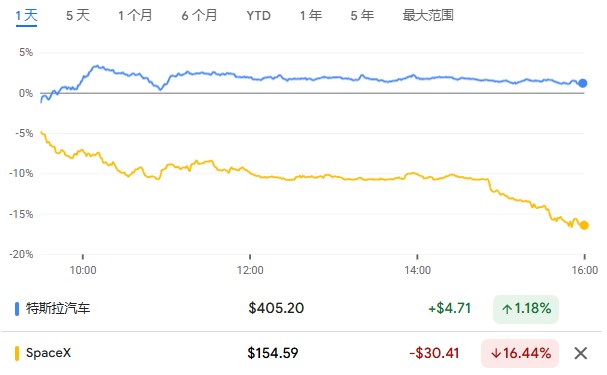
Expectations of an eventual merger of companies under Elon Musk's umbrella are becoming a key logical support for some investors shifting towards Tesla. Within this narrative framework, buying Tesla at a relatively lower valuation is seen as a more cost-effective path to positioning early for the "Musk Empire."
Valuation Chasm: SpaceX Premium Far Exceeds Tesla's
Both companies enjoy substantial valuation premiums driven by Musk's personal brand, but the disparity is stark.
According to The Information, SpaceX's current market capitalization corresponds to a price-to-sales (P/S) ratio of over 100x based on its 2025 revenue ($18.7 billion); whereas Tesla, based on $95 billion in revenue, trades at a P/S ratio of approximately 14x.
This comparison implies that the "Musk premium" investors are paying for SpaceX is far higher in absolute magnitude than that for Tesla. The thesis for SpaceX bulls lies in betting on Musk's grand visions—including orbital data centers, and large-scale settlements on the Moon and Mars. However, Tesla's narrative is no less ambitious: late last year, Musk publicly stated that his Optimus robots would "eliminate poverty," make work "optional," and provide "excellent healthcare" for everyone.
Against the backdrop of grand narratives surrounding both companies, the valuation gap itself constitutes a potential arbitrage opportunity.
Merger Expectations: Arbitrage Window May Be Limited
Another key factor driving capital flows from SpaceX to Tesla is the rising market expectation of an eventual merger between the two companies.
Both Musk and SpaceX President Gwynne Shotwell had publicly hyped the possibility of a merger before the IPO. This expectation is not baseless—Musk has historically integrated his assets faster than market expectations. In early 2025, SpaceX, xAI, and X were still separate private companies, but the integration process has since accelerated significantly. Currently, SpaceX and Tesla already have employee-sharing arrangements and are collaborating on projects such as AI agents and chip manufacturing, with both parties stating that these collaborations will benefit both companies.
If the merger ultimately materializes, the current valuation arbitrage opportunity between SpaceX and Tesla will disappear. For investors looking to position early for "Musk Inc.," buying Tesla at a lower valuation currently appears to be the more attractive option—but the time window for the market may not be wide.
Beyond merger expectations, fundamental pressures within SpaceX itself are also weighing on its stock price. The large-scale debt financing launched immediately after its listing has made the market aware of the high cash-burn nature of SpaceX's business model. Rocket launches, satellite internet infrastructure construction, and longer-term deep space exploration plans all require continuous, large-scale capital investment. This contrasts with Tesla's relatively mature automotive and energy businesses, which already possess a more stable cash flow foundation.
Part of the decline may be a normal post-IPO correction, but the timing of the debt financing has undoubtedly deepened investor concerns about SpaceX's capital needs, reinforcing the relative value logic of "sell SpaceX, buy Tesla" in the short term.
