


Panasonic: To Invest 500 Billion Yen in AI Infrastructure Over the Next Two Years
Panasonic is accelerating its transformation into the AI infrastructure sector, planning to invest approximately 500 billion yen over the next two years, with the goal of raising AI-related sales to 1.4 trillion yen within three years. Its core focus areas include energy storage systems, circuit materials, and electronic components required for AI data centers, leveraging energy storage batteries to stabilize the high power consumption demands of GPUs. The company aims for AI business revenue to account for 30% of total revenue within the next decade, establishing it as a new growth pillar
Panasonic is leveraging the investment boom in AI infrastructure to accelerate its strategic transformation, clearly positioning AI-related businesses as its core growth engine for the future.
According to a report on Wednesday, Panasonic CEO Yuki Kusumi disclosed a clear phased plan: over the next three years, the company will concentrate its efforts on capturing the demand for energy storage systems, circuit materials, and electronic components driven by the expansion of AI data centers; in the subsequent three years, it will focus on cultivating this business into a new generation growth pillar.
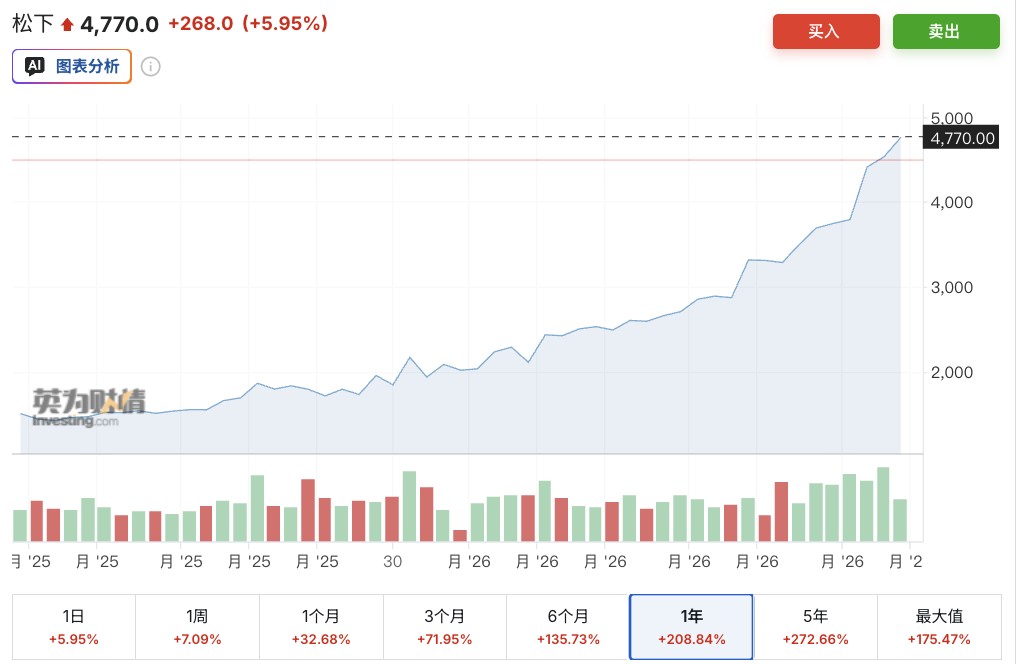
To this end, Panasonic plans to invest approximately 500 billion yen in this field over the next two years, striving to increase related sales to about 1.4 trillion yen within three years. The market has reacted positively to this strategy, with Panasonic's stock price doubling year-to-date and its market capitalization climbing to approximately 11.5 trillion yen, hitting a record high.
To free up resources for its AI business, Panasonic has simultaneously intensified its restructuring efforts. The scale of global layoffs has been increased from an initial plan of 10,000 to up to 12,000 employees. Annual cost savings starting from fiscal year 2024 are expected to rise to 145 billion yen, providing more ample financial support for emerging businesses.
Energy Storage Systems Become Key Entry Point for AI Data Centers
Panasonic's core competitiveness in the AI infrastructure track is concentrated in its energy storage battery system business.
Yuki Kusumi stated that graphics processing units (GPUs) driving AI servers consume massive amounts of electricity, and Panasonic's energy storage battery systems play a key role in peak shaving and valley filling, as well as stabilizing peak power demand. He emphasized that cooperation with major cloud computing operators in the AI data center sector is an important source of competitiveness for the company's energy storage system business.
This layout aligns with the broader context of Japan's AI supply chain benefiting overall. The Bank of Japan recently stated that strong exports to the AI industry are providing a boost to the Japanese economy. During the same period, flash memory chip supplier Kioxia Holdings Corp and fiber optic cable manufacturer Fujikura Ltd have both benefited from demand in the AI industry.
Restructuring Existing Assets to Establish AI as Core Growth for the Next Decade
Panasonic is advancing strategic business restructuring, optimizing the allocation of existing assets while expanding. Yuki Kusumi revealed that the company plans to transform a production facility in the United States, which has idle capacity due to reduced orders for Tesla electric vehicle batteries, into a manufacturing base for uninterruptible power supply (UPS) systems.
This move reflects Panasonic's overall strategy to accelerate its departure from dependence on home appliance business and cultivate new growth poles beyond its role as a core supplier to Tesla. In an interview, Kusumi stated, "We must accept change as the norm and be ready to adjust our direction flexibly at any time."
Looking at a longer cycle, Panasonic announced last year that it would fully integrate AI into its software and hardware sectors and established a partnership with AI firm Anthropic, with the goal of increasing the proportion of AI-related revenue to 30% within the next ten years.
Yuki Kusumi divided the next six years into two phases: the first three years will focus on seizing market opportunities brought by current AI infrastructure construction, while the latter three years will focus on cultivating related businesses into new growth pillars. He stated, "In the next three years, we must seize this opportunity; in the three years after that, we will build it into the next growth engine."
