


Upgrade Cycle Narrative Stumbles: UBS Survey Shows Apple AI Features Fail to Ignite Replacement Wave
A UBS survey indicates that Apple's Apple Intelligence features have failed to spark the anticipated replacement wave, with the proportion of users willing to upgrade early due to AI dropping by 500 basis points compared to the first half of the year. Market concerns are mounting that the AI-driven growth narrative is faltering, but the foldable iPhone has emerged as a new highlight, with the expected September launch of the first foldable iPhone potentially bringing an incremental sales volume of 5 million units
Apple's artificial intelligence feature, Apple Intelligence, has failed to become the catalyst for a super-cycle of iPhone replacements as expected by Wall Street. The latest survey by UBS shows that consumers' willingness to upgrade their devices early due to AI features continues to decline, putting further pressure on market confidence in Apple's AI-driven growth narrative.
According to the latest report by UBS analyst David Vogt, a survey conducted by its Evidence Lab among more than 7,500 smartphone users in five major markets revealed that approximately 24% of respondents said they would upgrade their phones early due to Apple Intelligence, a decrease of about 500 basis points from the first half of the year; meanwhile, the proportion of those who believe AI features have "no impact" on their purchasing decisions rose to about 31%, an increase of about 300 basis points.
These results indicate that Apple's core logic of hoping to drive a new round of hardware upgrade cycles with AI features has not yet effectively translated into consumer behavior, causing some investors to doubt the sustainability of further valuation expansion.
Weakening Driving Force of Apple Intelligence on Replacements
UBS pointed out that Apple Intelligence has not yet substantially driven user upgrade behavior, and the previously expected "AI-driven replacement cycle" has not materialized. Although iPhone purchase intent in the US, UK, and German markets rose by about 300, 600, and 400 basis points year-on-year respectively, showing relative stability, UBS analyst Vogt believes that the AI features released by Apple at WWDC26 will still struggle to become a key driver of demand in the short term.
Amid the cooling of the AI narrative, the foldable iPhone has become one of the few supports for market sentiment. Although the "net interest" in the overall foldable phone market decreased by about 600 basis points to -8%, consumers' preference for "Apple-branded foldable screens" is significantly stronger, with the relative premium expanding by about 600 basis points to approximately 48%. UBS expects that Apple is likely to launch its first foldable iPhone at its annual September event, which could initially bring an incremental sales volume of about 5 million units, equivalent to about a 2% upside to its iPhone shipment forecast.
Shipment Growth Coexists with Valuation Constraints as Apple Awaits New Product Validation
UBS expects Apple's FY26 iPhone shipments to reach approximately 261.6 million units, a year-on-year increase of about 15.7%, mainly driven by stronger demand for the iPhone 17 and potential front-loaded demand due to price hikes.
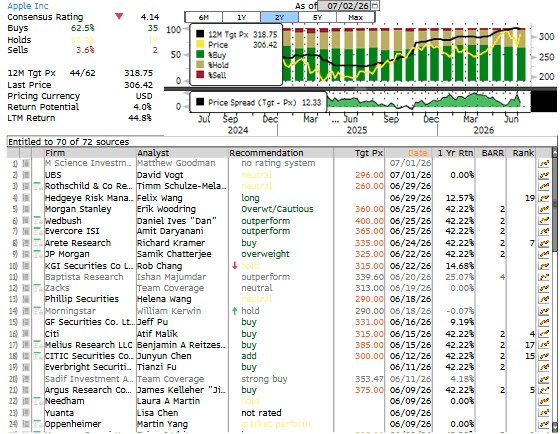
Regarding valuation, UBS maintains Apple's target price at $296, based on assumptions of earnings per share of $9.86 in 2027 and a P/E ratio of 30 times. The institution believes that the current stock price has partially reflected the short-term improvement in iPhone demand and the option value of AI, but uncertainties in the product roadmap, weakness in the Chinese market, and price factors limit the further upside space for valuation.
According to consensus market data, Wall Street generally maintains a bullish stance on Apple: 35 analysts give a "Buy" rating, 19 "Hold", and 2 "Sell", with a 12-month average target price of about $319. Apple's stock price has currently returned to above $300. Against the backdrop that the AI-driven replacement logic has not yet materialized, the market's focus is gradually shifting from "technology narrative" to "hardware cycle and product implementation pace".
Risk Warning and Disclaimer
The market carries risks, and investment requires caution. This article does not constitute personal investment advice, nor does it take into account the specific investment objectives, financial status, or needs of individual users. Users should consider whether any opinions, views, or conclusions in this article are suitable for their specific circumstances. Investment based on this is at your own risk.
