Market Misjudgment? Report: Taiwan Semiconductor's First-Gen CoPoS May Not Use Glass Substrates, and Glass Interposers Were Never Considered
According to reports, the first-generation CoPoS products are unlikely to adopt glass substrates. This fundamentally contradicts the widely circulated market narrative that "glass substrates are core to CoPoS," which has triggered significant speculative hype. Meanwhile, Taiwan Semiconductor has never considered using glass interposers
Market discussions surrounding Taiwan Semiconductor's CoPoS advanced packaging technology have heated up significantly in recent times, driving Taiwan's tech stocks into a phase of abnormal speculative activity.
According to multiple key supply chain sources interviewed by Taiwanese tech media, there is a major deviation in the market's interpretation of the CoPoS technical roadmap, particularly regarding whether glass substrates are a necessary component for the first-generation products.
Interviewees expressed strong dissatisfaction with the current proliferation of false rumors. While the market generally views glass substrates as an indispensable core material for CoPoS, the first generation of CoPoS is likely not adopting glass substrates in its technical roadmap.
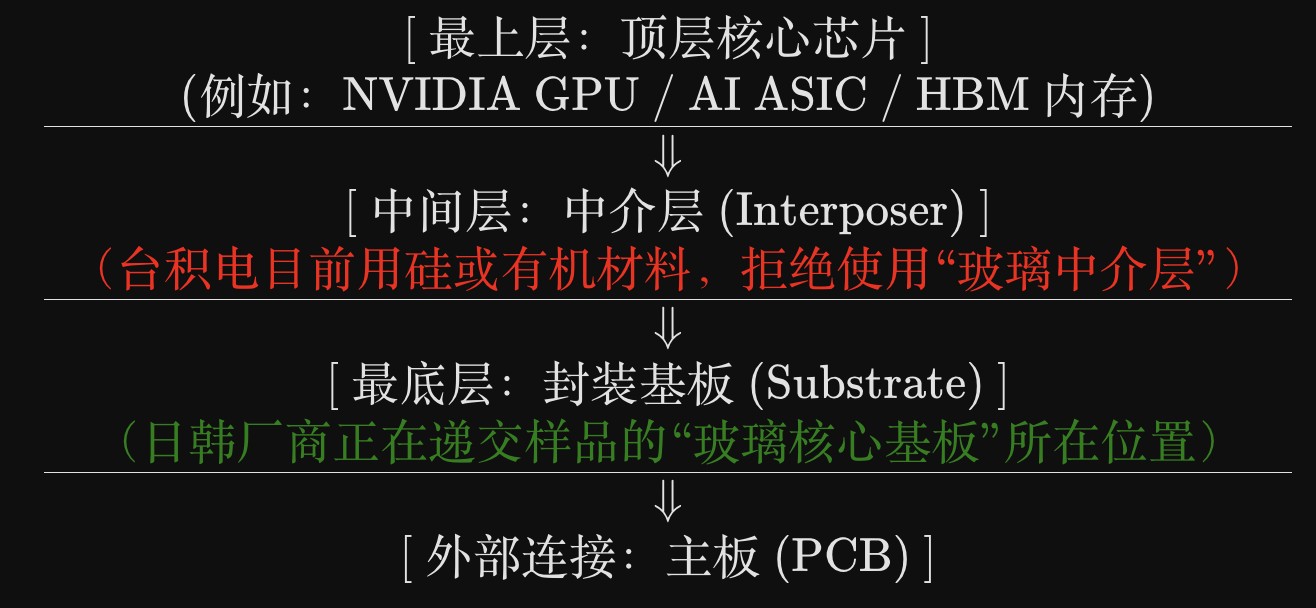
Meanwhile, Taiwan Semiconductor has never considered using glass interposers. CoPoS is expected to enter mass production in the first half of 2029.
Samsung Electro-Mechanics (SEMCO), part of the Samsung Group, Japan's Toppan, and other substrate manufacturers in Japan and South Korea have all joined the R&D race for glass-core substrates and have recently begun submitting engineering samples to Taiwan Semiconductor.
A glass interposer is located between the chip and the packaging substrate, responsible for high-speed interconnects between chips such as GPUs and HBM. The glass-core substrate is located beneath the interposer, serving as the carrier substrate for the entire package, providing mechanical support and connecting to the PCB.