


Epic IPO "collides" with chip giant tremors! SK Hynix's $28 billion ADR issuance encounters unexpected changes
SK Hynix is expected to be listed on NASDAQ on July 10, potentially becoming the largest foreign company IPO in U.S. stock market history. Due to the severe fluctuations in the global chip sector and the decline in stock prices, its ADR fundraising scale has been adjusted from $29 billion to $28 billion. Despite increased market volatility, subscription demand remains strong, and the final pricing will reference the latest transaction prices in the Korean stock market
According to the Zhitong Finance APP, SK Hynix is expected to be listed on NASDAQ on July 10 (Friday), potentially becoming the largest foreign company IPO in U.S. stock market history. However, this significant issuance has encountered rare variables: the global chip sector is experiencing the most severe fluctuations in years.
The memory chip manufacturer is currently accepting subscriptions from investors. However, due to the decline in stock prices, SK Hynix has lowered its expected fundraising scale for the ADR issuance from 45.45 trillion Korean won (29 billion USD) to 43.14 trillion Korean won (28 billion USD). It should be noted that since the total amount of ADR issuance remains unchanged, this adjustment is purely due to stock price fluctuations and is not a signal of the company's proactive intention to reduce financing.
SK Hynix's stocks listed in Seoul have fallen by 17% this month, including a drop of about 9% since the close on July 3, which is the benchmark price cited when the company submitted documents to the U.S. Securities and Exchange Commission.
SK Hynix's stock price volatility has intensified.
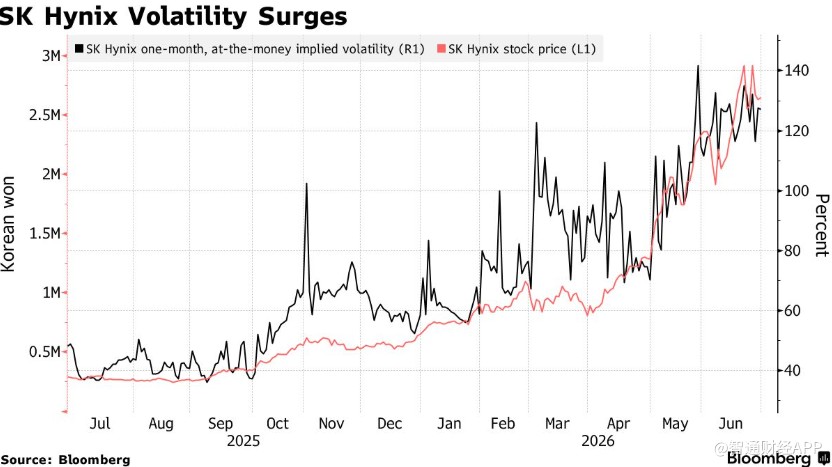
Market fluctuations have cast a shadow over the value of this transaction, making investors' decisions more complex. According to the transaction terms, SK Hynix will use the latest transaction price of its Korean stocks on the afternoon of July 9, New York time, as the pricing basis for issuing American Depositary Receipts (ADR). SK Hynix pointed out that current market conditions and other factors will also affect the final pricing, but did not specify the exact mechanisms of influence.
Jung In Yun, CEO of Fibonacci Asset Management, stated: "Market fluctuations may affect short-term investor sentiment or the timing of trade execution, but I believe it is unlikely to cause substantial disruption to the transaction itself. Unless market conditions significantly worsen from now on, the impact on prices should be controllable."
Despite stock price fluctuations, demand for SK Hynix ADR subscriptions remains strong
As SK Hynix advances its issuance, the severe volatility in the Korean stock market has not eased. On Tuesday, despite Samsung Electronics reporting a 19-fold year-on-year profit surge, its stock price still plummeted by 10%, dragging down the Korean benchmark stock index KOSPI, which experienced two circuit breakers in one day.
Although SK Hynix's stock price fell more than 6% on Tuesday, it has still risen over 700% in the past year, with no signs that market demand for its ADR has been affected. The transaction terms indicate that investor demand for SK Hynix ADR exceeds the issuance volume.
The issuance of ADR by SK Hynix has attracted strong interest from institutions such as Baqi Investment, Kotu Investment Company, and Situational Awareness Partners, which intend to collectively subscribe for ADRs worth up to 7 billion USD. Sanghyun Park, founder of Clepsydra Capital, stated that this indicates that despite the market facing sell-offs, institutional investors' subscription demand remains robust Park stated: "To ensure a strong listing on NASDAQ, the underwriting team may adopt a more conservative pricing strategy."
Roy Lim, a stock sales trader at NH Investment & Securities, noted that some of the volatility also stems from the rapid growth of leveraged exchange-traded products linked to SK Hynix. Lim pointed out that these influences "should be distinguished from Hynix's fundamentals."
Nori Chiou, investment director at White Oak Capital Partners, mentioned that aside from the volatility, U.S. investors will still want a piece of the action due to the asset's scarcity.
Chiou stated: "From the perspective of U.S. investors, South Korean stocks, especially those of memory companies, remain relatively scarce and difficult to invest in directly. This scarcity should help support demand."
