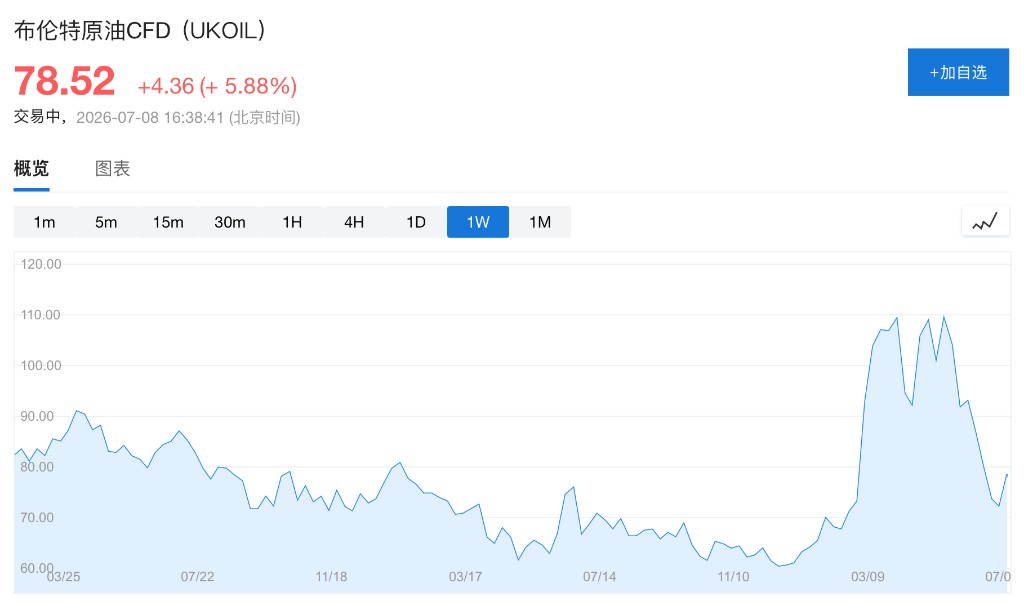
US-Iran Conflict Reignites! Trump Declares Memorandum of Understanding 'Terminated,' Oil Prices Surge 6%
More updates to follow
The fragile ceasefire agreement between the US and Iran has collapsed, bringing geopolitical conflict risks back into market focus and causing severe volatility in both commodities and financial assets.
According to Xinhua News Agency, on July 8, US President Trump stated at the NATO summit that he believed the US-Iran Memorandum of Understanding had "ended."
Following the news, US stock index futures plunged, with Nasdaq futures falling 0.42% during the day. US Treasury yields surged, Brent crude oil rose 5.88% to $78.52 per barrel, and spot gold dipped slightly to $4,091.57 per ounce. The US Dollar Index jumped nearly 20 points to 101.10.
Additionally, according to CCTV News, the Islamic Revolutionary Guard Corps (IRGC) of Iran issued a statement on the 8th, claiming that the US military launched airstrikes in the early hours against coastal areas in Hormozgan Province and some coastal bases and non-military facilities in Mahshahr, violating the ceasefire agreement and the Islamabad Memorandum of Understanding.

US Military Claims Offensive Strike, Hitting Over 80 Targets
According to CCTV International News, the US Central Command issued a new statement and video claiming that the US military launched a new round of offensive strikes against Iran, "using precision-guided munitions to hit more than 80 targets" as a "direct response to Iran's recent attacks on commercial vessels navigating the Strait of Hormuz."
The US military stated that the targets included Iranian air defense systems, command and control networks, coastal radar sites, and anti-ship missile facilities. It also claimed to have destroyed more than 60 small IRGC vessels in the Strait of Hormuz and surrounding waters.
The US side also listed the basis for its actions, stating that Iran had attacked three commercial vessels passing through the Strait of Hormuz: the Marshall Islands-flagged oil tanker "Al Rekaayat," the Saudi-flagged oil tanker "Wedian," and the Liberia-flagged oil tanker "Cyprus Prosperity." It warned that if Iran violated the agreement, the US would "hold it accountable at any time."
In fact, according to Xinhua News Agency, US President Trump posted a video titled "US Military Strikes Iran" on social media on July 7. The video showed ground facilities being hit, with flames and thick smoke rising into the night sky. Trump did not provide any text description for the video but later reposted it with a netizen's post that read: "Breaking News: Massive Attack on Iran."
Iran Responds Firmly, Claims to Have Shot Down US Drone
Iran responded quickly. According to Xinhua News Agency, citing Iranian media, the IRGC shot down a US MQ-9 "Reaper" drone in southern Iran.
According to CCTV News, Mohammad Bagher Ghalibaf, Speaker of the Iranian Islamic Consultative Assembly, posted on social media on the 8th, strongly condemning the US for "seriously violating" the US-Iran Memorandum of Understanding. Ghalibaf stated that the US had committed five violations of the memorandum: disrupting Iran's adjustment arrangements in the Strait of Hormuz; continuously threatening further strikes against Iran; reinstating oil sanctions; launching attacks on southern Iran; and Israel's continued aggression against Lebanon. Ghalibaf wrote, "The era of bullying and extortion is over. This path leads nowhere. We will not yield."
The Khatam al-Anbiya Central Headquarters of the Iranian Armed Forces also issued a statement, reiterating that it would not allow US interference in the management of the Strait of Hormuz under any circumstances, and emphasizing that the shipping lanes designated by Iran are the "only safe routes" for oil tankers and commercial vessels to pass through the strait. This statement has once again raised market concerns about the security of global energy transportation.
Trade Frictions Intensify, Multiple Risks Converge
As tensions in the Middle East escalate, trade frictions are also heating up. According to CCTV International News, citing Reuters, US President Trump requested Treasury Secretary Bessent to cut off all trade relations with Spain. This statement further heightened market risk aversion.
Amidst the convergence of multiple risks, market pricing logic has shifted back to geopolitical risks. The Strait of Hormuz handles about one-fifth of global crude oil exports, so any expectation of shipping disruptions will quickly push up energy risk premiums. With the ceasefire broken, investors' focus has shifted to whether the conflict will escalate further and whether transportation through the Strait of Hormuz can remain unimpeded.