


This former Apple executive bets on Shenzhen rather than Silicon Valley: the next Apple will be born here
Reality Metaverse CEO Wang Weier believes that consumer electronics startups are more likely to succeed in Shenzhen than in Silicon Valley. He pointed out that enthusiasm for hardware startups in Silicon Valley has waned, with talent and capital shifting towards AI software; meanwhile, Shenzhen boasts top-notch supply chains and engineering talent. The company has just completed a $150 million financing round, achieving a valuation of $1 billion, with investors including Meituan and Tencent, aiming to expand into overseas markets
Key Points
- Wang Weier, founder and CEO of Even Realities, stated that consumer electronics startups have a much higher success rate in Shenzhen than in Silicon Valley if they want to replicate Apple's success;
- Wang Weier mentioned that Silicon Valley's enthusiasm for investing in hardware startups has significantly declined;
- The company’s next round of financing will target global investors to support its expansion into overseas markets.
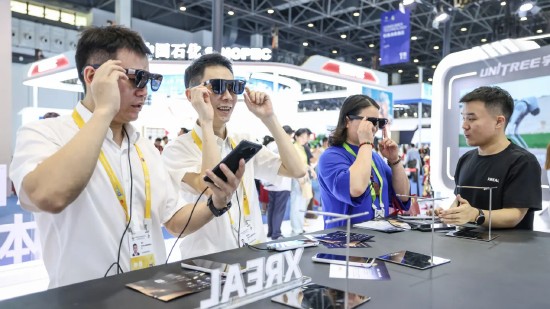 On April 13, 2026, at the 6th China International Consumer Products Expo in Haikou, Hainan, visitors experience smart glasses.
Wang Weier, CEO of the domestic smart glasses unicorn Even Realities, stated that consumer electronics startups aiming to create "the next Apple" have a better chance of rooting in Shenzhen than in Silicon Valley.
On Wednesday, Wang Weier said in an interview: "If we are determined to deeply cultivate the consumer electronics sector and build a company that could rival Apple, we must root ourselves in the core of the hardware industry — Shenzhen." He pointed out that Shenzhen boasts a vast pool of engineering talent and has a global top-notch supply chain advantage.
The Shenzhen-based company announced on Monday that it has completed a $150 million financing round, with a post-investment valuation of $1 billion, with investors including Meituan and Tencent. Wang Weier previously worked at Apple from 2016 to 2018, participating in the research and production of the Apple Watch and iPhone; now he is targeting the AI wearable device market led by the metaverse platform Meta.
Wang Weier admitted that Silicon Valley no longer favors hardware entrepreneurs: the R&D cycle for hardware products is longer, the profit ceiling is not as high as that of AI software, and they face unavoidable supply chain challenges, causing capital to shy away.
"Silicon Valley is no longer very favorable to hardware practitioners." He stated that talent and capital are flooding into the AI and intelligent software agency sectors, "the number of consumer electronics startups in Silicon Valley is decreasing, and related technical talent continues to flow away."
On the other side of the ocean, Shenzhen's industrial talent ecosystem is becoming increasingly vibrant. The area is home to a large number of mobile phone, drone, and consumer electronics manufacturers, with a vast reserve of mechanical, electrical, and optical engineers.
Shenzhen gathers many Chinese tech giants: Tencent, Huawei, drone company DJI, and new energy vehicle company BYD; it continues to attract a new generation of entrepreneurs, giving rise to innovative companies such as panoramic camera manufacturer Infinex and robotics company UBTECH.
Looking at the global market, the United States remains the core battleground for the company's overseas expansion, with over half of Even Realities' users coming from the U.S.
Currently, many Chinese startups are focusing on the AI consumer hardware sector, leveraging the complete domestic manufacturing supply chain to compensate for the first-mover advantage of the U.S. in the software field.
According to investment database PitchBook, domestic peer smart glasses company Rokid has received investments from Singapore's sovereign wealth fund Temasek and other institutions, with a valuation of $2.58 billion; The valuation of the industry small manufacturer Thunderbird Innovation is $239.9 million.
When asked whether this round of financing deliberately only introduced Chinese capital, Wang Weier responded: Domestic investors have higher decision-making efficiency and are closer to the enterprise; however, the next round of financing will focus on raising funds from global investors to support overseas business expansion.
In the past, the investors in Reality Metaverse were mostly local venture capital firms, including DCM, Cornerstone Capital, and CVC Capital. In January of this year, it also received undisclosed investments from Unicorn Capital and Qinglan Capital.
The company was established in 2023 and launched the Even G2 smart glasses at the end of last year, paired with the controllable Even R1 smart ring. Unlike Ray-Ban smart glasses equipped with cameras from Meta, the G2 has no camera or recording hardware, relying on built-in heads-up display in the lenses to achieve functions such as message reminders, navigation, and real-time translation
