


SK Hynix's US stock "debut" is coming tonight with a heavy impact! The AI investment boom is facing a critical stress test
SK Hynix priced its ADR at $149 for its debut on the US stock market, raising approximately $26.5 billion, setting a record for foreign companies' IPOs on US exchanges. This issuance was oversubscribed by more than 7 times, reflecting strong global capital confidence in the AI storage industry chain. As a leader in the HBM market, SK Hynix's listing is seen as a key stress test to assess the sustainability of the AI investment boom
According to Zhitong Finance APP, South Korean memory chip giant SK Hynix (SKHY.US) will officially debut on the U.S. market for trading on Friday. This U.S. listing debut will be a key test to determine whether investors still believe in the sustainability of the artificial intelligence (AI) boom, especially after a recent pullback in semiconductor stocks.
SK Hynix has set the issuance price of its American Depositary Receipts (ADR) for the U.S. listing at $149 per share, which is a 2.7% premium over the average stock price of its common shares listed in Seoul over the past three trading days. According to a listing issuance document previously submitted to the U.S. Securities and Exchange Commission (SEC), each SK Hynix ADR issued corresponds to one-tenth of a share of the company's common stock. The final scale of this ADR issuance is determined to be 17.79 million common shares (equivalent to 177.9 million ADRs), raising approximately $26.5 billion. This will become the largest initial public offering (IPO) ever conducted by a foreign company in the U.S., surpassing the previous record of $25 billion set by Alibaba Group.
It is reported that the SK Hynix ADR issuance has received over 7 times oversubscription. Insiders previously stated that this issuance attracted demand from numerous institutional investors, including global long-term investment funds, technology-focused funds, sovereign wealth funds, and global investment institutions focused on the Asian market. SK Hynix has received subscription intentions from institutions such as Baillie Gifford, Coatue Management, and Situational Awareness Partners, with the total amount of ADRs they intend to subscribe reaching up to $7 billion.
The enthusiastic subscription for SK Hynix's ADR issuance reflects a global capital consensus on the pricing of the AI storage industry chain. SK Hynix is the world's second-largest DRAM manufacturer and the largest HBM manufacturer globally, with a market share of 56.4% in the HBM market in Q1 2026, and a global market share of 18.5% in NAND flash memory, with net profit increasing by 398% year-on-year during the same period and an operating profit margin exceeding 70%, deeply binding with NVIDIA to form a joint R&D relationship.
However, after experiencing a strong rally, chip stocks have seen a cooling trend in recent weeks, partly due to investor concerns that the growth rate of AI spending may slow down. The price of SK Hynix's common shares listed in Seoul has fallen about 25% from the historical high reached two weeks ago. Nevertheless, even so, the company's stock price is still up about 630% compared to a year ago.
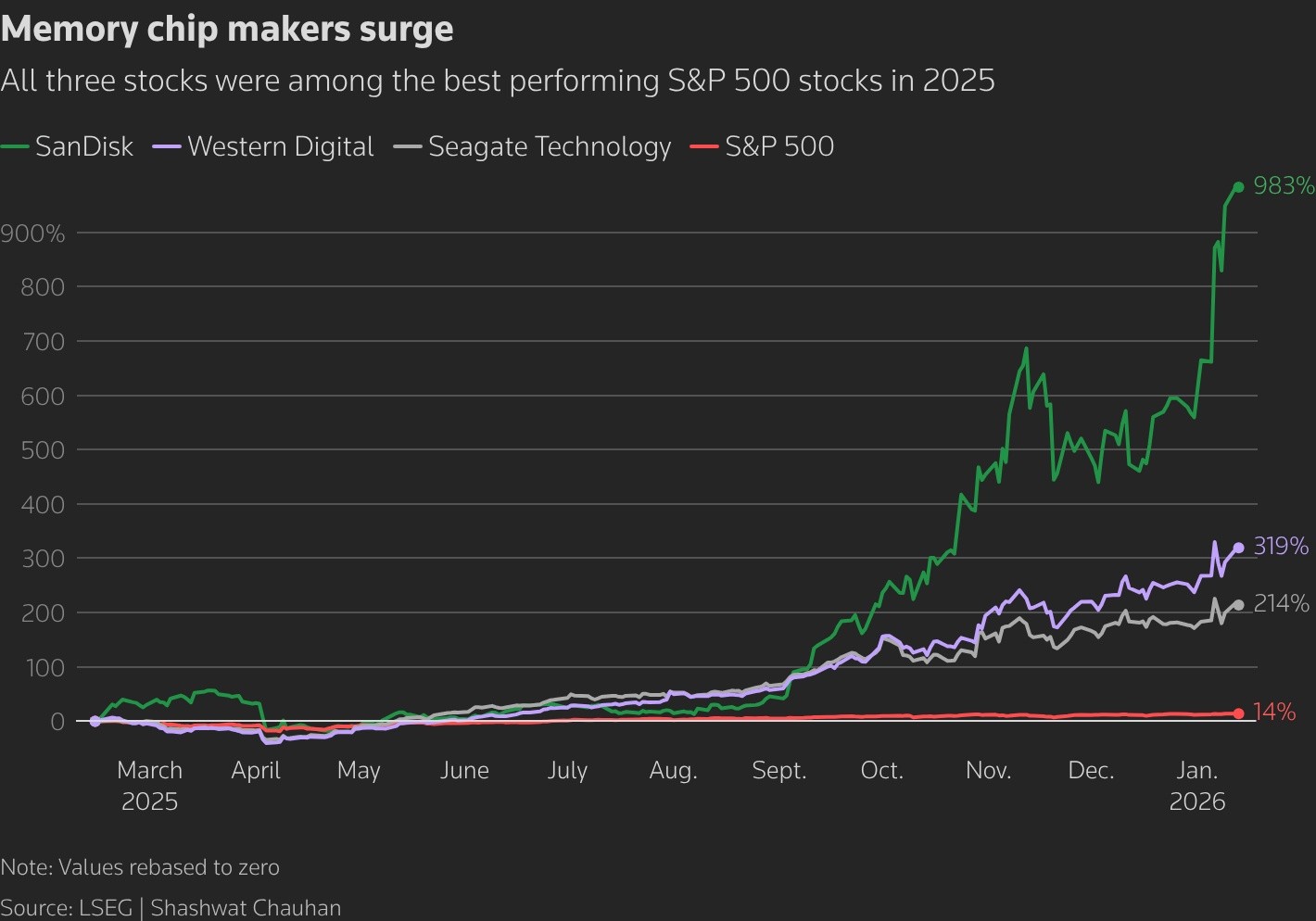
Thomas Hayes, chairman of Great Hill Capital in New York, stated: "The global semiconductor sector is now the most crowded trade in the world. Underwriters and issuers—namely SK Hynix—are financing at a time when market demand is at its peak. They believe that valuations are currently at a high level and therefore want to seize this opportunity SK Hynix's issuance is the second largest stock issuance transaction in the U.S. market following SpaceX (SPCX.US) record-breaking initial public offering (IPO) last month. This financing will provide funds for SK Hynix to build new factories, while also allowing this memory chip manufacturer to directly access the largest group of global investors.
SK Hynix stated that the raised funds will focus on the construction of the first wafer fab in the Yongin semiconductor cluster, the expansion of advanced packaging facilities at the Cheongju P&T7 park, and the construction of an AI memory packaging factory in Indiana, USA. At the same time, the company will also procure extreme ultraviolet (EUV) lithography equipment to further enhance advanced process manufacturing capabilities. Overall, this fundraising is highly focused on HBM, advanced packaging, and high-end manufacturing capacity expansion, aligning with SK Hynix's long-term strategy to continuously strengthen its competitive advantage in the AI chip supply chain and meet the rapidly growing demand for AI memory.
In addition, SK Hynix stated that this listing aims to enhance the company's visibility in the global capital markets and strive for a more reasonable market valuation. The company believes that although it has established a leading position in the AI memory market, its current valuation is still lower than its competitor Micron Technology (MU.US).
Data shows that Micron Technology's stock price has also surged 711% over the past 12 months. Although SK Hynix dominates the HBM market, its expected price-to-earnings ratio for the next 12 months is about 5.8 times, while Micron Technology's expected price-to-earnings ratio for the next 12 months is about 7 times. Analysts say that SK Hynix's listing in the U.S. will expand its investor base, improve stock investability, and help narrow the valuation gap with Micron Technology.
Giuseppe Setti, co-founder of investment analysis platform Reflexivity, stated: "For U.S. investors, this is the purest large-cap target for investing in AI storage chips. SK Hynix chose to list on Nasdaq to meet this demand and enjoy a higher valuation level compared to the Seoul market." "SK Hynix successfully completed this financing with its AI story, but subsequent companies going public in the U.S. may face a more difficult and discerning market."
As the market's enthusiasm for AI infrastructure investment begins to cool, leading to significant fluctuations in related chip stocks, SK Hynix's listing will undoubtedly be a major test.
To compete for a leading position in faster and smarter AI models, tech giants are investing hundreds of billions of dollars to build the infrastructure that supports AI development, and are funding this costly expansion plan through stock issuance and debt financing. Analysts expect that this type of capital expenditure will continue to grow in the short term. A report released by Bank of America Securities this week predicts that global capital expenditures on cloud computing and AI infrastructure will approach $1.5 trillion by 2027, a year-on-year increase of 40% to 50%.
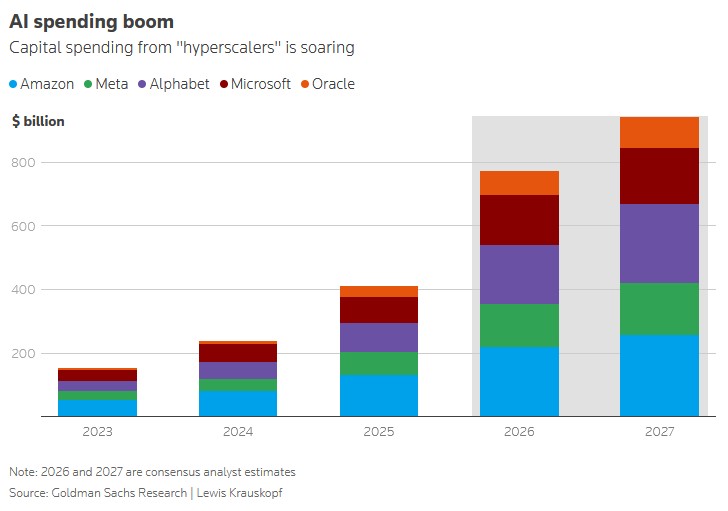 However, the market's questions about how much return these massive investments will ultimately bring are increasing. This has also raised investors' concerns about ultra-large-scale cloud service providers potentially having to slow down capital expenditures.
Matt Kennedy, a senior strategist at Renaissance Capital, which focuses on IPO research and ETF products, stated: "Investors will weigh the strong performance accumulated from the significant stock price increases over the past year against the recent market volatility. Concerns about oversupply are always an inherent risk in the semiconductor industry."
