


Triple Market Catalysts Collide on a Make-or-Break Tuesday: Surging Fed Hike Odds, Bank Earnings Kickoff and New Chair’s Congressional Debut
Multiple catalysts including U.S. CPI data, new Fed Chair’s congressional testimony and big bank Q2 earnings converge this week, with hawkish Fed rhetoric lifting July hike odds and threatening AI-driven U.S. stock gains amid rising inflation and capital cost risks.
A convergence of three major market-moving events—sharply repriced Federal Reserve rate hike expectations, the official launch of U.S. bank earnings season, and the new Fed Chair’s maiden congressional testimony—will make this Tuesday the most consequential single trading session for markets in recent weeks.
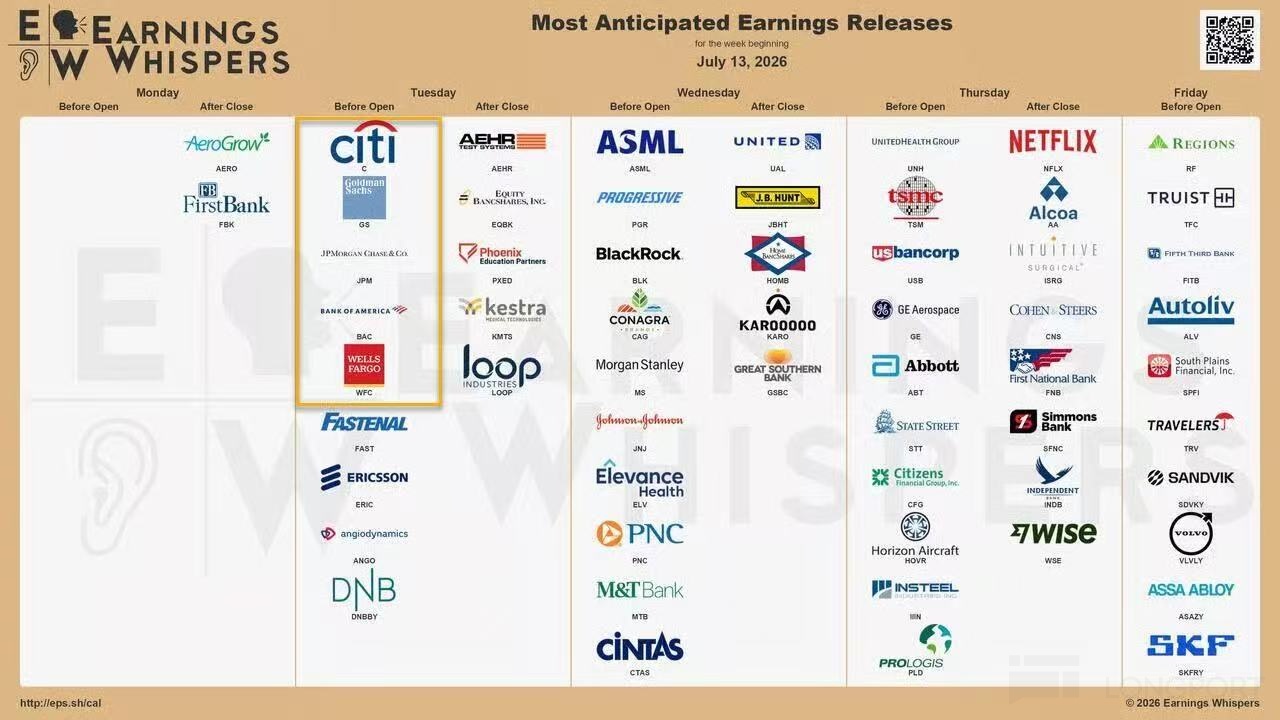
The U.S. June Consumer Price Index (CPI) report will print first at 8:30 a.m. Washington time on Tuesday. Immediately afterward, newly installed Fed Chair Kevin Wash will deliver his first monetary policy testimony before the House Financial Services Committee. The same morning also marks a blockbuster earnings release slate for five top U.S. lenders: JPMorgan Chase, Bank of America, Wells Fargo, Goldman Sachs and Citigroup, ringing in the broader Q2 earnings cycle. Ian Lyngen, Head of U.S. Rates Strategy at BMO Capital Markets, commented: “The pairing of CPI data and Wash’s congressional testimony will deliver a material directional shift to market pricing for rate hikes one way or another.”
Federal Reserve Governor Christopher Waller laid out explicit triggers for tighter policy on Monday, stating the FOMC would need to weigh near-term monetary tightening if core inflation prints another hot reading this week. His remarks triggered an abrupt repricing across markets: money-market odds of a July rate jump rocketed from under 10% to roughly 50%, while the 2-year U.S. Treasury yield hit 4.28%, its highest level in more than a year. Adding to inflation headwinds, U.S.-Iran geopolitical tensions flared anew, with Brent crude surging nearly 10% intraday and creating dual pressure on inflation expectations.
On corporate earnings, Goldman Sachs projects S&P 500 Q2 year-over-year profit growth of 22%, with AI infrastructure names set to account for around half of the index’s total earnings expansion. Yet the bank issued a concurrent warning: a resumption of Fed rate hikes would subject U.S. equities to three headwinds—downwardly revised growth outlooks, higher capital costs, and the historical fragility of richly valued markets.
CPI Outlook: Energy to Drag Headline Inflation, Core Pressures Remain the Key Flashpoint
Consensus forecasts see June headline CPI falling roughly 0.2% month-over-month, with annual inflation cooling from May’s 4.2% to 3.8%. This would mark the first negative monthly headline print since the 2020 pandemic, driven almost entirely by slumping gasoline prices—regular retail gasoline tumbled approximately 15% between mid-May and late June.
Goldman Sachs’ internal forecasts call for a 0.11% month-over-month drop in headline CPI and a 0.17% rise in core CPI, both below the broader market consensus of a 0.2% core gain. The bank’s economists flag several channels for inflation relief in the coming months: airfares set to ease alongside cheaper jet fuel, hotel booking rates pulling back from World Cup-era peaks, and ongoing deceleration in rental inflation.
Core Personal Consumption Expenditures (PCE) inflation, however, is expected to improve at a slower pace than core CPI. Goldman Sachs pencils in an average monthly core PCE rise of 0.23% over the next three months, partially due to rising implicit financial services prices fueled by stock market gains, plus elevated costs for software and peripherals—a category that carries a weight 30 times larger in core PCE than in core CPI.
The Producer Price Index (PPI) paints a more complicated picture. Energy shocks stemming from the Iran conflict continue to filter through supply chains, with the 12-month core PPI inflation rate projected to accelerate from 4.9% to 5.2%.
Wash’s Congressional Debut: Scaled-Back Forward Guidance Fuels Policy Opacity
Wash will testify before the House on Tuesday and the Senate Banking Committee on Wednesday, marking his first public monetary policy hearing since taking office as Fed Chair in May.
In a departure from the Powell era, Wash has repeatedly pledged to pare back formal forward guidance on the interest-rate path, a stance that leaves investors without a clear policy anchor. Ed Al-Hussainy, Portfolio Manager at Columbia Threadneedle, put it bluntly: “The odds of a July hike outweigh the odds of a pause,” adding that “we will need a fair amount of luck to pull inflation back down to the 2% target.”
Lyngen noted that even a soft CPI print would leave markets pricing some meaningful probability of a July hike, and the risk of an unanticipated Fed tightening move—one not fully priced in by investors—cannot be ruled out.
Bloomberg’s Chief U.S. Economist Andrew Sacher struck a more dovish tone in his assessment. He argued a meaningful jump in hike probabilities would require two simultaneous triggers: a far hotter-than-expected CPI print paired with distinctly hawkish rhetoric from Wash, a twin scenario he sees as low-probability. Current market pricing assigning just a 24% chance of a July increase already reflects broad baseline skepticism over near-term tightening.
Big Bank Earnings Kick Off Earnings Season: Robust Profit Growth Collides With Policy Uncertainty
The opening stretch of this earnings cycle features an unusually concentrated slate of major bank results. JPMorgan, Bank of America, Wells Fargo, Goldman Sachs and Citi will all report pre-market Tuesday, while ASML and Taiwan Semiconductor Manufacturing Co. (TSMC) will release results later in the week to serve as a critical gauge of global AI chip demand strength.
Goldman Sachs trading desk calculations put consensus S&P 500 Q2 year-over-year earnings growth at roughly 22%, the fastest clip since 2021. The index has beaten consensus estimates for 11 consecutive quarters, with Q1 actual profit growth hitting 27%—15 percentage points above consensus—driven overwhelmingly by AI-linked sectors.
For individual bank names, key focal points diverge sharply:
- JPMorgan: Investors will watch for potential management premium erosion following Marianne Lake’s departure.
- Bank of America: Fee expense trends and Net Interest Income (NII) guidance visibility stand as the primary stock catalysts.
- Citigroup: Benefits from ECB rate hikes lifting Services NII, with muted market expectations for its capital markets division creating meaningful upside room.
- Goldman Sachs: Widely viewed as the top beneficiary of the AI capital markets cycle, with its equities trading division under heavy scrutiny.
- Wells Fargo: Its 2026 full-year NII target hangs in the balance amid risks of slowing deposit growth in the second half.
Goldman Sachs strategists warn the current earnings cycle lacks the powerful incremental catalyst seen last quarter—massive upward revisions to AI capital expenditure forecasts. With macro policy risks tilting tighter, markets face steeper hurdles to sustain index gains driven purely by earnings beats.
Waller Draws Hard Line for Rate Hikes, Policy Bias Shifts Materially Hawkish
Waller’s speech Monday before the New York Association for Business Economists was interpreted by markets as the Fed’s clearest hawkish warning to date.
He noted core PCE inflation hit a 3.4% year-over-year pace as of May and had been trending higher since January, well before the latest U.S.-Iran geopolitical flare-up. Inflationary pressures stem from tariffs, elevated energy prices and massive capital outlays for AI infrastructure. “By every measure, inflation has moved higher this year,” he stated. “I am increasingly concerned about the persistent upward trajectory in core inflation.”
Waller invoked the policy missteps of 2021–2022, when the FOMC faced widespread criticism for delaying rate hikes amid runaway inflation, stressing such errors must not be repeated. While he signaled support for holding rates steady if several consecutive cooling inflation prints emerge, the bar for patience remains extremely high.
His remarks align with the tone of the June FOMC meeting minutes, which revealed half of the 18 committee members now project at least one 25-basis-point rate increase before year-end, lifting rate hikes from a fringe policy option to a central debate topic. Goldman Sachs’ chief economist Jan Hatzius and his team conclude Waller’s latest hawkish comments, paired with the June meeting minutes, confirm the FOMC’s openness to restarting tightening has risen substantially.
Three Layers of Downside Risk If the Fed Resumes Hiking: Growth, Capital Costs and Historical Precedent
Goldman Sachs laid out a three-pronged bear case for U.S. equities in its latest weekly U.S. strategy note should the Fed restart its rate-hiking cycle.
First, tighter monetary policy directly crimps growth expectations. While corporate earnings growth typically exerts a larger influence on equities than interest rates, all else equal, monetary contraction will weigh on market forward growth assumptions.
Second, the current economic cycle is uniquely capital-intensive. AI infrastructure stocks now make up 42% of the S&P 500’s total market capitalization and are projected to deliver around half of the index’s 2026 earnings growth. Goldman data shows hyperscale cloud operators plan capital expenditures equivalent to 100% of operating cash flow this year, with their aggregate net debt surging 190% year-over-year to $239 billion as of Q1 2026. Meanwhile, Q2 U.S. equity issuance hit an all-time high of $2520 billion, topping the prior peak set in Q1 2021. Any jump in capital costs threatens the cycle’s single most important growth engine.
Third, historical market patterns show Fed tightening cycles frequently precede peaks in high-valuation, highly concentrated bull markets. Rate hikes predated major market tops in 1929, 1972, 1987 and 1999, while U.S. equities priced in peak valuations ahead of the 2022 tightening cycle. Goldman rates strategists estimate a return of interest-rate volatility to levels seen during the 2022–2023 hiking cycle would compress S&P 500 price-to-earnings multiples by roughly 6%, equivalent to one full valuation turn.
Goldman Sachs currently targets an S&P 500 year-end level of 8,600 and a 12-month forward target of 8,300, implying approximate upside of 14% and 10% respectively from the index’s current 7,544 level. Strategists emphasize, however, these targets hinge entirely on a material absence of monetary policy tightening—a baseline assumption set to face its most rigorous market test over Tuesday and Wednesday.
Article source:Wallstreetcn
