


JPMorgan Chase Q2 Net Profit Surges 41%, Equity Trading Revenue Soars 86%; Dimon Warns of Accumulating Deep-Seated Risks | Earnings Insights
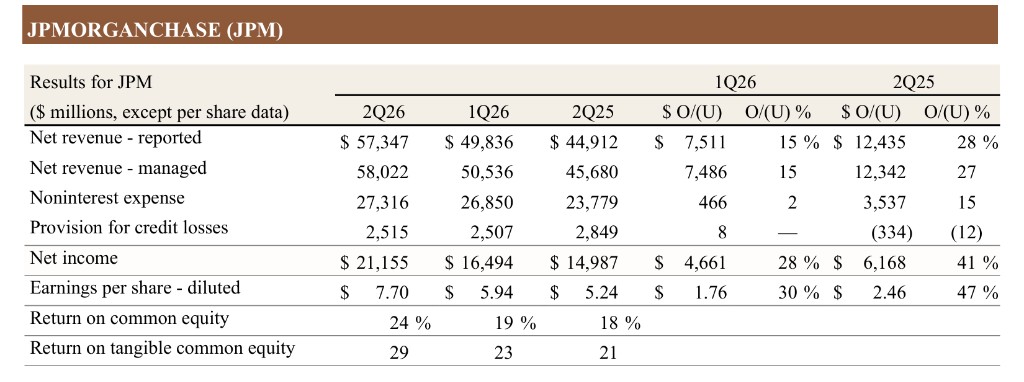
JPMorgan Chase's second-quarter net profit reached a record high of $21.1 billion, driven by an 86% surge in equity trading and gains from its Visa stake, significantly beating expectations. However, pre-market shares fell as the full-year cost guidance was raised to $107.5 billion. Jamie Dimon warned that deep-seated risks, including geopolitical tensions, persistent inflation, and large fiscal deficits, could trigger substantial shocks
JPMorgan Chase reported its highest-ever quarterly net profit, with explosive growth in its equity trading business and gains from its Visa stake driving performance well beyond expectations. However, amidst the celebration, CEO Jamie Dimon issued a warning that multiple risks are quietly shifting beneath the surface.
On Tuesday, JPMorgan Chase announced that its second-quarter net profit reached $21.1 billion, a 41% year-over-year increase. Excluding major one-off items such as the $4.6 billion net gain from the sale of Visa shares and $1 billion in equity investment income, net profit stood at $16.9 billion, with earnings per share (EPS) of $6.14 and a return on tangible common equity (ROTCE) of 23%. Revenue from equity trading soared 86% year-over-year to $6 billion, not only surpassing the highest estimates from analysts surveyed by Bloomberg but also pushing total trading revenue to a record high of $12.1 billion.
Investment banking and market operations were the most significant highlights of the quarter. The Commercial & Investment Bank (CIB) division saw revenue grow 27% year-over-year, while market operations revenue surged 35%, with equity markets revenue jumping 86%; investment banking fees rose 30% year-over-year to their highest level since 2021, securing the top global market share of 9.3% for year-to-date investment banking fees. Meanwhile, assets under management (AUM) in the Asset & Wealth Management (AWM) division surpassed $5 trillion for the first time.
In his statement, Dimon attributed the performance to "particularly favorable market conditions, strict execution, years of sustained investment, and prudent capital deployment." However, he warned that "multiple risks are moving like tectonic plates deep below the surface, including geopolitical tensions and wars, persistent high inflation, large global fiscal deficits, and elevated asset prices," cautioning that these forces "could cause substantial shocks when they collide."
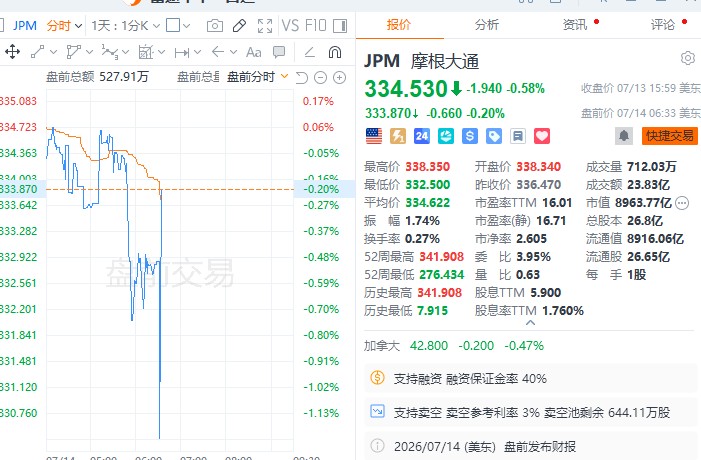
JPMorgan Chase's pre-market share price decline widened to 2.3%, as the bank expects full-year adjusted expenses to be approximately $107.5 billion, up from the previous expectation of around $105 billion.
Revenue Across All Business Lines Hits Record Highs
JPMorgan Chase's total managed revenue for the second quarter reached $58 billion, a 27% year-over-year increase, or 15% excluding major items. Net interest income was $25.6 billion, up 10% year-over-year; non-interest income was $32.4 billion, up 45% year-over-year, or 20% excluding major items. Revenue across all business lines set new historical records.
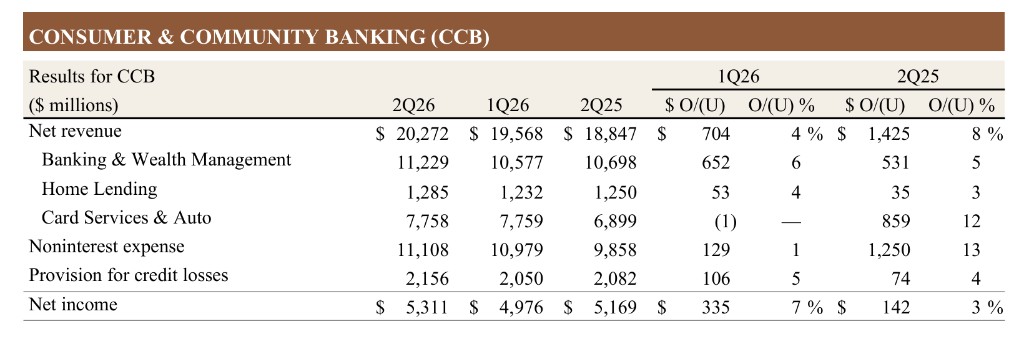
The Consumer & Community Banking (CCB) division reported revenue of $20.3 billion, an 8% year-over-year increase. Within this, Banking and Wealth Management revenue was $11.2 billion, up 5%, primarily driven by growth in JPMorgan Wealth Management asset management fees and deposit-related fees; Card and Auto Finance revenue was $7.8 billion, up 12%, mainly boosted by rising revolving loan balances and increased auto operating lease income. The division's net profit was $5.3 billion, a 3% year-over-year increase. Dimon specifically noted in his statement that the number of new investors opening wealth management accounts reached nearly 44,000, a historic high; annual credit card fee income grew by over 30%, reflecting strong demand for premium products and healthy customer retention.
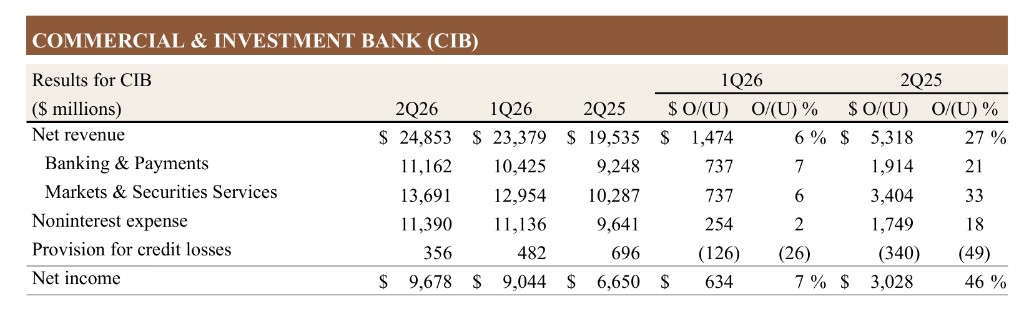
The CIB division reported net profit of $9.7 billion, a 46% year-over-year increase, with revenue of $24.9 billion. Of this, equity markets revenue was $6 billion, surging 86% year-over-year, with "strong performance across all products and regions"; fixed income markets revenue was $6.1 billion, up 6%, with better performance in credit, currencies, emerging markets, and rates businesses, while commodities dragged slightly. Payments revenue was $5.3 billion, up 12% year-over-year, driven by growth in deposit balances and fees; Securities Services revenue was $1.7 billion, up 17%.
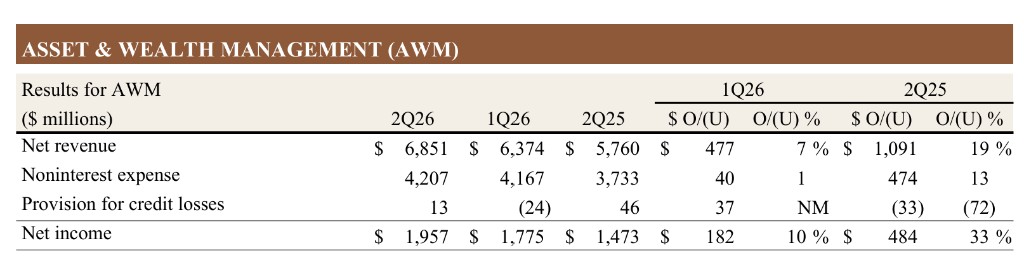
The AWM division reported net profit of $2 billion, a 33% year-over-year increase, with revenue of $6.9 billion, up 19%. Assets under management (AUM) reached $5.1 trillion, an 18% year-over-year increase; total client assets amounted to $7.7 trillion, up 19%. Long-term AUM net inflows reached $50 billion, which Dimon described as "remaining robust."
One-Time Gains Boost Reported Profit; Credit Quality Remains Stable
This quarter's reported net profit was boosted by two significant one-time items: first, a $4.6 billion net gain related to Visa shares, stemming from JPMorgan Chase's exchange in May of its 18.6 million Class B-2 common shares for Class B-3 and Class C common shares, with gains on Class C shares recognized at fair value; second, approximately $1 billion in equity investment income. Together, these items increased after-tax net profit by about $4.2 billion, making the reported earnings per share $1.56 higher than the $6.14 figure excluding major items.
Regarding credit costs, the provision for credit losses for the quarter was $2.5 billion, with net charge-offs of $2.4 billion and a net increase in reserves of $149 million (mainly concentrated in wholesale businesses). The CCB division's credit card net charge-off rate was 3.34%, slightly higher than the same period last year. Compared to the same period last year, the provision in Q2 last year was $2.8 billion and included a $774 million corporate segment income tax benefit, which did not recur this year. Overall, credit quality remained stable, with no clear signs of deterioration.
Strong Capital Position and Significant Shareholder Returns
In terms of capital strength, JPMorgan Chase maintained a robust "fortress balance sheet." As of the end of the reporting period, the standardized Common Equity Tier 1 (CET1) ratio was 14.1%, and 14.2% under the advanced approach; the supplementary leverage ratio was 5.5%; cash and marketable securities totaled approximately $1.5 trillion; and total loss-absorbing capacity was $590 billion. Tangible book value per share was $113.35, up 10% year-over-year; book value per share was $133.01, up 9% year-over-year.
Regarding shareholder returns, the company paid total common stock dividends of $4 billion for the quarter, equivalent to $1.50 per share; net common stock repurchases amounted to $6.2 billion; and the net payout ratio over the past 12 months was 73%.
Dimon Warns of Deep-Seated Risks Including Geopolitics and Inflation
Despite the impressive results, Dimon's remarks on the macroeconomic environment were cautious. He acknowledged that the U.S. economy has shown "significant resilience" this year, with strengthening business investment and employment, aided by multiple tailwinds including AI-driven capital investment, fiscal stimulus, and improved regulatory efficiency.
However, Dimon also warned that "multiple risks are moving like tectonic plates beneath the surface," including geopolitical tensions and wars, stubborn inflation, large global fiscal deficits, and elevated asset prices. He stated that it is difficult to predict how these factors will ultimately evolve, noting they "may remain contained, but could also cause significant shocks when they move or collide." He indicated that the company is closely monitoring these risks and preparing for a wide range of scenarios.
In terms of outlook guidance, JPMorgan Chase raised its full-year net interest income forecast to approximately $105.5 billion, with the figure for the second quarter standing at $25.5 billion. However, pressure on the cost side cannot be ignored. Second-quarter expenses reached $27.3 billion, higher than market expectations, leading to an upward revision of the full-year cost guidance to approximately $107.5 billion, exceeding the magnitude Dimon had previously signaled at an industry conference in May.
Regarding internal governance, JPMorgan Chase announced late last month the appointment of Troy Rohrbaugh and Doug Petno as Co-Presidents, introducing new variables into the succession landscape for the eventual departure of Dimon (currently 70 years old). In this adjustment, long-serving executive Marianne Lake announced her retirement, with Rohrbaugh taking over her previously responsible massive consumer business segment, while Petno assumed sole command of the Commercial & Investment Bank business.
