


YOFC Hong Kong Shares Surge 22% at Open; Morgan Stanley Upgrades Rating to Overweight
Morgan Stanley has upgraded the rating of YOFC's H-shares to Overweight, compounded by the company's positive earnings pre-announcement—projecting a year-on-year net profit increase of over ninefold to RMB 3 billion in the first half of 2026. This dual catalyst resonance drove the stock price to a single-day maximum gain of 22%. Morgan Stanley pointed out that the previous 50% correction has fully digested supply-side concerns, the AI-driven super cycle demand for optical fibers remains unchanged, current valuations are highly attractive, and the entry timing is mature
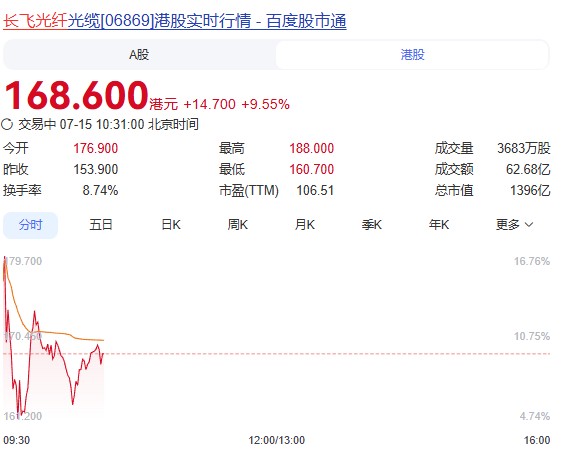
YOFC is experiencing a strong resonance of catalysts. Morgan Stanley upgraded the company's H-share rating to Overweight, combined with the company's release of impressive positive earnings guidance, driving the stock price to a maximum intraday gain of 22% early Thursday, marking its largest single-day rise in over three weeks.
Morgan Stanley analysts, including Andy Meng, noted in their report that YOFC's H-shares have cumulatively fallen about 50% from their June peak, but supported by the AI-driven optical fiber super cycle, the company's earnings growth trajectory remains intact, and the current risk/reward ratio of the stock price has become more attractive.
Morgan Stanley maintained its target price at HKD 230. Meanwhile, the company announced that it expects the net profit attributable to shareholders of the listed company for the first half of 2026 to be approximately RMB 2.4 billion to RMB 3 billion, representing a year-on-year increase of 711% to 914%.
As of now, YOFC's Hong Kong shares are up 9.55%, trading at HKD 168.6.
Morgan Stanley: Correction Has Fully Reflected Supply-Side Concerns; Entry Timing Is Mature
The core logic behind Morgan Stanley's rating upgrade is that the previous stock price correction primarily reflected market concerns regarding supply-side risks, rather than a substantive deterioration in fundamentals.
Analysts including Andy Meng stated in the report that capacity release within the industry still requires time, while demand driven by the boom in AI infrastructure remains robust, making it difficult for the earnings growth momentum to change substantially in the next 6 to 12 months. In this context, after experiencing a significant correction, the current valuation of the stock has become highly attractive, with the recent pullback creating a compelling entry opportunity for investors.
Morgan Stanley also stated that the company's positive earnings pre-announcement further validates the credibility of its earnings forecasts, judging the probability of YOFC achieving its full-year earnings forecast of RMB 7.5 billion as extremely high.
Positive Earnings Pre-announcement: First-Half Net Profit Surges More Than Ninefold Year-on-Year
The positive earnings pre-announcement released by YOFC shows a significant leap in the company's profitability during the reporting period.
The announcement indicates that the net profit attributable to shareholders of the listed company for the first half of 2026 is expected to be approximately RMB 2.4 billion to RMB 3 billion, compared to just RMB 296 million in the same period last year, representing a year-on-year increase of 711% to 914%. The net profit after deducting non-recurring gains and losses is estimated at approximately RMB 2 billion to RMB 2.6 billion, with a year-on-year increase of 1349% to 1784%.
The announcement attributed the substantial performance growth to two main drivers: first, the continued expansion of domestic and international demand for new types of optical fiber and cable products spurred by the accelerated construction of computing power data centers; and second, the continuous improvement of the industry's supply and demand structure. This performance confirms the rapid recovery in the prosperity of the optical fiber and cable industry and highlights the strong driving effect of computing power infrastructure construction on related companies in the industrial chain.
