


Sudden Halt! Gemini 3.5 Pro Struggles to Launch, Google Falls into Disappointment Trap
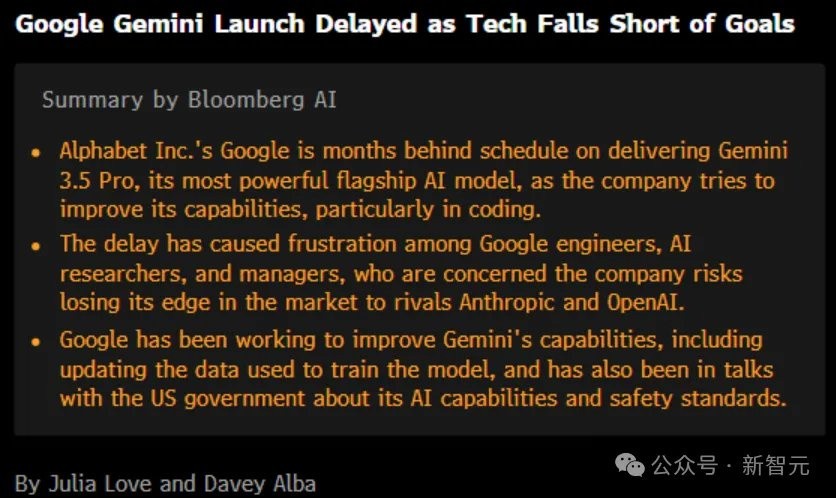
Google's flagship AI model, Gemini 3.5 Pro, has been delayed for several months as its key capabilities, such as coding, failed to meet internal standards. The market had previously expected it to disrupt the landscape, but a Bloomberg report revealed lagging development progress, causing Google's stock price to drop by as much as 4.4%
Just yesterday, the entire AI community was immersed in excitement.
Leaks poured in from all sides: Google's ultimate weapon—Gemini 3.5 Pro, codenamed "Cappuccino," was set to officially launch within 48 hours!
With a massive 2 million token context window and a new "Deep Think" reasoning mode, it was rumored to have decisively outperformed GPT-5.6 Sol and Claude Fable 5 in internal evaluations.
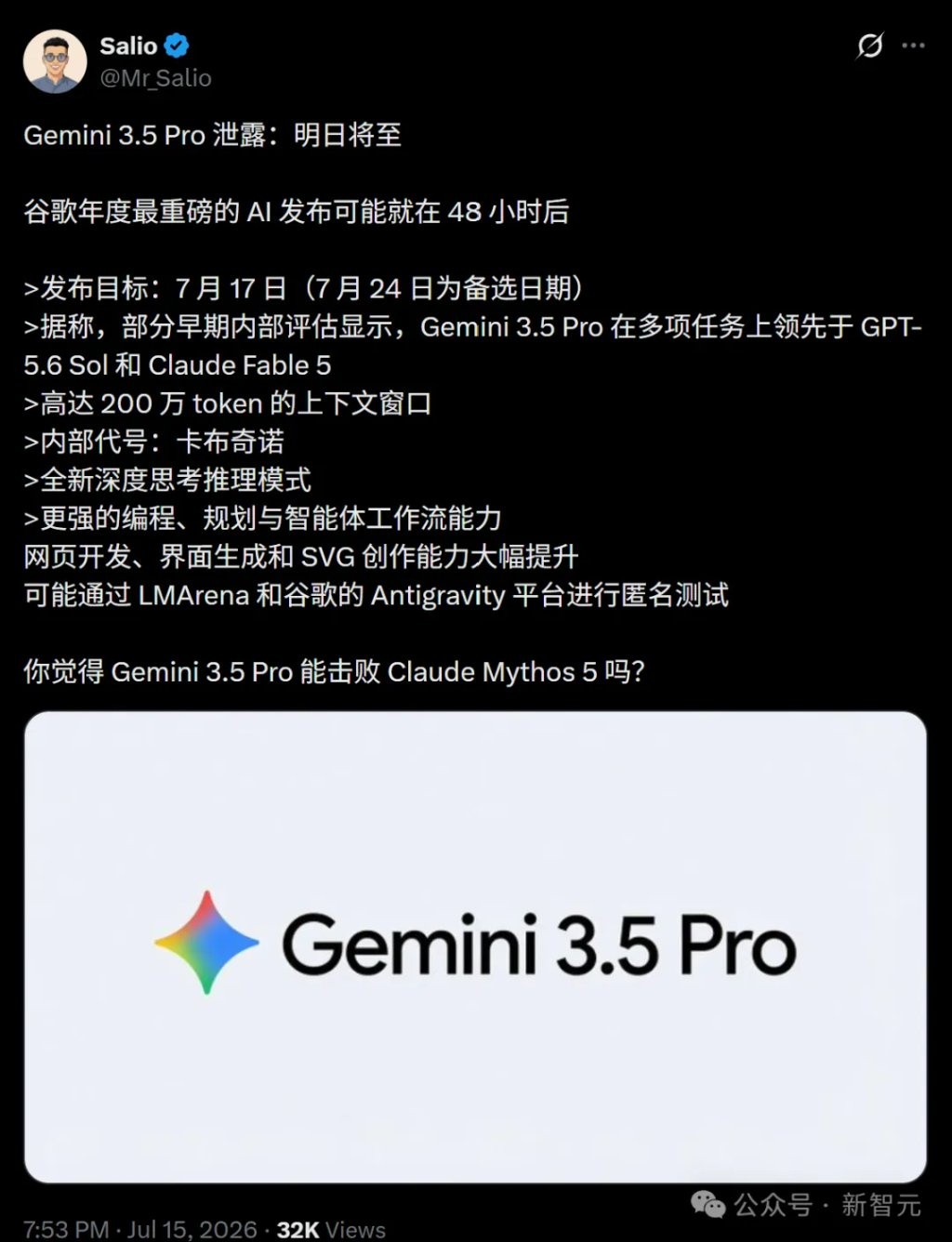
Clearly, this was a blockbuster product poised to reshape the AI landscape.
Everyone was excitedly counting down, gearing up to witness history.

However, upon waking up, the situation changed dramatically.
An exclusive report from Bloomberg acted like a bucket of ice water, dousing everyone's enthusiasm: the release of Gemini 3.5 Pro has been delayed, and not by just a few days, but by several months!

What should have been a historic launch was put on pause by Google itself.
Why?
48-Hour Frenzy and Emergency Brake
Just yesterday, social media platforms were flooded with spoilers about Gemini 3.5 Pro.
Codename: Cappuccino.
Ultra-long context: 2 million tokens.
Deep Thinking: The new "Deep Think" mode reportedly reached unprecedented heights in mathematics, programming, and logical reasoning.
Comprehensive Evolution: Significant improvements in code generation, agent workflows, front-end UI design, and SVG graphic generation capabilities.
Insiders predicted this would be Google's "ultimate weapon" to counterattack OpenAI and Anthropic.
Reactions were swift. Everyone was anticipating the legendary launch date of July 17.
However, a report by a Bloomberg journalist this morning instantly dashed hopes.
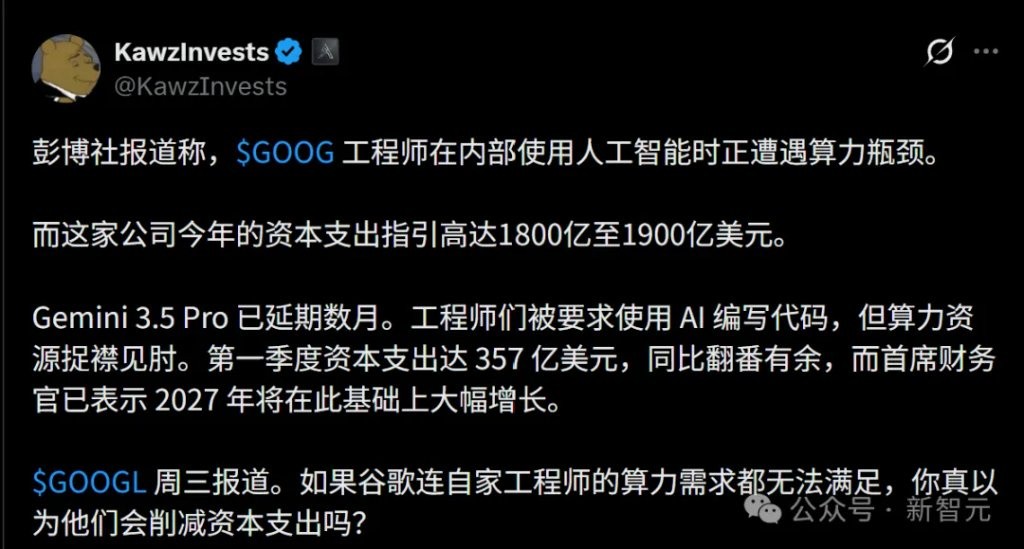
Insiders stated that the development of Gemini 3.5 Pro is already months behind schedule. The core issue is that the model failed to meet stringent internal standards in key capabilities, particularly AI coding.
As recently as late last month, Google urgently updated its training data in a final sprint to boost coding capabilities, but the results were "disappointing."
These four words marked the end of the 48-hour frenzy.
Google's stock price fell in response to the news, dropping as much as 4.43% at one point.
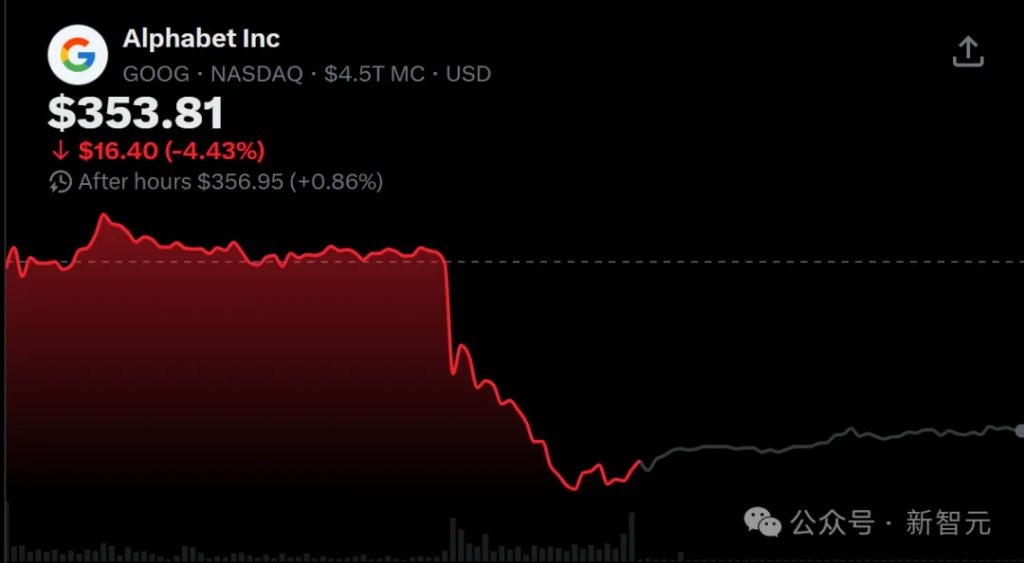
As new models from OpenAI and Meta surged ahead in coding capabilities, the difficult birth of Gemini 3.5 Pro directly caused severe anxiety within Google.
Engineers, AI researchers, and executives felt deeply frustrated, increasingly worried that Google is losing its already thin moat.

Google's "Tacitus Trap": Why Can't All-Out Efforts Produce the Strongest AI?
Why did the highly anticipated blockbuster fail to deliver?
This report unveils the myriad difficulties within Google. It is a microcosm of a vast empire during a period of transitional transformation.
- Innovation Speed "Dragged Down" by Bureaucracy
The report mentions a key detail: Google has complex internal hierarchies and numerous stakeholders.
The launch of a single model must accommodate the needs of massive product lines such as Search, Maps, and YouTube.
This "wanting everything" decision-making model leads to scattered resources and slow decisions.
A former employee offered a vivid analogy: "Getting every department's leadership to pull in the same direction is like trying to boil the entire ocean."
The result is frequent changes in directives, multiple departments reinventing the wheel, and an inability to form a unified force.
While OpenAI and Anthropic race forward at startup speed, Google's "giant ship" stalls due to internal coordination issues.
One netizen commented sharply: "Google needs to trim its bloated bureaucracy to make progress in this field."

- AI Coding Waterloo: Engineers' Purist Complex and Compute Hunger
And why specifically did coding capabilities falter? This hides deeper contradictions within Google.
On one hand, Google boasts the world's top engineering culture, which has fostered a "purist" complex.
Many old-school engineers believe that "all important code should be written manually." This distrust of AI-generated code has limited engineers' use of Gemini to assist in development, fearing proprietary code might leak into training data.
When Google finally realized the importance of AI coding and decided to mandate the use of AI for writing code, a new problem arose—insufficient compute power.

The report points out that when engineers tried to use internal AI tools, they frequently encountered compute capacity limits.
The most ironic detail in the entire report is that in a company expected to have capital expenditures as high as $180 billion to $190 billion this year, its own engineers cannot access GPUs!
Wall Street data shows that Google's capital expenditure in the first quarter of this year reached $35.7 billion, more than double the same period last year. With so much money spent on buying chips and building data centers, what is the result?
Facing this chaos, Google is attempting to remedy the situation.
The Chief AI Architect is unifying various departments' AI programming tools under the underlying architecture of Google Antigravity, and a special AI programming team has been established within DeepMind, but it may be too late.
- Internal Competition, Vicious Cycle of Talent Drain
Google is not unaware of the problems. It possesses top-tier research laboratories like Google DeepMind, the cloud division Google Cloud, and the Android team, and has even established multiple internal groups to tackle AI coding.
However, this "horse racing" mechanism also means internal friction.
Different teams operate independently, with overlapping products and wavering strategies. Worse still, this confusion and frustration have directly led to the loss of top talent.
The report states that many researchers, disappointed by Google's lag, have jumped ship to Anthropic and OpenAI.
This forms a terrifying closed loop: Bureaucracy leads to inefficiency -> Inefficiency leads to product lag -> Product lag leads to talent drain -> Talent drain exacerbates technological backwardness.
The delay of Gemini 3.5 Pro is the inevitable outcome of this loop.
Industry-Wide Alarm Sounded, Giants Collectively Fall into "Next-Gen Large Model Disappointment Trap"
Ethan Mollick from Wharton School proposed a thought-provoking point when sharing the report—
This is not just a tragedy for Google, but a "cyclical tech winter" that the entire Silicon Valley is encountering.
Mollick sharply pointed out that Google's current setbacks perfectly replicate the pain previously experienced by Meta's Llama 4 and xAI's Grok 4.

He named this phenomenon the "Next-Gen Large Model Disappointment Trap."
The next generation of models, trained with huge investments of capital and compute, show actual performance improvements far below expectations, leading to a noticeable slide in market leadership.
In the past, the industry believed in Scaling Laws. However, when model scales expand to a certain extent, the "brute force aesthetics" of simply piling on compute and data begin to fail.
Data Bottleneck: High-quality human text data is almost "exhausted," and the effectiveness of synthetic data remains to be verified.
Algorithm Bottleneck: The existing Transformer architecture and its variants may be approaching their performance ceiling. Diminishing returns: Achieving minor performance improvements requires exponentially growing compute costs.
In this game of giants, only OpenAI has temporarily escaped this trap with Orion/GPT-4.5, avoiding a major slump.
It is certain that as model sizes approach physical and engineering limits, the difficulty of iterating frontier models is rising sharply.
The delay of Gemini 3.5 Pro has sobered everyone—
We are in a plateau phase. The rapid surge of "one day in AI equals one year in the human world" is coming to an end.
For the entire industry, this might be a good thing. When the noise fades, people will truly reflect on the value of AI.
As for Google, the time and patience left by the market may indeed be running out.
Risk Warning and Disclaimer
The market carries risks; invest with caution. This article does not constitute personal investment advice, nor does it consider the specific investment objectives, financial status, or needs of individual users. Users should consider whether any opinions, views, or conclusions in this article align with their specific circumstances. Investment based on this content is at your own risk.
