


Plunging 10% in a Single Week, Falling Sharply for Three Consecutive Weeks, and Retreating 20% from Highs! The "AI Bull Market Leader" Experiences "One of the Largest Momentum Sell-Offs in History"
The Philadelphia Semiconductor Index plummeted nearly 10% in a single week, with a cumulative retreat of over 20% from its June highs, officially entering a technical bear market. Goldman Sachs characterized this as "one of the largest momentum strategy sell-offs on record." The primary cause was not a deterioration in fundamentals, but rather the concentrated unwinding by hedge funds of the year's hottest pair trade—"long semiconductors, short cloud computing providers"—compounded by concerns over overinvestment triggered by Taiwan Semiconductor's capital expenditure warning. The wave of selling has swept across global tech stocks
U.S. semiconductor stocks suffered their worst single-week decline in over a year, with the Philadelphia Semiconductor Index retreating more than 20% from its June highs and officially entering a technical bear market. Christian Mueller-Glissmann, Head of Asset Allocation Research at Goldman Sachs, characterized this sell-off as "one of the largest momentum strategy sell-offs on record."
The Philadelphia Semiconductor Index fell nearly 10% for the week, marking its largest single-week drop since the Trump tariff shock hit the market in April 2025. On Friday, the index dropped another 1.6%, while the Nasdaq Composite fell 1.4% and the S&P 500 declined 1%. This round of selling has erased tens of billions of dollars in market value from chip and memory stocks.
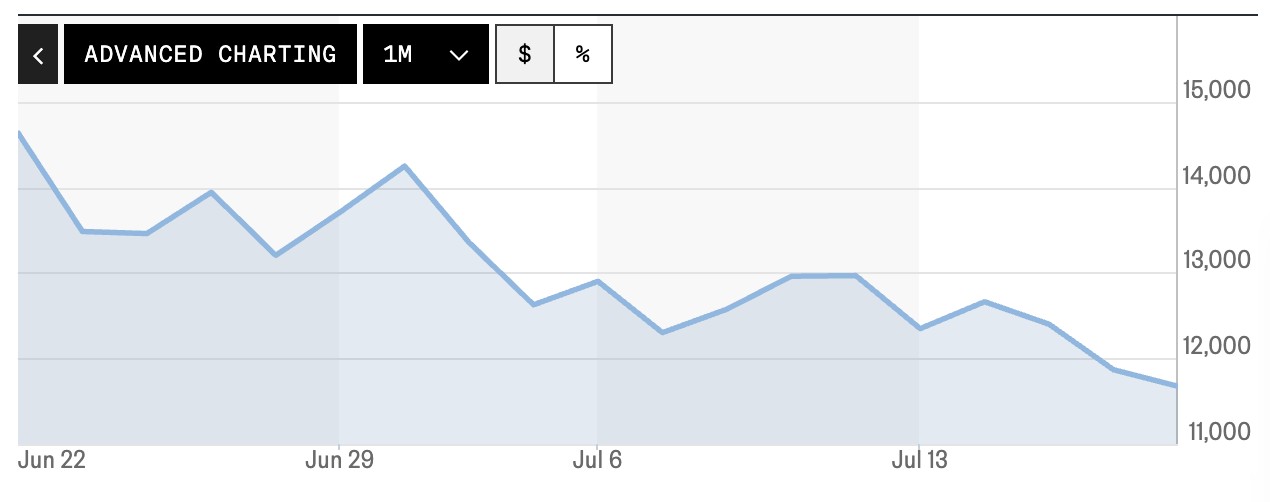
At the core of this turmoil is the large-scale unwinding by hedge funds and mutual funds of the year's most popular pair trade: "long semiconductors, short hyperscale cloud computing providers." As market direction reversed, the inherent vulnerabilities of momentum strategies were exposed in concentration, with the stocks that had previously gained the most becoming the hardest hit by the selling.
Momentum Strategies Unravel in Concentration, Three-Week "Shakeout" Continues
The main driver of this decline was not a sudden change in fundamentals, but the systematic unwinding of momentum trades.
Mueller-Glissmann stated that a popular trade among hedge funds and mutual funds this year was going long on semiconductor stocks while shorting so-called "hyperscale" cloud computing providers. "The narrative around semiconductors was widely accepted... For quick-money traders and mutual funds, this may now be a painful trade."
Bloomberg's index tracking momentum strategy performance has fallen 13% cumulatively since the overall tech stock rally peaked in June, and is poised to record one of its worst monthly performances since the index's inception in 2007—ironically, just this June, the index recorded its best single-month performance ever.
Momentum trading is widely sought after by hedge funds, based on the logic of betting that strong stocks will continue their upward trend. However, once market direction reverses, these strategies face the risk of concentrated stampedes.
Strong Earnings Fail to Boost Confidence; Capital Expenditure Expectations Spark Concerns
Notably, this week's sell-off occurred after both ASML and Taiwan Semiconductor (TSMC) reported strong earnings, indicating that market sentiment has moved beyond fundamental logic.
Michael Zigmont, Co-Head of Trading at Visdom Investment Group, pointed out that the market was "unsettled" by Taiwan Semiconductor's indication that capital expenditures would increase over the next few years, sparking investor concerns about industry overinvestment. "The lesson is that even with impressive results and optimistic prospects, investors may still be dissatisfied with the status quo... Investors may simply be looking for an excuse to sell certain stocks." Taiwan Semiconductor fell 7% in a single day on Friday.
Max Kettner, Chief Multi-Asset Strategist at HSBC, warned that if chip companies fail to deliver on high profit expectations, the "painful unwinding" of momentum trades could continue. "Profit growth expectations for semiconductor stocks remain extremely aggressive, whereas the situation for the 'Magnificent Seven' is quite the opposite."
Sell-Off Spreads Globally, Asian Tech Stocks Bear the Brunt
This round of selling has crossed geographical boundaries, with Asian tech stocks suffering particularly severe impacts.
Japan's Nikkei 225, heavily weighted with tech stocks, plunged 4% on Friday. Japanese chipmaker Kioxia plummeted more than 16% in a single day, having already halved from its June highs. Hao Hong, Chief Investment Officer at Lotus Asset Management, attributed the sharp decline in Asian tech stocks to selling by quantitative funds, characterizing it as a "momentum crash."
In the domestic market, AI startups Z.ai and MiniMax plunged 28.5% and 15.6% respectively, triggered by competitor Moonshot AI releasing a large language model with capabilities approaching those of top U.S. labs like Anthropic.
In Europe, the Stoxx Europe 600 Index fell 0.3%, and ASML, the world's largest chip manufacturing equipment supplier, dropped nearly 4%. Elon Musk's SpaceX fell 5%, with its share price dropping below last month's IPO issue price.
At the individual stock level, memory chip manufacturers faced the most concentrated impact. Memory chip companies such as Micron and SanDisk were identified as the most significant decliners in this "reversal of momentum trades," as these high-beta varieties had previously attracted a large influx of trend-following capital.
