


AI super cycle ignites capacity war: TSMC increases investment by $100 billion in Arizona, pouring $265 billion into the U.S. AI chip landscape
Taiwan Semiconductor announced an additional investment of $100 billion in its Arizona factory, bringing the total investment to $265 billion to address the surge in AI-driven structural demand. The company raised its full-year capital expenditure forecast to $60-64 billion, accelerating the ramp-up of advanced process capacity and the construction of the U.S. semiconductor ecosystem
According to Zhitong Finance APP, TSMC (TSM.US) Chief Financial Officer Huang Renxiao stated in an interview that as the "super trend of multi-year demand" continues to emerge, the company is fully accelerating the ramp-up of its Arizona factory's capacity.
In response to the sustained structural demand surge in the field of artificial intelligence, TSMC is significantly expanding its investment footprint in the U.S., committing an additional $100 billion to aggressively expand its chip manufacturing layout in the United States.
This new commitment raises TSMC's total investment in Arizona to $265 billion, highlighting the massive capacity construction driven by AI, and prompting the company to raise its full-year capital expenditure expectations to a range of $60 billion to $64 billion.
Huang Renxiao stated that this new investment is driven by strong customer demand in the U.S. market and robust government support. "We are witnessing this strong, structural multi-year demand, and we do not intend to let any opportunities slip away," he said. "As long as this super trend holds, we can continue to create profitable growth for our shareholders."
Surge in Demand
To meet the surging customer demand, TSMC is actively optimizing its advanced process capacity, including rapidly converting 5-nanometer capacity to the more advanced 3-nanometer node to support customers, Huang Renxiao said.
Regarding TSMC's expansion plans in the U.S., Huang Renxiao revealed that the first-phase factory using 4-nanometer technology has officially begun production. "In the coming quarters, the scale will continue to grow," Huang Renxiao stated, positioning 2-nanometer technology as the latest revenue growth driver for the company after it began generating revenue in the second quarter.
Although the construction costs of U.S. fabs are four to five times higher than in Taiwan, Huang Renxiao pointed out that while the initial dilution effect will intensify as overseas operations expand, this expansion will ultimately further enhance the U.S. semiconductor ecosystem.
"This will include both front-end wafer fabs and back-end advanced packaging plants," Huang Renxiao said regarding the deployment direction of this $100 billion new investment.
After TSMC announced its earnings, the stock price rose over 1% on the same day, but fell 7% on Friday. Year-to-date, the stock has accumulated an increase of about 48%.
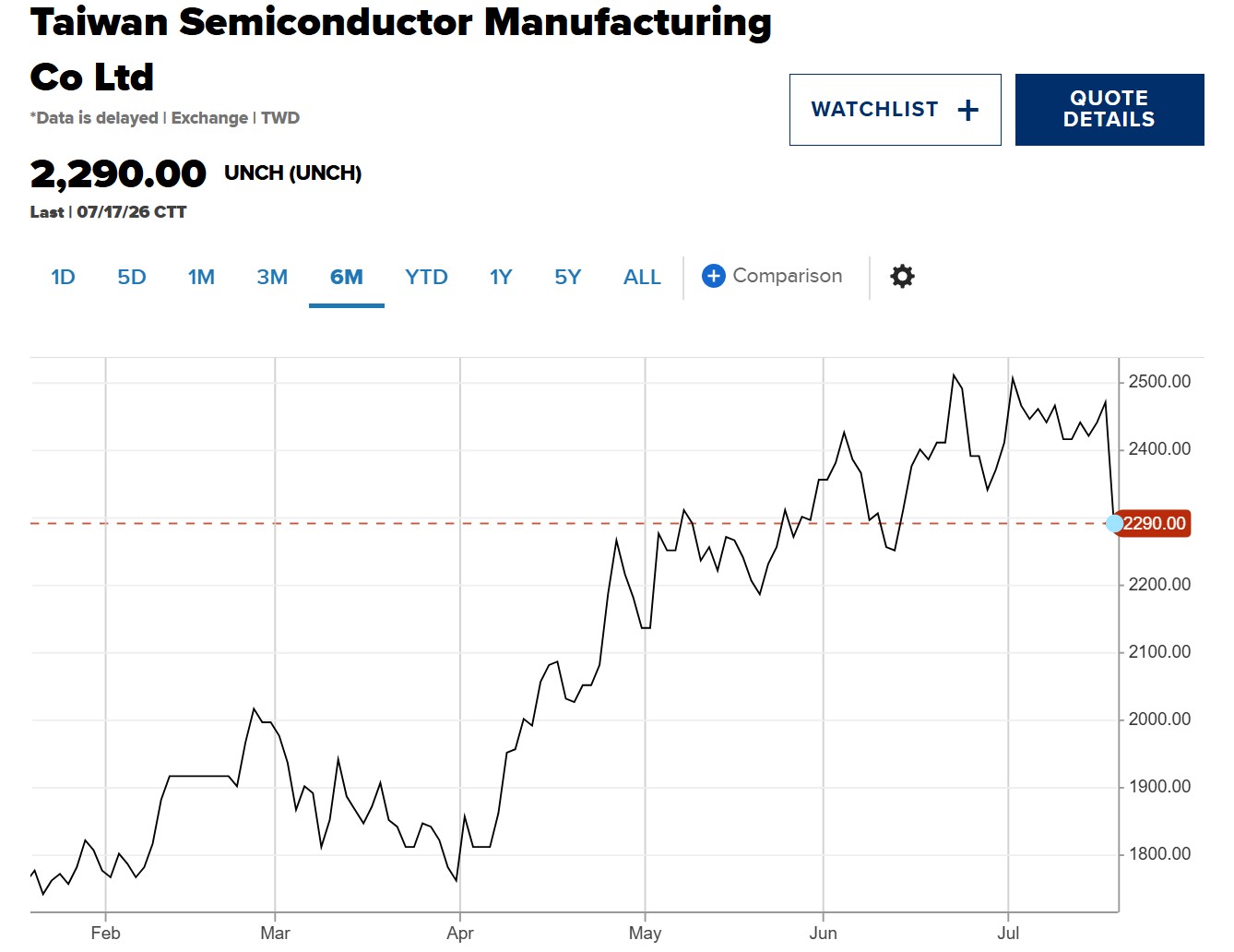
Regarding the company's stock price performance, Huang Renxiao stated that TSMC cannot control the financial market. "What we can do is to truly focus on the fundamentals of the business," he said. He added that despite the industry facing significant pressure from rising component prices, the company's focus on the high-end market has mitigated the impact.
The chip manufacturer is looking towards future growth engines. Regarding the prospects of physical artificial intelligence, he added that the recent joint venture with Sony to establish an image sensor company is one of its strategic commitments to support long-term growth for customers in specialized technology fields
