


Battery Consumption Tax May Accelerate Industry Reshuffling: CATL Shows Greater Resilience, Limited Impact on Passenger Vehicles, Higher Sensitivity in Energy Storage Returns
China's Ministry of Finance and two other departments announced that a consumption tax will be levied in stages on certain battery products starting September 2026, with a maximum rate of 4%, while new technologies such as sodium-ion and solid-state batteries are exempt. JPMorgan believes the policy eliminates uncertainty, while Goldman Sachs notes that the impact on industry leaders is manageable but poses challenges to manufacturers with weaker profitability. This tax is recorded under "Taxes and Surcharges," affecting net profit but not gross profit margin, and applies only to domestic production and sales, leaving exports unaffected
The long-awaited battery consumption tax in China has finally been implemented, potentially accelerating the reshaping of the industry landscape.
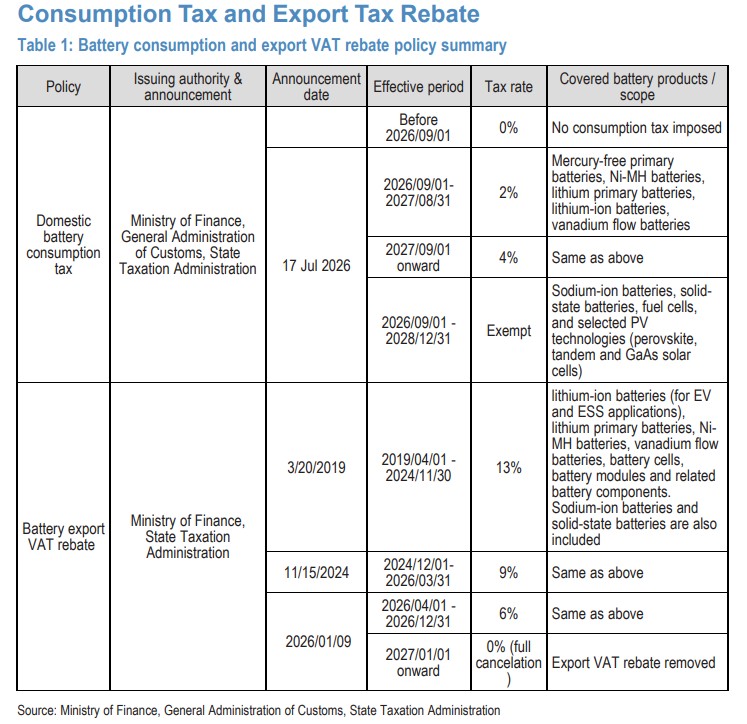
On July 17, the Chinese Ministry of Finance, the General Administration of Customs, and the State Administration of Taxation jointly issued an announcement clarifying that the consumption tax policy for certain battery products will be adjusted in stages starting September 1, 2026. From September 1, 2026, mercury-free primary batteries, metal hydride nickel storage batteries, lithium primary batteries, lithium-ion storage batteries, and all-vanadium redox flow batteries will be taxed at a rate of 2%, rising to 4% from September 1, 2027. From April 1, 2027, photovoltaic (PV) batteries will be taxed at 2%, increasing to 4% from April 1, 2028. Meanwhile, sodium-ion batteries, solid-state batteries, fuel cells, and certain PV batteries will be exempt from consumption tax within specified periods.
Rumors about this policy had circulated as early as May 2026, and now the "other shoe has finally dropped." According to Zhuifeng Trading Desk, JPMorgan pointed out in a research report on July 18 that the policy is “largely consistent with previous market expectations, eliminating uncertainty in the industry.” Goldman Sachs, in its report on July 19, characterized it as “manageable for industry leaders, but more challenging for battery manufacturers primarily focused on the domestic market with weaker profitability.”
Policy Details: Two-Step Tax Rate Implementation, Exemptions for New Technologies
According to the announcement, lithium-ion batteries will be subject to a 2% consumption tax starting September 1, 2026; the rate will rise to 4% from September 1, 2027.
Clear Exemption Scope: Sodium-ion batteries, solid-state batteries, fuel cells, and certain new PV technologies (perovskite, tandem, and gallium arsenide solar cells) will be exempt from consumption tax from September 1, 2026, to December 31, 2028.
Defined Taxation Scope: The consumption tax applies only to lithium batteries produced and sold within China. Exported batteries and those manufactured in overseas facilities are not subject to this tax.
Financial Impact: Gross Profit Margin Unaffected, Net Profit Under Direct Pressure
Consumption tax is recorded under "Taxes and Surcharges" in financial statements, below the gross profit line, and is classified as an operating expense. Therefore, it does not affect revenue or gross profit margin, but it will compress operating profit and net profit.
JPMorgan noted that this differs from the impact path of export tax rebate adjustments—changes in export rebates affect gross profit margin, whereas consumption tax does not.
JPMorgan calculated the impact on net profit for 2026 and 2027 based on each company's domestic revenue share in 2025. This calculation uses a relatively conservative scenario assumption, assuming that battery manufacturers bear the full cost of the relevant taxes without passing them on to downstream customers:

The impact in 2026 is relatively manageable, with the net profit of the aforementioned companies declining by 3%–16%, and the net profit margin dropping by approximately 0.4–0.6 percentage points. In 2027, after the tax rate rises to 4%, the pressure significantly intensifies, with the net profit decline expanding to 10%–55%, and the net profit margin falling by 1.5–2.5 percentage points.
CATL Shows Greatest Resilience: Triple Advantages Build a Moat
Both JPMorgan and Goldman Sachs identified CATL as the most resilient target. Why is CATL least affected?
First, high proportion of overseas revenue. Since the consumption tax only applies to domestic sales, and CATL's overseas sales account for over 30%, its relative domestic tax base is lower.
Second, substantial profit buffer. Goldman Sachs data shows that CATL's unit net profit in 2025 was 109 yuan/kWh, far exceeding other covered companies (which ranged from 8–41 yuan/kWh). The unit consumption tax corresponding to a 4% rate is approximately 24 yuan/kWh, giving CATL ample profit buffer space.
Third, strong bargaining power. JPMorgan pointed out that about 80% of CATL's EV battery shipments in China come from Class B vehicles and above, where customers prioritize quality, safety, and performance over simple price comparison. The company holds relative advantages in product value and business synergy.
Goldman Sachs estimates that in a 50% pass-through scenario, CATL's net profit decline from 2026 to 2028 would be only 1%–6%; even with no pass-through, the decline would be limited to 2%–13%.
In contrast, battery manufacturers primarily focused on the domestic market with limited profitability may need to better adapt to policy changes through measures such as optimizing product structure, cost management, and customer synergy.
Passenger Vehicles: Limited Impact, Low Consumer Perception
If the 4% consumption tax is fully passed on to downstream customers, what is the impact on the terminal prices of passenger vehicles?
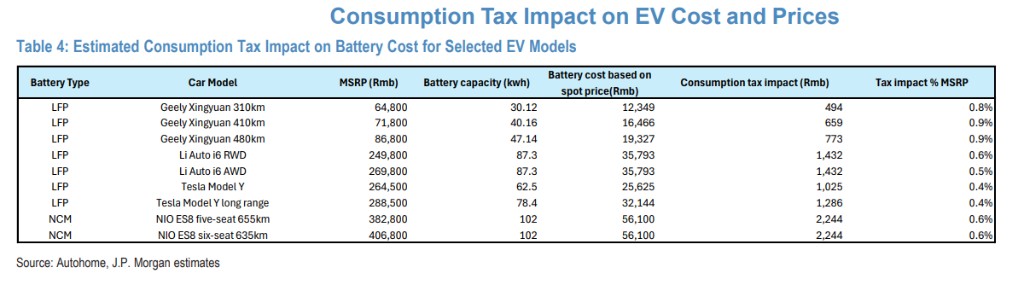
JPMorgan provided specific calculations:
- Geely Xingyuan (LFP, 310km version, guide price 64,800 yuan): Battery consumption tax impact is approximately 494 yuan, accounting for about 0.8% of MSRP
- Li Auto i6 (LFP, RWD, guide price 249,800 yuan): Impact is approximately 1,432 yuan, accounting for about 0.6% of MSRP
- Tesla Model Y (LFP, guide price 264,500 yuan): Impact is approximately 1,025 yuan, accounting for about 0.4% of MSRP
- NIO ES8 (NCM, five-seater 655km, guide price 382,800 yuan): Impact is approximately 2,244 yuan, accounting for about 0.6% of MSRP
Goldman Sachs' conclusion is more direct: “The impact on customer prices in the passenger vehicle segment is approximately 1%–2%, with economy models slightly more affected than luxury models.”
For electric heavy trucks, Goldman Sachs believes the impact is also limited. At current oil prices, short-haul electric heavy trucks earn approximately 8,000 yuan more per month than fuel-powered heavy trucks. Even if the 4% consumption tax is fully passed on (approximately 8,000 yuan/vehicle), drivers can recover the incremental cost within one month.
Energy Storage Projects: Higher Sensitivity in Returns, Some Projects May Fall Below Thresholds
Compared to passenger vehicles, energy storage (BESS) projects are more sensitive to cost changes brought by the consumption tax.
Goldman Sachs estimates that if the 4% consumption tax is fully passed on, the IRR of a 400MWh energy storage project will decrease by 0.3 percentage points. For projects already hovering near the return threshold, the importance of economic assessment will further increase.
JPMorgan's estimate is similar: in a full pass-through scenario, the IRR of energy storage projects will decrease by 0.5–1 percentage points.
This means that investment decisions for energy storage projects will place greater emphasis on lifecycle costs, revenue stability, and return levels due to the consumption tax policy.
Industry Concentration May Further Increase, Corporate Competitiveness Expected to Diverge
JPMorgan pointed out that the consumption tax, combined with previous tightening of capacity approvals and reductions in export tax rebates, forms a policy package that may drive companies to place greater emphasis on technological upgrades, cost control, and market expansion. Industry resources are expected to further concentrate in companies with advantages in technology, customer base, and globalization.
Goldman Sachs stated, “We view this policy shift as a favorable opportunity for leading companies to further consolidate their market share.”
Notably, the exemption arrangements for sodium-ion and solid-state batteries provide additional support for the early commercialization of next-generation battery technologies—a field where CATL also holds a leading position.
Goldman Sachs also warned that expectations of the consumption tax adjustment might lead to some advance purchasing before the implementation date, a short-term effect worth monitoring.
Battery Price Background: Price Increases Already Underway, Consumption Tax Impact Relatively Limited
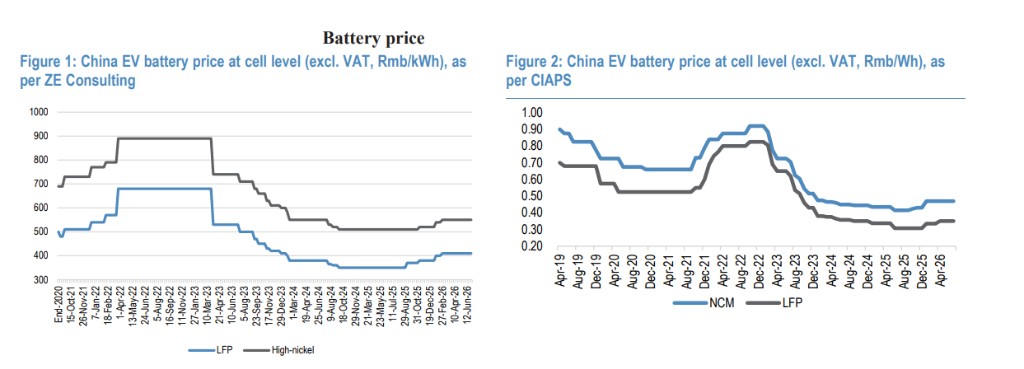
Since bottoming out in the second half of 2025, EV battery prices have cumulatively risen by approximately 9%–13% (NCM batteries up about 13%, LFP batteries up about 9%), while energy storage battery prices have risen by approximately 25% since July 2025. The drivers for this price recovery mainly include rising prices of upstream raw materials such as lithium, tightening capacity, and strong demand.
In comparison, the price change resulting from a full pass-through of the 4% consumption tax is relatively moderate against the backdrop of existing price adjustments. However, JPMorgan also noted that downstream EV customers still need to maintain a balance between market competition, demand changes, and cost management. The actual pace and magnitude of tax pass-through will depend on supply chain negotiations, product structure, and market supply and demand conditions.
The above exciting content comes from Zhuifeng Trading Desk.
For more detailed interpretations, including real-time analysis and frontline research, please join [Zhuifeng Trading Desk ▪ Annual Membership]

Risk Warning and Disclaimer
Market investments carry risks; please invest with caution. This article does not constitute personal investment advice, nor does it take into account the specific investment objectives, financial status, or needs of individual users. Users should consider whether any opinions, views, or conclusions in this article align with their specific circumstances. Investment decisions made based on this content are the sole responsibility of the investor.