


AMD officially launched the Sun God rack-mounted AI system to compete with NVIDIA, and Microsoft announced its entry into procurement
AMD officially launched its first self-developed rack-level AI system, Helios, aimed at competing with NVIDIA. Microsoft announced that it will deploy this system in Azure data centers, with Meta, OpenAI, and Oracle also as early customers. The product is set to ship within the year, providing Microsoft with diversified hardware options to support next-generation AI applications and large model inference tasks
Key Points
Helios is AMD's first self-developed rack-level AI complete solution and is AMD's most significant product to date that directly competes with NVIDIA. The equipment will be shipped and delivered within this year.
An exclusive in-depth visit to AMD's research and testing laboratory in Texas reveals all the details of this new system for the first time.
AMD launches competitive AI rack system to directly face NVIDIA, securing orders from major clients Microsoft and Meta.
After a decade of dormancy and recovery, chip giant Advanced Micro Devices (AMD) is about to deliver its first rack-level artificial intelligence complete system—Helios. The list of signed clients continues to expand, with Microsoft officially joining the procurement camp.
This product is the first serious competitor to NVIDIA's popular Grace Blackwell and Vera Rubin rack systems, marking the first time in years that the world's highest-valued chip manufacturer faces real industry competition.
On Monday, Microsoft announced its procurement plan to implement Helios hardware in its own data centers. Currently, tech companies are scrambling for computing resources, with Meta, OpenAI, and Oracle also finalizing procurement collaborations. AMD will begin bulk shipments to all clients, including Microsoft, later this year, although the specific transaction amounts and procurement scale have not been disclosed.
Microsoft CEO Satya Nadella stated in the official announcement: "We are introducing AMD Helios to expand Azure's computing infrastructure, providing the necessary performance, scalability, and diverse hardware options for customers to build and run the next generation of AI applications."
This new Helios system will support cutting-edge large model inference tasks for Microsoft and its cloud customers while empowering the entire Azure cloud AI service. Microsoft will also launch two cloud computing instances based on AMD's latest Venice CPU, one aimed at agent AI and data pipeline services, and the other serving chip design simulation scenarios.
The collaboration between the two has a long history: for many years, AMD chips have been used in the entire Microsoft Surface PC lineup and Xbox gaming consoles. In 2023, Microsoft became the first major company to implement AMD's MI300X AI acceleration GPU, which was designed to compete with NVIDIA's AI graphics cards. Additionally, Microsoft's data centers have also deployed its self-developed Maia AI chips.
Like its industry peers, Microsoft currently faces a huge gap in computing demand. On one hand, the iteration of self-developed large models is accelerating, and on the other hand, the computing quota for the R&D sector continues to increase, with the company releasing seven self-developed large models in June alone. However, the market performance of Microsoft's AI products varies significantly, with mixed reviews and commercial effectiveness for both the Office 365 intelligent assistant Copilot and the coding tool GitHub Copilot. Among the "Magnificent Seven" in the U.S. stock market, Microsoft has also been the worst-performing stock this year An increasing number of leading enterprises are beginning to use AMD products to support AI acceleration workloads. Official data from AMD shows that eight out of the top ten AI giants globally are using AMD Instinct series GPUs to run their businesses, with clients including OpenAI, Cohere, and SpaceX's AI department under Elon Musk.
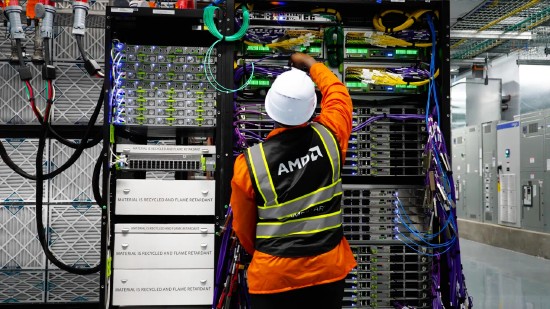 On June 24, 2026, at a data center laboratory in Rockdale, USA, AMD engineers completed the installation and debugging of the first Helios rack AI system; this product supports four customized configuration versions, and the model in the picture is the one selected by Meta, which will be deployed this year.
In February of this year, Meta announced that it would gradually launch an AMD computing power cluster with a total scale of up to 6 gigawatts, with the first phase of 1 gigawatt relying on the Helios rack. OpenAI and Oracle have also finalized plans for large-scale deployment of Helios this year, and India's leading IT company Tata Consultancy Services (TCS) has also signed a procurement contract.
Helios is named after the sun god in ancient Greek mythology who drives four divine horses across the sky. The entire machine deeply integrates AMD's four core self-developed components: GPU graphics cards, CPU processors, high-speed interconnect networks, and a complete software stack.
Forrest Norrod, head of AMD's data center division, stated in an interview: "The core goal of our first-generation rack system is to create the optimal total cost of ownership (TCO) and the industry's lowest single token full-link cost, and customer test data also confirms that we have achieved this goal."
AMD CEO Lisa Su previously revealed to Jim Cramer that Helios has significant performance advantages over NVIDIA's rack products in terms of model inference, memory bandwidth, and memory capacity.
AMD has not disclosed the official pricing for Helios, but industry research firm Futurum estimates that the price range for a single Helios system is between $5 million and $5.5 million; in contrast, the estimated price for NVIDIA's second-generation Vera Rubin rack system is only $3.5 million to $4 million. Additionally, the Helios system can weigh up to 7,000 pounds, with dimensions and weight greater than NVIDIA's competing products.
Futurum data shows that NVIDIA currently dominates over 95% of the data center GPU market share, while AMD's market share is only 4.5%, and Helios is expected to change this disparity.
Daniel Newman, CEO of Futurum Group and industry analyst, predicts: "AMD has a complete opportunity to raise its market share to 20% to 25%, which corresponds to a revenue increase potential of hundreds of billions of dollars." Microsoft's Nadella publicly criticizes Anthropic's Fable model for having issues with human editing control.
In the first quarter of 2026, the data center business has become AMD's largest source of revenue, with a year-on-year increase of 57%. AMD revealed that starting in 2027, the company's data center AI business will generate hundreds of billions of dollars in revenue, with the majority coming from the Helios system.
In the data center CPU sector, Intel still holds the leading position, but AMD's market share has been steadily increasing over the long term. The self-developed CPU advantage is AMD's core barrier that distinguishes it from NVIDIA: NVIDIA only launched its first server CPU in 2021 and has only recently adjusted its strategy to strengthen its processor business.
Official evaluation: Today's AMD has undergone a complete transformation.
Norrod showcased the core system chip to reporters while referring to Helios as "the work we have poured our heart and soul into." The entire rack contains 18 computing trays, with each tray configured with 4 Instinct acceleration GPUs, managed by a single Epyc CPU.
It is the Epyc series data center CPUs that have helped AMD regain the market voice it lost for a decade.
In 2003, AMD launched a groundbreaking data center processor, quickly capturing nearly a quarter of the market share; however, subsequent product iterations were delayed, strategic missteps followed, and the company faced massive layoffs and continuous revenue shrinkage until Dr. Su took over and halted the decline.
Norrod commented: "In the 12 years that Dr. Su has led AMD, the company has undergone a complete transformation."
In 2017, AMD officially released the first generation of Epyc server CPUs, marking a turning point in the company's performance.
"We publicly announced the complete roadmap for three generations of products at that time, which was quite rare in the industry, and we strictly adhered to the plan to deliver all products."
In the Helios product planning, the hardware is paired with the current mainstream MI400 series GPUs; a single Helios tray can house up to 12 network chips, with this technology sourced from AMD's 2022 acquisition of Pensando.
In recent years, multiple acquisitions have bolstered Helios's R&D capabilities:
In 2022, AMD spent nearly $50 billion to acquire FPGA leader Xilinx, marking AMD's largest acquisition ever;
In 2025, AMD spent nearly $5 billion to acquire server manufacturer ZT Systems;
AMD has also acquired several software companies and developed its own ROCm open-source software ecosystem to compete with NVIDIA's monopolistic CUDA software system.
Counterpoint Research analyst Neil Shah commented: The hardware performance of AMD Helios can now stand on par with NVIDIA's GPUs and CPUs, and the true killer feature of this product lies in its supporting software and deep system optimization "The CUDA ecosystem has been deeply entrenched over the years, and NVIDIA still significantly leads AMD on the software front."
The implementation of Helios creates a window for AMD to catch up, and the ultimate effectiveness will depend on the actual operational performance after large-scale deployment by major clients.
Newman raises a core industry question: "Will AMD's future market share increase rely on genuine technological advantages? Or will it simply depend on the current global demand-supply gap in computing power — as long as AMD's production capacity keeps up, will there be no worries about product sales?"
