


Undervaluing the Inflection Points of Azure and Copilot! Morgan Stanley: The Market's "16x PE" Valuation for Microsoft Is Too Low
Morgan Stanley maintains an Overweight rating on Microsoft. With a current forward PE of only about 16x, the tech giant is significantly undervalued given its expected earnings growth rate of over 20%. As supply bottlenecks in Azure ease, growth is expected to accelerate continuously. Copilot's commercialization is evolving from a single per-seat fee model to a three-engine drive comprising seat expansion, migration to E7 subscriptions, and consumption-based billing. Copilot revenue is projected to reach $22.5 billion in fiscal year 2029
Morgan Stanley believes Microsoft stands at a critical turning point in the AI monetization cycle, yet the market appears to have not fully priced in this opportunity.
According to Zhuifeng Trading Desk, on July 21, Adam Wood’s team at Morgan Stanley published a research report stating that Microsoft's Azure cloud business growth is about to enter an acceleration phase, while Copilot's commercialization path is evolving from a single per-seat fee model into a three-engine driven expansion opportunity.
The report points out that based on the current stock price, the implied PE is only about 16x. However, for a tech leader with expected earnings growth exceeding 20%, a 16x PE significantly undervalues its intrinsic value.
Although the firm recently lowered its 12- to 18-month target price for Microsoft from $650 to $600 due to concerns over margin pressure, increased capital expenditures, and rising debt, it maintains an "Overweight" rating. This still implies approximately 50% upside potential from the current stock price.
What Does "16x PE" Mean?
Simply put, a "16x PE" means the market is currently severely undervaluing Microsoft.
This figure is calculated by dividing Microsoft's current stock price of $402.29 by Morgan Stanley's forecasted earnings per share (EPS) of $23.86 for fiscal year 2028.
In US stock valuation logic, a reasonable PE should typically match the company's earnings growth rate, meaning a PEG ratio of 1.
Microsoft's forecasted growth rate for fiscal year 2028 is as high as 21.6%. Under normal circumstances, it should command a PE of at least 21x. For comparable large-cap software companies with high certainty, the market even assigns a PEG of 1.4x, effectively amplifying the 21.6% growth rate to a PE of around 30x.
In contrast, the market assigns Microsoft a forward PE of less than 17x, implying that investors are buying a high-growth giant with annual growth exceeding 20% at the cheap price typical of slow-growth companies.
Morgan Stanley believes this pricing logic contains a clear deviation. If conservatively re-evaluated using a PEG of 1.2x (lower than peers, corresponding to approximately 25x PE), multiplying the forecasted FY2028 EPS of $23.86 by a 25x PE suggests Microsoft's fair target price should be around $600.
Azure: Supply Release Opens Up Acceleration Space
Improved growth expectations for Azure are one of the most important catalysts for Morgan Stanley's bullish stance on Microsoft.
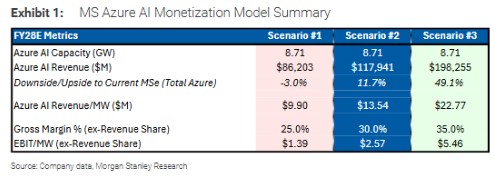
(Microsoft Azure AI Monetization Model)
Over the past year, the bottleneck for Azure growth was insufficient supply. Microsoft management has consistently emphasized that customer demand always exceeds available capacity, requiring the company to balance compute allocation between external Azure customer services, first-party applications (such as Copilot), and internal R&D.
Microsoft CFO Amy Hood disclosed during the F2Q26 earnings call that if all GPUs launched in Q1 and Q2 had been allocated entirely to Azure, the quarter's Azure growth would have exceeded 40%, rather than the reported 38% (on a constant currency basis).
As new capacity comes online, Morgan Stanley believes these supply constraints are easing, and Azure growth is poised for sustained acceleration.
Management has provided guidance indicating that Azure growth in the second half of 2026 will accelerate sequentially compared to the first half, expressing clear confidence.
Consequently, Morgan Stanley has raised its Azure revenue forecasts, expecting Azure and other cloud service revenues to reach $214.9 billion and $305.9 billion in fiscal years 2028 and 2029, respectively, which are 5% and 7.8% higher than market consensus expectations.
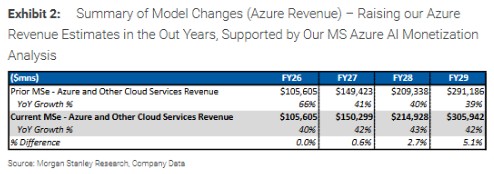 (Morgan Stanley raises Azure revenue forecasts for future years)
Analysts believe the market has underestimated the magnitude and sustainability of this Azure acceleration. Historically, once capacity is released to meet backlogged constrained demand, it often drives growth to exceed expectations and sustain for a longer period.
Copilot: From "Selling Seats" to Three-Engine ARPU Expansion
The monetization logic for Copilot is undergoing a structural shift. Morgan Stanley views this as one of the most significant ARPU (Average Revenue Per User) expansion opportunities in Microsoft's history.
Over the past year, the main discussion around Copilot focused on product-market fit and the feasibility of enterprise deployment scale. Today, the focus has shifted to commercialization paths and long-term revenue scale.
Morgan Stanley summarizes the ARPU growth driven by Copilot into three engines:
- First, direct seat expansion for M365 Copilot;
- Second, migration of enterprise customers to higher-value M365 E7 subscriptions;
- Third, monetization models based on consumption billing for AI Agents, workflow automation, etc.
The launch of the E7 SKU is a core milestone in this strategic evolution. E7 bundles E5, Copilot, and Agent365 into one package, similar to the previous upgrade wave from E3 to E5. It is expected to kick off a new multi-year enterprise software upgrade cycle, simultaneously boosting ARPU and Copilot penetration rates.
Morgan Stanley's latest CIO survey shows that currently, 47% of enterprises use E5 licenses and 7% use E7. In the coming year, the proportion expected to migrate to E5 and E7 is projected to rise to 50% and 21%, respectively.
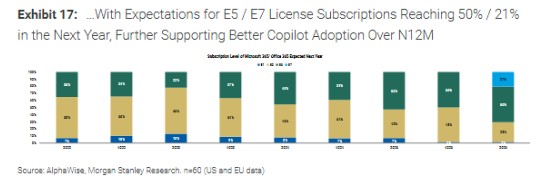 (Morgan Stanley expects subscription rates for E5 and E7 licenses to reach 50% and 21% respectively next year)
From the demand side, 88% of CIOs stated in Morgan Stanley's latest survey that they will deploy M365 Copilot in the next 12 months, a significant increase from 80% in the previous survey (Q4 2025) and 72% a year earlier.
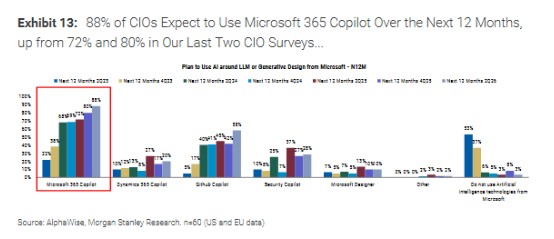
(88% of CIOs expect to use Microsoft 365 Copilot within the next 12 months)
As a result, Morgan Stanley has significantly raised its Copilot forecasts: expecting Copilot revenue to be approximately $4.4 billion in fiscal year 2026, increasing to about $22.5 billion in fiscal year 2029.
Margin Pressure, But Operating Profit Remains Sustainable for Expansion
Gross margin is one of the most common concerns regarding Microsoft, but Morgan Stanley believes this pressure is being overinterpreted.
The firm has lowered its gross margin forecasts for fiscal years 2027 to 2029 to 65.7%, 64.4%, and 63.4%, respectively. The main reasons include the increasing proportion of Azure AI and Copilot revenue, rising AI-related depreciation expenses, and the front-loaded cost effects of large-scale infrastructure construction.
However, Morgan Stanley also points out that continuous control of operating expenses is sufficient to offset gross margin pressure, keeping operating profit and EPS growth above the 20% level. Forecasted operating margins for fiscal years 2027 to 2029 are 46.5%, 46.7%, and 47.2%, respectively, showing a trend of mild expansion.
Historical precedents also support this judgment. During the peak construction period of FY14, Microsoft's cloud business gross margin once fell into negative territory. However, as capacity utilization improved, software efficiency increased, and scale effects materialized, gross margins continued to recover, rising to over 70% by FY23.
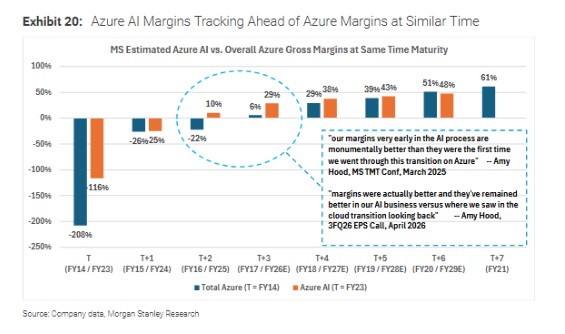
(Azure AI margin trends outperform 同期 Azure margins)
CFO Amy Hood has stated multiple times that the current gross margin level of the AI business is significantly better than the same stage during the previous cloud transition. She reiterated this during the April 2026 earnings call:
The gross margin of the AI business is better than when we went through the cloud transition, and it remains so.
