


The End of an Era: Tencent and Moutai Drop Out of Top 20, "AI Transformation" Becomes the Only Choice
By the end of Q2 2026, the top 20 heavyweight stocks held by active equity funds underwent disruptive changes. Traditional core assets such as TENCENT and Moutai exited, while hard-tech and AI computing power chain companies like Cambricon and Zhongji Innolight took dominance. The communication and electronics sector occupied 18 spots, indicating that mutual fund holdings have fully "AI-ified," reflecting a drastic shift in market style toward the technology sector
"It was the best of times, it was the worst of times, it was the spring of hope, it was the winter of despair."
Dickens' depiction in his novel 167 years ago inadvertently became the summary of fund holdings at the end of the second quarter of 2026.
According to the latest Q2 reports, active equity funds underwent disruptive portfolio changes during the quarter. Familiar faces of "core assets" from past years, such as TENCENT, Moutai, Zijin Mining, and Alibaba, all exited the top 20.
They were replaced by a batch of hard-tech companies: Cambricon, NAURA Technology, GigaDevice, Yuanjie Technology, AMEC, and Three-Circle Group.
If we include the "Three Heroes of Optical Modules"—Zhongji Innolight, Eoptolink, and Dongshan Precision—the lineup of the top ten heavyweight stocks held by mutual funds has become completely "AI-ified."
Such a disruptive portfolio inevitably reminds people of the capital markets on the other side of the Pacific. As the calendar turned to July 2026, domestic professional institutions and investors there shared a "strong resonance."
Note: Data source: Wind Terminal; statistics cover ordinary stock funds and hybrid funds.
Communication and Electronics Occupy 18 of the Top 20 Heavyweight Stocks
What kind of extreme market was Q2?
Look at the Q2 reports, and you will have the answer.
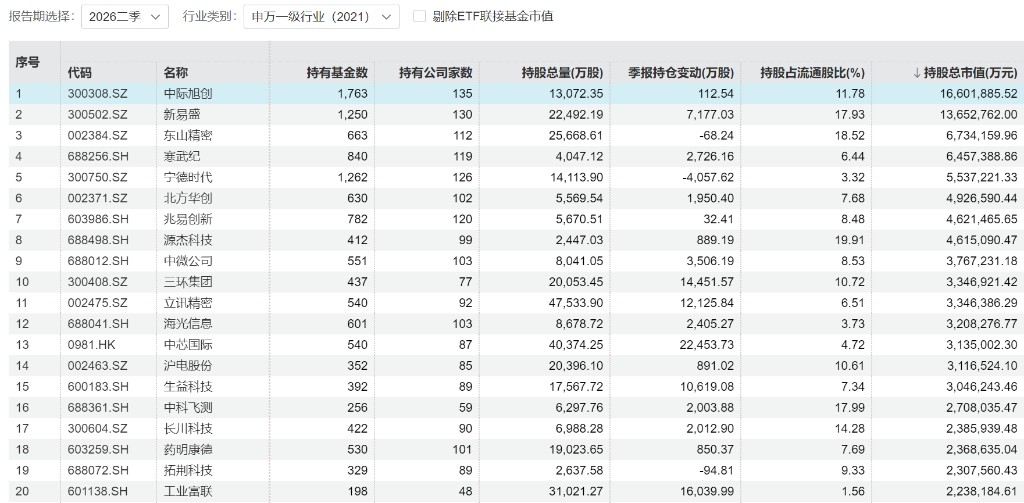
Wind statistical data shows that at the end of Q2, 18 of the top 20 heavyweight stocks held by public active equity-biased funds were from the communication and electronics industries.
"Leading optical module enterprise" Zhongji Innolight continued to rank as the number one heavyweight stock in active funds, with a holding market value of RMB 166.019 billion.
Its peer Eoptolink followed closely with RMB 136.528 billion.
After that, Dongshan Precision, which "switched to optical modules midway," ranked third, and "chip manufacturer" Cambricon ranked fifth.
Only CATL remained as the sole non-AI company among the top five heavyweight stocks.
Positions six through ten were entirely occupied by electronics stocks: NAURA Technology, GigaDevice, Yuanjie Technology, AMEC, and Three-Circle Group.
Looking at the top 20, except for WuXi AppTec at 18th place and the aforementioned CATL, all were from the communication and electronics sectors.
Half of Holdings "In TMT"
If we look through all heavyweight stocks, the heavy holding structure of active funds in Q2 showed even more pronounced concentration characteristics.
First, the AI computing power chain remains at the core of holdings. Zhongji Innolight and Eoptolink occupy the top two positions, and Yuanjie Technology entered the eighth spot, indicating that optical modules and optical chips remain one of the most concentrated directions for institutions.
Second, fund heavy holdings radiate across the entire AI industry chain. The top 20 already cover domestic AI chipmaker Cambricon, CPU/DCU manufacturers Hygon Information, foundry SMIC, semiconductor equipment enterprises NAURA Technology, AMEC, Hwatsing Technology, Changchuan Technology, and Piotech, as well as PCB and material players Wus Printed Circuit, Shengyi Technology, and Three-Circle Group.
Third, the position of traditional "core assets" has significantly shifted backward and may continue to do so. Leading companies in non-tech industries such as TENCENT, Moutai, Zijin Mining, and Alibaba-W have all exited the top ten of their respective industries. WuXi AppTec dropped from 9th to 18th. Although CATL remains in the top five, both its holding market value and share volume decreased.
Fourth, concentration in heavyweight industries has significantly increased. At the end of Q2, the combined market value share of heavyweight stocks in the electronics and communication industries reached 58.34% of all heavyweight stocks, an increase of 26.8 percentage points from the end of Q1. Active fund portfolios are also showing markedly increased sensitivity to the prosperity of the AI industry, the performance realization of related companies, and valuation fluctuations.
AI Propels Traditional Enterprise Rankings Up by 126 Spots
Among the top 20 heavyweight stocks in Q2, the fastest riser was Three-Circle Group. As a veteran electronic ceramics enterprise, the company's products gained new market demand amidst the AI boom, earning recognition from fund managers.
In Q2, active funds increased their holdings in the company by 145 million shares, raising the holding market value from less than RMB 3 billion to RMB 33.5 billion; ranked by total holding market value, it surged from 136th place at the end of Q1 to 10th place, a jump of 126 spots.
Another veteran electronics enterprise, Shengyi Technology, had a similar trajectory to Three-Circle Group. Its mainstay product, copper-clad laminates, is a core base material for PCB boards, which are important supporting materials for optical modules. Ultimately, they all became assets "in the light."
In Q2, active funds increased their holdings in Shengyi Technology by 106 million shares, with the holding market value rising from less than RMB 3.8 billion to nearly RMB 30.5 billion, moving from 100th place to 15th.
Besides these two electronics stocks that almost saw their positions "skyrocket," other electronics stocks were not far behind: Changchuan Technology rose from 54th to 17th, Hwatsing Technology from 48th to 16th, SMIC H-shares from 34th to 13th, and Cambricon from 24th to 4th.
From an industrial distribution perspective, these rising stocks are concentrated in areas such as electronic ceramics, copper-clad laminates, wafer foundries, semiconductor inspection and testing equipment, and domestic AI chips. This indicates that the focus of fund allocation has extended from optical modules in the mid-stream of the computing power chain further toward chip manufacturing, equipment, materials, and components.
Top of the Increase List Focuses on AI Hardware
Ranked by the quarter-over-quarter increase in total holding market value at the end of the quarter, Zhongji Innolight, Eoptolink, Cambricon, Dongshan Precision, and NAURA Technology were the top five additions by active funds in Q2.
Among the top 20 increases, there were 17 electronics stocks and 2 communication stocks, with only China Jushi coming from the building materials industry.
But don't forget, Jushi is a producer of electronic cloth, which plays an important role in PCB circuits. After all this, it is still part of the "All-AI Family."
If we look through the top 20 heavyweight stocks added by active funds, the businesses mainly revolve around three AI sub-industry chains.
The first is the global AI computing infrastructure chain, including Zhongji Innolight, Eoptolink, Yuanjie Technology, Wus Printed Circuit, etc. Market attention has gradually extended from optical modules to optical chips, PCBs, servers, and precision manufacturing.
The second is the domestic semiconductor industry chain, including Cambricon, Hygon Information, GigaDevice, SMIC, Huahong Grace, as well as NAURA Technology, AMEC, Hwatsing Technology, Changchuan Technology, etc. Allocation now covers multiple links from chip design and wafer manufacturing to equipment, inspection, and testing.
The third is the computing power basic components chain. For example, China Jushi from the building materials industry. This reflects that some capital is beginning to spill over into the materials segment and cyclical varieties.
Internet, Baijiu, and Energy Resources Collectively "Step Aside"
Compared to the list of market value increases, the characteristics of the reduction list are clearer: star companies from non-AI industries are crowded shoulder-to-shoulder on this list.
TENCENT ranked first with a decrease in holding market value of over RMB 18.7 billion, followed by CATL, Moutai, Alibaba-W, and Zijin Mining.
Internet, baijiu, new energy, energy, and non-ferrous metal leaders, which once occupied the core positions of active fund heavy holdings, generally saw significant contraction in holdings.
Moreover, for the 20 individual stocks with the most significant decreases in holding market value, the corresponding shareholdings by active funds all declined in Q2. This indicates that the decrease in holding market value was not just due to stock price changes but was generally accompanied by actual reductions in fund positions.
Among the top 20 reductions, Moutai, Wuliangye, Shanxi Fenjiu, and Luzhou Laojiao all faced selling pressure; baijiu no longer serves as the "ballast stone." In the internet sector, the heavyweight rankings of TENCENT and Alibaba-W also slid significantly. In the new energy sector, CATL, BYD, and Salt Lake Industry all saw reductions.
Notably, resource stocks such as Zijin Mining, Chifeng Gold, Zhongjin Gold, and CNOOC also appeared among the top reductions. This means that the portfolio adjustments in Q2 were not just a switch from consumption to growth, but also included realizing profits from previously strong-performing sectors like energy and precious metals to make room for technology directions.
Indeed, technology is "drawing blood" from everything.
Although it is impossible to predict when such an extreme market trend will end, it clearly will not last forever.
In the long run, the market's internal adjustment mechanisms and the national economy's internal equilibrium mechanisms will come into play, moderately balancing investment opportunities.
In the long term, technology can continue to shine, but other industries should not fall into "complete silence."
Risk Warning and Disclaimer
The market carries risks; invest with caution. This article does not constitute personal investment advice, nor does it consider the specific investment goals, financial status, or needs of individual users. Users should consider whether any opinions, views, or conclusions in this article align with their specific circumstances. Investors bear full responsibility for actions taken based on this information.
