The Worst Day of the "Tariff War"! US Tech Giants "Mag 7" Lose Nearly $800 Billion in Market Cap in a Single Day
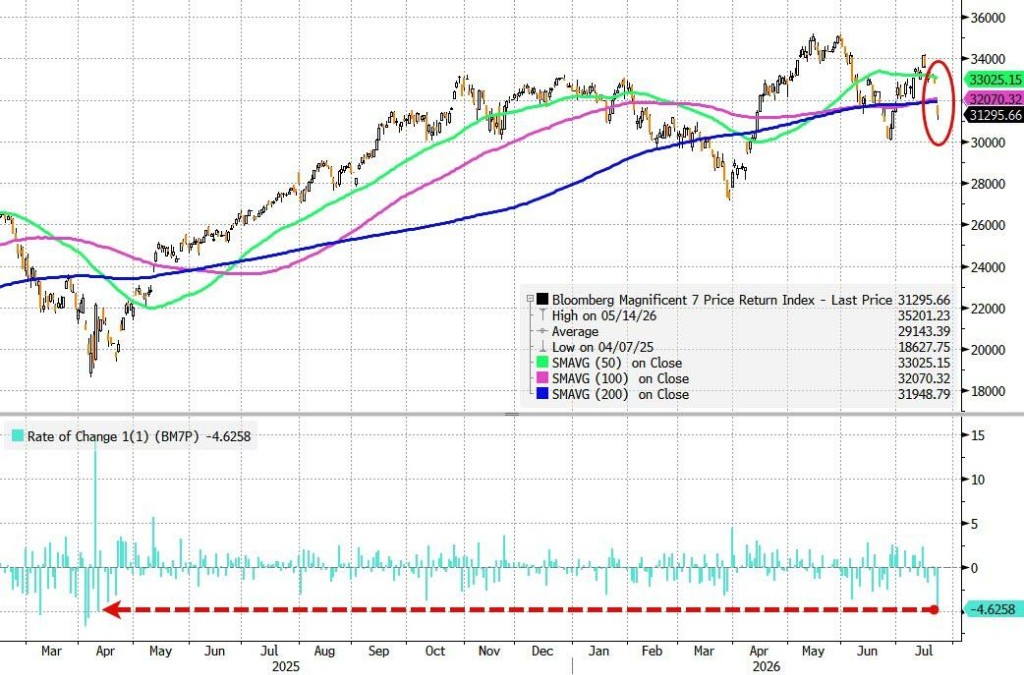
The US Mag 7 stocks lost $797 billion in market cap in a single day, dropping nearly 5%, marking the largest single-day decline since the "Tariff Storm" of April 2025. Alphabet's free cash flow turned negative for the first time, compounded by Tesla's significant profit miss, sparking doubts about the AI narrative. Meanwhile, tensions between the US and Iran pushed oil prices above $100, and the probability of a Fed rate hike in July surged to 38%. The dual pressure of macroeconomic and microeconomic factors subjected tech stocks to a perfect storm
Alphabet's capital expenditures spiraled out of control, Tesla's profits missed expectations drastically, and Middle East conflicts drove up oil prices, causing the Mag 7 to lose nearly $800 billion in market cap in a single day.
On Thursday, July 23, the combined market capitalization of the US "Magnificent 7" (Mag 7) tech giants evaporated by $797 billion in a single day. The Mag 7 index fell 4.8%, marking its largest single-day drop since the "Tariff Storm" in April 2025. The S&P 500 Index declined by 1.2%, and the Nasdaq 100 Index dropped by 1.9%.
Trigger: Alphabet's Free Cash Flow Turns Negative for the First Time, Tesla's Profits Miss Significantly
The direct trigger for this plunge was the earnings reports released by Alphabet and Tesla after hours on July 23.
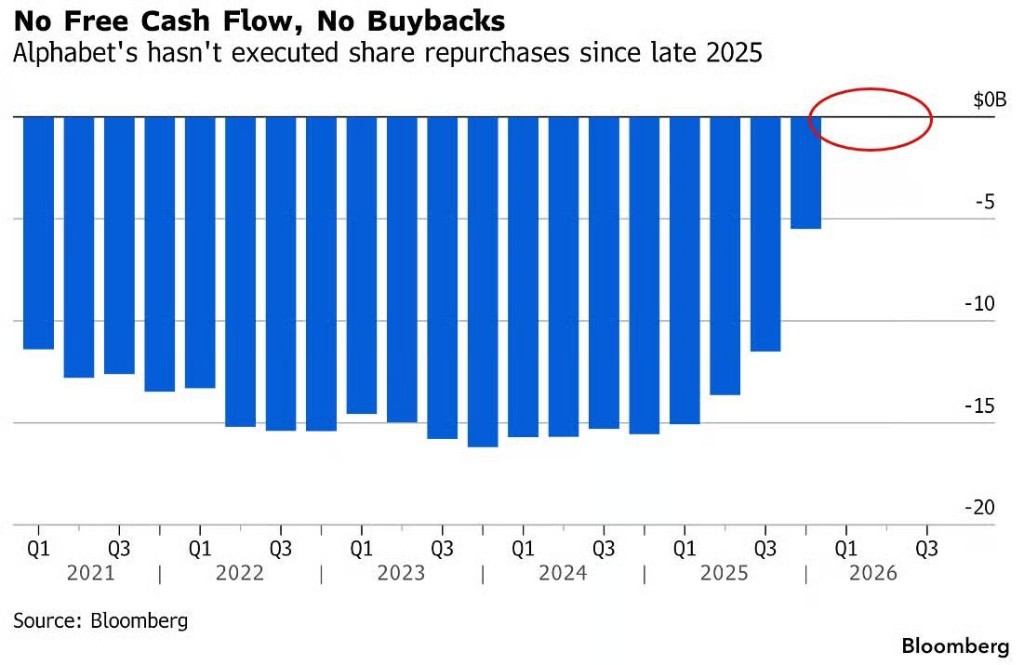
Alphabet: Cloud computing business growth was strong in the second quarter, with net profit beating expectations by 216%. However, the capital expenditure figures made investors gasp—single-quarter capex reached $45 billion, raising the full-year upper limit to $205 billion. More critically, this spending directly pushed Alphabet's free cash flow into negative territory for the first time since its listing.
Jason Lemire, Chief Investment Officer at Bold Wealth Partners, stated, "This indicates that the risk associated with this stock is now much greater than when it was previously regarded as a cash-generating machine."
Notably, Alphabet's negative cash flow occurred against the backdrop of operating cash flow also falling short of expectations. Even with net profit significantly exceeding expectations, it failed to "plug the hole" created by capital expenditures. Additionally, Alphabet reported $10 billion in inventory, reflecting the deep transformation of this former search and advertising company.
Tesla: Revenue exceeded expectations, but profit margins and earnings per share fell significantly short of analyst forecasts. CEO Elon Musk told investors that Tesla should "spend capital expenditures as quickly as possible—as fast as possible without excessive waste," and stated that 2026 would be a "year of massive capital expenditure."
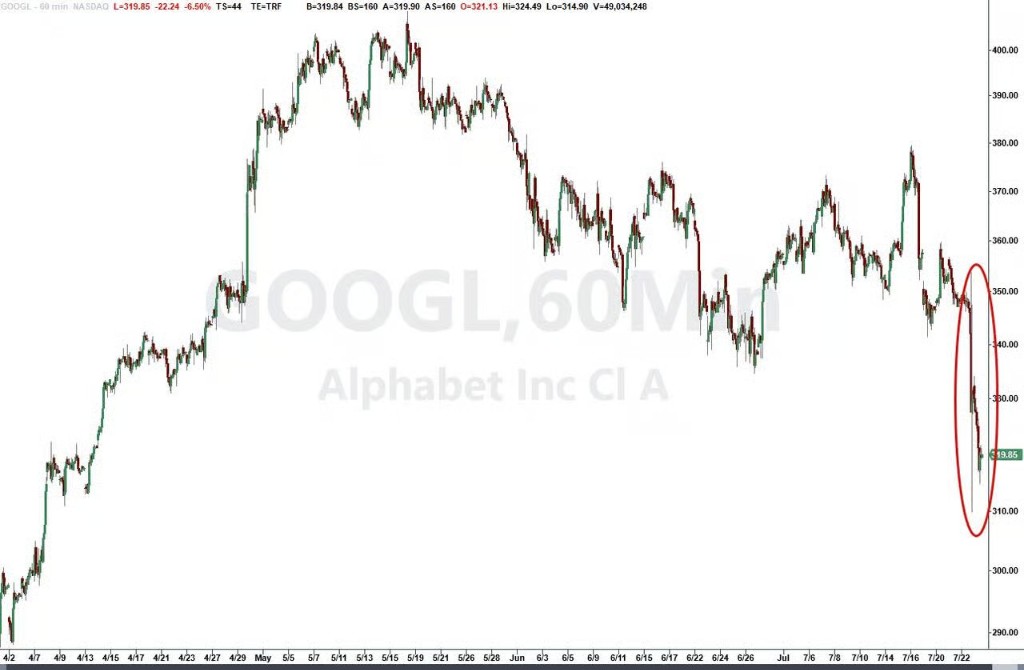
As a result, Tesla's stock price plummeted 15% in a single day, its largest single-day drop since March 2025; Alphabet fell 7.1%, its largest single-day drop since May 2025.
All Seven Giants Decline, Apple Becomes the "Exception"
All seven member stocks of the Mag 7 declined, but the magnitudes varied:
- Tesla: -15%
- Alphabet: -7.1%
- Amazon: -4.6%
- Meta: -3.4%
- Microsoft: -2.2%
- Apple: Smallest decline
Apple was the "exception" in this downturn. The company largely stayed out of the AI arms race and did not follow the trend of massive capital expenditures. Investors have recently rewarded this "restraint"—Apple's stock price has risen 11% this month and is up 18% year-to-date.
Microsoft, Amazon, and Meta are scheduled to release their earnings reports next week, and the market is already on alert for similar investor reactions.
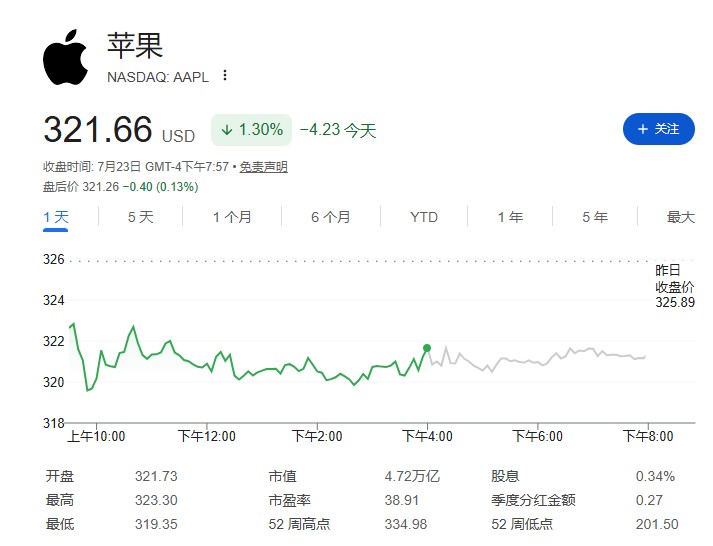
Chip stocks were relatively resilient on the day, with the Philadelphia Semiconductor Index dropping only 0.5%, still accumulating a gain of over 70% year-to-date.
BTIG analyst Jonathan Krinsky named the current situation "Hypershrinkers." He pointed out that in historical data of previous Mag 7 plunges, if the Mag 7 single-day drop reached -3% or deeper, the Philadelphia Semiconductor Index never recorded positive returns—but this time, the semiconductor index remained largely unchanged.
How long this divergence can last remains to be seen.
Narrative Reversal: AI Money Burned, Where Are the Returns?
Behind this sell-off lies an increasingly sharp question: Was the money spent worth it?
Ken Mahoney, CEO of Mahoney Asset Management, said, "The real issue is the scale of spending currently underway. No one knows what the return on investment is."
He added that the macroeconomic background, including rising oil prices due to the escalation of the Iran conflict, is further increasing pressure on these stocks. "It is a perfect storm."
For more than three years, Wall Street almost unconditionally applauded heavy investments in AI, with stock prices soaring every time a new capital expenditure plan was announced. But now, this logic has reversed—if huge investments cannot translate into larger-scale concrete returns, stock prices will be punished.
Lemire said, "These companies once possessed the healthiest balance sheets in US corporate history; now they have become asset-heavy companies, and return on investment has become an issue. This is a major shift in how investors view them—and this doesn't even account for the lack of transparency regarding their debt obligations in the coming years."
From a data perspective, the Mag 7 index has cumulatively fallen 11% from its late-May highs, wiping out $2 trillion in market value.

Macro Pressure: Oil Prices and Rate Hike Expectations Both Rise
The market also faced macroeconomic shocks on the same day.
Iran-backed Houthi forces claimed to have attacked two Saudi oil tankers in the Red Sea, pushing Brent crude oil prices above $100 per barrel for the first time in two months. Meanwhile, tensions between the US and Iran continued to escalate—the US Central Command stated it had conducted strikes on Iran for the 12th consecutive night, and Trump threatened on social media that if the Houthis continued to attack ships, there would be "significant military punishment" against Iran.
Bob McNally, President of Rapidan Energy Group, stated, "The scope of the second round of military conflict will be wider than the first, posing significant risks to shipping and energy infrastructure."
The oil price shock directly transmitted to inflation expectations. The market probability of a rate hike at the Fed's FOMC meeting next week has risen to about 38%, the 2-year US Treasury yield rose by 6 basis points in a single day, and the 30-year real interest rate approached 3%, the highest level since 2008.
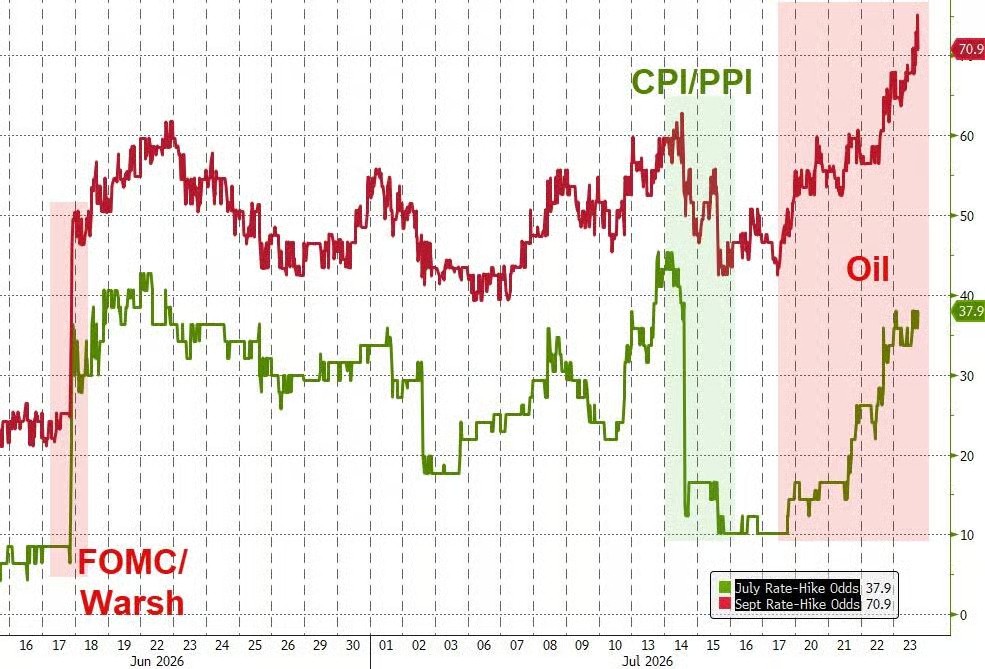
Mahoney summarized, "The macroeconomic background, including the escalation of the Iran conflict driving up oil prices, is exerting additional pressure on these stocks."
Rob Haworth, Senior Director of Investment Strategy at US Bank Wealth Management, added, "If oil prices remain in the $90 to $120 range by late summer, that is when we might see a greater impact on consumer spending, as wage growth simply cannot keep up."
Market Structure Under Pressure, Volatility May Further Amplify
From a market structure perspective, the impact of this decline may go further.
The S&P 500 Index has fallen below its 50-day moving average (7,462 points), and the Nasdaq also closed below its 50-day moving average. According to SpotGamma analysis, the S&P 500 has broken through the key risk hub at 7,480. Current mild positive Gamma support may buffer the initial decline, but if put option buying intensifies, dealers may move into a negative Gamma zone, opening a channel down to 7,300 points.
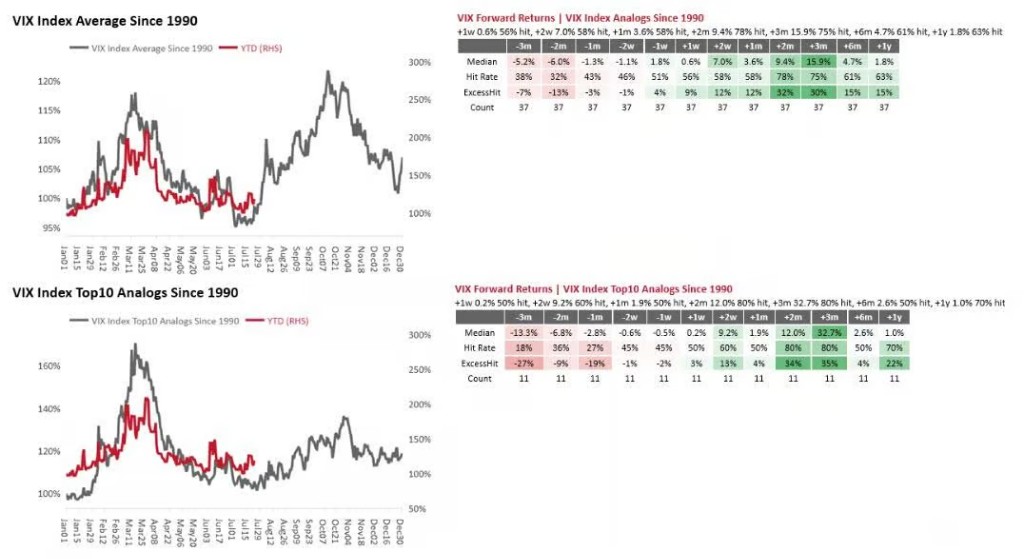
Charlie McElligott of Nomura Securities warned that CTAs (trend-following funds) are undergoing real deleveraging, and the trigger point for "turning short" is imminent. He also pointed out that VIX seasonal patterns are about to "take off" in August, a month characterized by scarce liquidity and low risk tolerance.
Bitcoin was not spared either, falling below $65,000, despite ETF inflows exceeding $1 billion this week. Gold came under downward pressure due to the strengthening US dollar.
Goldman Sachs' trading desk listed several psychological levels to watch closely: the S&P 500's 50-day moving average (7,462 points), the 10-year US Treasury yield at 4.7%, WTI crude oil at $90, and the VIX at the 20 level.