


Reaping the AI dividends, Intel delivers its strongest quarterly report in fifteen years
Intel released its Q2 2026 financial report, with revenue of $16.1 billion, a year-on-year increase of 25%, marking the highest growth rate in fifteen years; Non-GAAP net profit was $2.2 billion, achieving profitability for four consecutive quarters. The AI dividend has driven a surge in CPU demand, and the company has raised its full-year capital expenditure to $20 billion to expand capacity, but structural pressures still remain
Intel encounters a period of significant transformation coinciding with an era of dividends, with its CPU business expected to be on an upward path in the short term, although structural pressures remain.
On July 23 local time, American chip company Intel released its Q2 2026 financial report. The data shows that Intel's total revenue for Q2 was $16.1 billion, a year-on-year increase of 25%, significantly exceeding the company's previous guidance range of $14.3 billion to $14.4 billion, and marking the highest year-on-year growth rate in quarterly revenue for the company in fifteen years.
The revenue recovery is accompanied by improved profitability: Under Non-GAAP standards, Intel's net profit attributable to shareholders for Q2 2026 was $2.2 billion, with diluted earnings per share of $0.42; in the same period last year, the Non-GAAP net loss was $400 million, with a loss per share of $0.10. Since turning a profit in Non-GAAP terms in Q3 2025, Intel has achieved adjusted profitability for four consecutive quarters, with quarterly profits and earnings per share continuing to rise, and the scale of profitability expanding.
Artificial Intelligence (AI) is the core theme supporting Intel's high growth in this performance cycle. With the large-scale implementation of intelligent applications, the hardware demand structure for AI computing clusters has changed significantly: the market is no longer solely reliant on GPUs (AI chips), and the demand for CPU (general computing chips) computing power has also surged, leading to tight supply and demand for high-end server CPUs and a continuous increase in product average prices, directly driving significant revenue growth for related products.
During the earnings call, Intel's CEO Pat Gelsinger stated that CPU supply shortages will continue to exist in the foreseeable future.
Intel's Chief Financial Officer David Zinsner indicated that to meet the growth demands for computing products and foundry services this year and in the coming year, the company is significantly increasing investments in key capacity elements such as equipment, cleanroom space, and packaging substrates.
The company announced that it is raising its full-year capital expenditure plan for 2026 from $18 billion to $20 billion.
Even with Q2 results significantly exceeding expectations, Intel's fundamentals still harbor concerns: ongoing losses in foundry services, capital expenditures squeezing cash flow, and other structural pressures remain, and the transformation process is still constrained by multiple factors.
 Table
Table
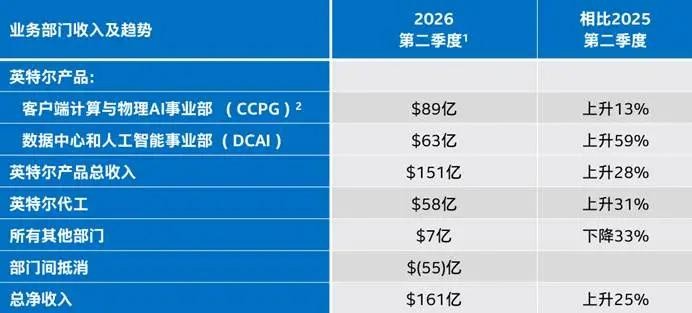
1: Revenue of Intel's various business segments
 Data Center AI Business Soars
Intel's business mainly consists of three major segments: Client Computing and Physical AI Division (CCPG, primarily producing CPUs for PCs and other smart terminal devices); Data Center and AI Division (DCAI, mainly producing CPUs for data center servers), and Foundry Services (Intel Foundry business).
In this quarter, all three major segments of Intel achieved double-digit year-on-year revenue growth. The Data Center and AI Division reported quarterly revenue of $6.3 billion, a year-on-year increase of 59%; the Client Computing and Physical AI Division generated revenue of $8.9 billion, a year-on-year increase of 13%. The Foundry Services segment had a total revenue of $5.8 billion (including internal supply), a year-on-year increase of 31%. Due to the internal supply included in the foundry segment, the combined revenue of the segments exceeds the total revenue of the group ($16.1 billion) after consolidation.
The Data Center and AI Division led the three business segments with a year-on-year growth rate of 59%. This strong growth is attributed to the redefinition of CPU value by AI agents.
In early January 2026, a survey report released by Wall Street investment firm KeyBanc indicated that Intel and AMD's server CPU capacity for 2026 is essentially sold out. To address the extreme supply-demand imbalance, both giants are considering raising CPU prices.
KeyBanc pointed out at that time that the shortage is due to large-scale cloud providers like Meta, Google, and Microsoft not only competing for storage chips but also hoarding server CPUs to cope with the explosion of AI agents.
The specific reason is that AI agents need to possess "reflection" and "multi-step planning" capabilities. In the AI agent environment, not only do GPUs handle model calculations, but CPUs are also needed to manage complex task orchestration, tool invocation, and logical judgment.
In mid-May, during JP Morgan's 54th Global Technology, Media, and Telecommunications Conference, Chen Liwu publicly stated that he learned from customer feedback that the configuration ratio of CPUs to GPUs in AI infrastructure is shifting from 1:8 to 1:1, and could even reach 4:1.
This trend is driving server CPUs into a price increase cycle. Intel raised the official guidance prices for server CPUs in two rounds in March and July, while another CPU chip giant, AMD, followed suit with price adjustments across the board in April; the average increase for general server CPUs from manufacturers is 10%-15%, while high-end AI models can see price increases of 10%-20%. According to sources from chip traders in Huaqiangbei, some CPUs have seen a cumulative price increase of over 40% so far.
An executive from a well-known domestic computing power service provider told Caijing that since the beginning of the year, although most categories of data center CPUs have significantly increased in price, there has not been a noticeable shortage.
As a core supplier of global server CPUs, Intel has not only reaped substantial revenue and profit increases but has also seen its stock price undergo a rare deep V-shaped reversal in the US semiconductor sector over the past 12 months.
In August 2025, Intel hit a nearly one-year low stock price of $18.97, at which time the market was generally concerned about the company's lagging advanced process iterations, continued large losses in the foundry business, and sluggish growth in its PC main business, with the stock price lingering below $20 for a long time However, as AI agents reconstruct computing power architecture, the market has re-recognized the core value of general-purpose CPUs in AI clusters, and Intel's valuation continues to recover. As of June 30, 2026, Intel's stock price reached a peak of $142.35 during trading; based on the lowest and highest intraday prices in the past year, the 52-week range saw an increase of approximately 650%. From the beginning of 2026 to the end of June, the stock's cumulative increase for the year reached 278.4%, while the S&P 500 index rose by 9.55% and the Philadelphia Semiconductor Index (SOX) increased by 101.1%. Intel's increase significantly outperformed the two major indices, making it one of the top-performing semiconductor technology blue chips in the U.S. stock market in the first half of 2026.
Entering July, profit-taking funds concentrated on cashing out, leading to a deep correction in Intel's stock price. In the week before the earnings report was disclosed, the stock fell continuously from its year-to-date high, with a maximum monthly drawdown exceeding 26%.
On July 23, local time, the overall U.S. stock market faced downward pressure, with all three major indices collectively declining. The Nasdaq index fell by over 2%, and large technology stocks experienced a collective sell-off: Tesla dropped by over 14%, Google A fell by over 7%, and Amazon and Meta declined by over 4% and 3%, respectively. On that day, the combined market value of the "Tech Seven Giants" in the U.S. stock market evaporated by approximately $800 billion, marking the worst single-day performance since April 2025.
In the context of a broad decline in technology stocks across the market, Intel became a rare highlight of the day. During regular trading hours, the stock followed the market down, falling by 2.33%, but after releasing better-than-expected second-quarter earnings post-market, the stock price surged, rising by about 3.5%.

Foundry business remains under pressure
The wafer foundry is the core business that the market uses to evaluate Intel's transformation and has always attracted industry attention.
The chip industry chain is divided into three main segments: design, manufacturing, and packaging/testing. Most chip companies, such as Nvidia, AMD, Huawei, and Cambricon, adopt a Fabless model, focusing solely on chip design while outsourcing the production process to specialized wafer foundries, with TSMC and SMIC being such manufacturers. Intel has long been a benchmark for the IDM vertical integration model, with its own wafer fabs covering the entire process of chip design and manufacturing; it wasn't until 2021 that the company officially opened its wafer foundry business to external clients.
The layout of the foundry was a core strategy set by former CEO Pat Gelsinger, who publicly stated that Intel aimed to surpass Samsung by 2030 and become the second-largest wafer foundry in the world, only behind TSMC. After Chen Lifeng took over, he also clearly stated that he would fully promote breakthroughs in the foundry business.
From a short-term performance perspective, the foundry business has shown growth momentum: in the second quarter, Intel's wafer foundry segment achieved revenue of $5.8 billion, a year-on-year increase of 31%.
It should be noted that this revenue includes foundry settlements for internal product departments and orders from external third-party clients. The earnings report shows that the foundry revenue from external clients in this quarter was only $293 million, with over 95% of the segment's revenue coming from supplying Intel's own product lines, indicating that the external commercialization scale is still in its early stages Despite the relatively small external revenue scale, the business has made two significant advancements.
First, the progress of the advanced process 18A is in line with expectations, which is the core support for the long-term competitiveness of the foundry business.
18A is the code for Intel's 1.8-nanometer advanced process, regarded as a "do-or-die" battle for its manufacturing business. Only by achieving stable mass production can Intel take on high-end external advanced foundry orders.
The basic version of 18A has entered mass production: In May of this year, Chen Liwu disclosed that using ASML's high numerical aperture extreme ultraviolet lithography machine, some models of the Panther Lake Core Ultra 3 based on 18A have achieved mass production, with a yield improving by 7% each month, and the ramp-up pace exceeding internal expectations; the Xeon 6+ server CPU for data centers has also landed on the 18A production line.
However, the performance-enhanced version of the 18A-P process is currently only in the risk trial production stage. Intel stated that the development pace aligns with the previously announced timeline, completing upgrades in performance, power consumption, and thermal stability, and will connect with high-end external customer demands in the future, but large-scale production is not yet feasible in the short term.
Second, there has been a historic breakthrough in expanding external customers.
This quarter, Intel officially announced a strategic cooperation with cybersecurity firm Fortinet to develop a new generation of security processors based on its self-developed processes, advanced packaging, and manufacturing capabilities. This is also the first well-known external customer for the foundry business since Chen Liwu took office.
Senior semiconductor experts have indicated that the explosion of AI computing power has heightened the shortage of advanced capacity at TSMC, and the overflow of foundry demand is expected to open up external customer expansion opportunities for Intel and Samsung.
Although improvements have been made in revenue, technology, and customers, Intel's foundry business is still deeply mired in structural difficulties caused by heavy asset investments, with two major pressures continuing to suppress the group's profitability and cash flow.
First, the foundry segment's quarterly loss remains high, with a slow process of loss reduction.
In the second quarter, Intel's foundry operations incurred a loss of $2.089 billion. The construction of new advanced production lines, procurement of high-end lithography equipment, and depreciation of factory buildings have created rigid and substantial costs. Advanced manufacturing belongs to a long-cycle heavy asset track, making it difficult to achieve a balance between income and expenditure in the short term.
Looking at the extended cycle, from 2021 to 2024, Intel has cumulatively invested $90 billion into the foundry system, including $37 billion for equipment, $35 billion for factory buildings, and $18 billion for process research and development; continuous investments correspond to consecutive years of losses: the operational losses for the relevant business in 2022, 2023, and 2024 are $5.2 billion, $7 billion, and $13.4 billion, respectively, with losses narrowing to $10.3 billion in 2025, a year-on-year reduction of 23%, but the loss scale remains substantial. According to management's plan, the foundry business will not achieve operational breakeven until the end of 2030.
Second, the global expansion continues to drain resources, significantly pressuring the company's free cash flow.
High construction and equipment investments directly impact cash flow performance, with the company's adjusted free cash flow in the second quarter being negative $8.419 billion, primarily due to the payment of $12.216 billion in net distributions to joint venture partners during the period, coupled with ongoing large capital expenditures for overseas wafer fabs and mask factories in Ireland and Germany, continuously consuming the company's financial reserves Intel synchronously provided guidance for the third quarter of fiscal year 2026: revenue range of $15.8 billion to $16.8 billion, GAAP gross margin of 41%, Non-GAAP gross margin rising to 42%; GAAP earnings per share of $0.31, Non-GAAP earnings per share of $0.38. Overall guidance remains robust, with the revenue midpoint slightly lower than the actual level in the second quarter, and gross margin continuing a moderate upward trend.
At this current juncture, institutions tracking Intel's core observation points focus on two main dimensions: first, the pace of wafer foundry loss reduction, customer validation of the 18A-P process, and the progress of large external orders; second, the intensity of global capacity expansion capital expenditure, and when the company's free cash flow will return to a positive range
