


Meta, Microsoft, and Amazon Face Major Test: AI Spending Intensifies as Market Patience Wanes
Alphabet's stock plunged after it raised its spending budget, sounding an alarm for Microsoft, Meta, and Amazon, which are set to report earnings soon. Microsoft's Azure is showing strong growth with accelerated Copilot monetization; Meta faces pressure from peaking user growth and rising expenditures; AWS growth may hit a new high. Fitch warns that the capital-intensive transition could erode credit quality, as investors urgently seek signals that AI investments are yielding returns
The AI arms race among tech giants is testing the limits of investor patience. Microsoft, Meta, and Amazon are scheduled to release their quarterly earnings reports this week, shifting the focus from revenue growth to a more fundamental question: When will the continuously expanding capital expenditures finally deliver returns?
This test comes against the backdrop of a live lesson provided by Alphabet last week. The company reported its highest-ever quarterly profit, reaching $112.1 billion, but its stock price subsequently fell by over 7%—as investors grew wary of the company raising its 2026 capital expenditure forecast by $15 billion.
The combined capital expenditures for Alphabet, Microsoft, Meta, and Amazon are expected to reach $700 billion this year, with Wall Street predicting this figure could exceed $1 trillion by 2027.
Market fragility has set the stage for this week's earnings season for the three companies. According to Bloomberg, citing UBS Global Wealth Management, "Limited visibility into capital expenditures beyond 2027, coupled with heightened investor demands for spending discipline, may continue to suppress risk appetite." Meanwhile, Moody's, under Fitch Ratings, warned last week that ongoing capital expenditure plans could "threaten credit quality," with the direct debt of six major tech companies totaling approximately $460 billion.
Microsoft: Strong Azure Momentum, Copilot Monetization Enters New Phase
Among the three companies, Microsoft faces perhaps the most clearly defined expectations. Analysts expect Microsoft's capital expenditures for this quarter to surge 74% year-over-year. At the same time, the market has high expectations for the growth of its Azure cloud services.
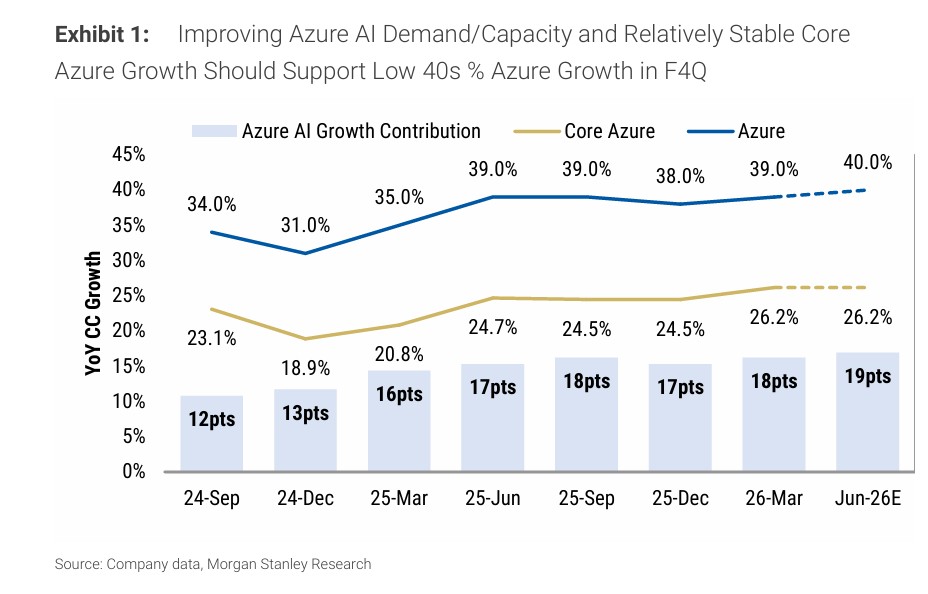
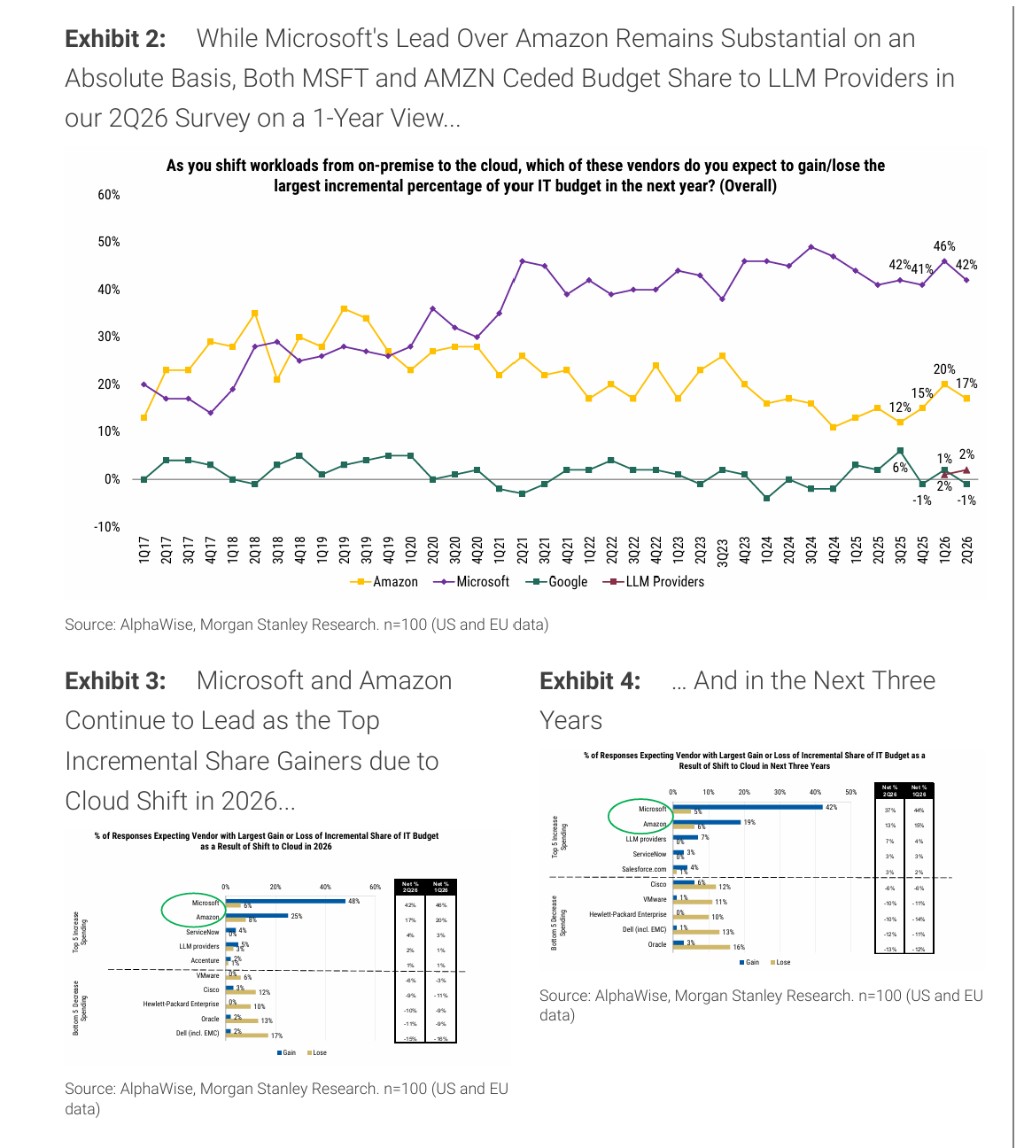
According to a Morgan Stanley research report, analysts are confident that Microsoft's Azure will achieve approximately 41% constant-currency growth in the fourth fiscal quarter, about 1 percentage point higher than the upper end of management's guidance of 39% to 40%. Morgan Stanley's confidence stems from positive feedback from channel partners, improved GPU supply capabilities, and the firm's own survey of Chief Information Officers (CIOs)—in cloud migration scenarios, 72% of CIOs expect to increase investment in Microsoft solutions over the next year, with Microsoft leading all vendors in expectations for capturing incremental IT budgets.
Progress in Copilot commercialization is also drawing significant attention. In the third fiscal quarter, Microsoft's M365 Copilot paid seats increased from 15 million to 20 million, with management guiding that net additions of paid seats will continue to rise quarter-over-quarter. Morgan Stanley points out that Copilot's monetization path is evolving into three parallel growth lines: direct seat sales, user migration to higher-value E7 subscription packages, and consumption-based AI service pricing. Notably, the price increase for Microsoft's commercial M365 took effect for new customers on July 1, 2026. Morgan Stanley expects this pricing adjustment to contribute approximately $2 billion, $4 billion, and $6 billion in incremental revenue in FY27, FY28, and FY29, respectively.
Regarding capital expenditures, Morgan Stanley believes street forecasts remain conservative and have room for further upward revision. Management had previously disclosed that calendar year 2026 capital expenditures are expected to be around $190 billion, with approximately $25 billion attributed to rising component costs. The firm maintains its "Overweight" rating on Microsoft with a target price of $600, considering the current forward P/E ratio of approximately 16x for FY28 "too cheap" and failing to fully reflect the company's sustained high-growth potential.
Meta: Capital Expenditures May Rise Sharply Again Amid Pressure from Peaking User Growth
Meta's situation is more complex. According to Bloomberg, citing Bloomberg Intelligence (BI) analysis, Meta may "significantly" raise its capital expenditure guidance to cope with pressure from rising component costs—which was the core trigger for Alphabet's stock decline last week.
At the same time, user growth faces new pressure from regulatory bodies. As regulators worldwide advance legislation to restrict teenagers' use of social media, Meta's user growth prospects will face greater pressure. The "Family Daily Active Users" metric, which measures the daily active users across its four core products, is expected to record its weakest growth performance since 2021.
Amazon: AWS Growth May Hit New High Since 2022
Compared to Microsoft and Meta, market expectations for Amazon's earnings appear relatively optimistic. According to Bloomberg, citing Truist's analysis, Amazon's overall revenue growth may reach 17%, the highest in nearly five years; Amazon Web Services (AWS) growth is expected to exceed 30%, hitting a new high since 2022. Strong demand for AI-related services is seen as the core driver of AWS growth.
However, Amazon also faces scrutiny regarding capital expenditures. After Alphabet's raised spending forecast triggered a stock drop, investors remain highly alert to whether the three companies will further raise their capital expenditure outlooks for 2027 and beyond.
Fitch Warning: Balance Sheets Under Pressure, Credit Risks Emerge
Moody's research report released last week set a grim tone for this week's earnings season. The agency pointed out that Alphabet, Microsoft, Amazon, Meta, Oracle, and CoreWeave are transitioning from asset-light software, intellectual property, and cloud service models to heavy-asset models requiring "unprecedented investment scales," a trend that could pressure the credit metrics of these companies.
Kevin McNeil, a Vice President at Moody's, stated in the agency's podcast: "These companies are large enterprises with solid market positions, and their balance sheets are often impeccable, but they are initiating capital investments on an almost unprecedented scale. The increase in capital intensity may lead to negative free cash flow for some companies, or at least a significant contraction." He further noted that debt financing "could push up leverage ratios, bringing additional risks to balance sheets."
Among the six companies under scrutiny, Oracle is in the most vulnerable position. Moody's adjusted its credit rating outlook for Oracle to negative, with its Baa2 rating just two notches above junk status. Just last month, another rating agency, S&P Global, also downgraded Oracle to just one notch above investment grade. In contrast, Alphabet, Amazon, Meta, and Microsoft currently maintain robust balance sheets, with their investment-grade ratings safe in the short term.
Bulls vs. Bears: Will AI Investments Pay Off or Overdraw the Future?
Faced with continuously expanding capital expenditures, the market has formed a clear divergence. The core logic of the bulls is: Demand is real; it is supply, not demand, that limits growth. Taking Azure as an example, Morgan Stanley pointed out that Microsoft CFO Amy Hood explicitly stated in the previous quarter's earnings call that Azure's guidance is essentially "allocated capacity guidance," with growth constraints stemming from data center construction progress and GPU deployment timelines, rather than customer demand. As Microsoft plans to double its total data center capacity over the next two years, this constraint is expected to gradually ease.
The bears, however, focus on the lack of visibility into returns. UBS Global Wealth Management noted that "limited visibility into capital expenditures beyond 2027" is a key factor suppressing investor risk appetite. Moody's warning is more direct: the transition from asset-light to asset-heavy models is eroding the high free cash flow advantage these companies have historically boasted.
For long-term investors, UBS still recommends holding positions: "For diversified long-term investors, staying invested is the most effective strategy to deal with current uncertainty. Given strong earnings growth and an improving cyclical background, there are attractive equity opportunities across sectors and regions." However, in light of Alphabet's cautionary tale, the market's verdict is clear: Good results are not enough; companies must also keep their spending in check.
