


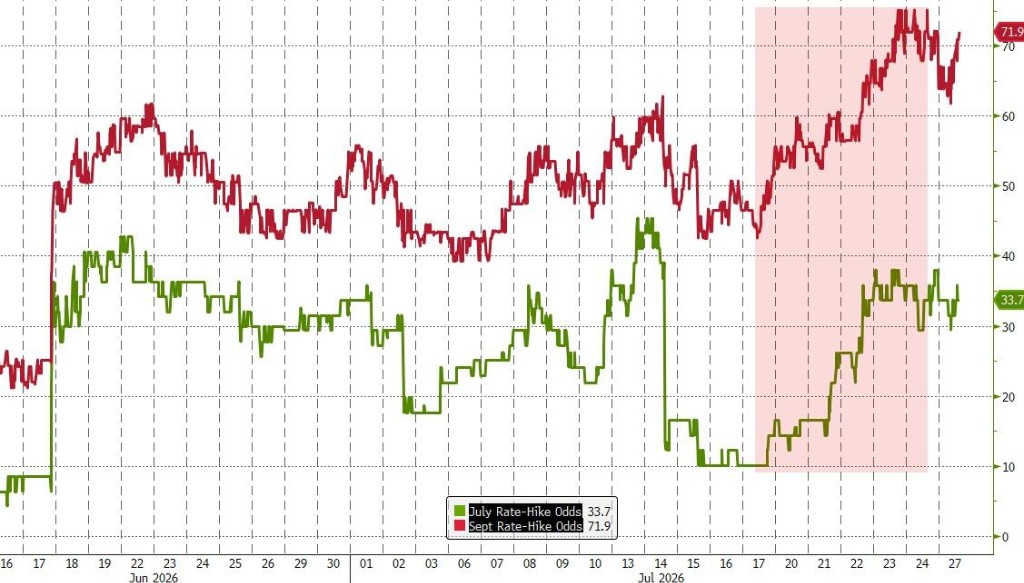
Rate Hike Probability Surges to 35%, Hedge Fund Sensitivity to US Stocks Hits Five-Year Peak; Bloomberg Warns of VaR-Driven Cascading Liquidation Risk
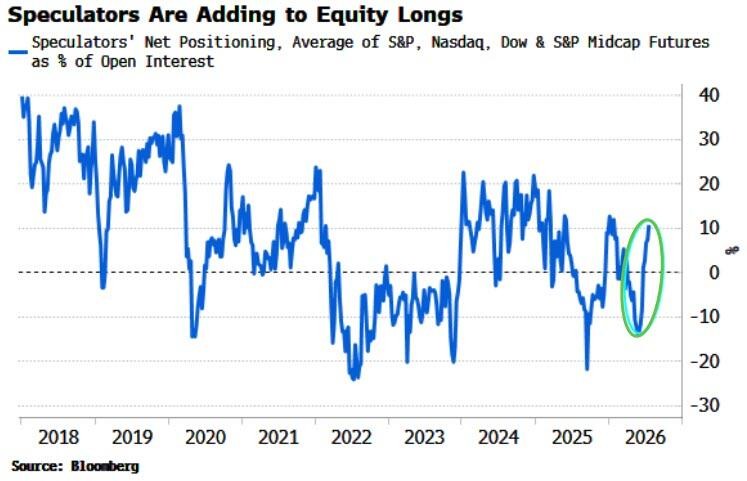
Bloomberg strategist Simon White points out that speculators' net long positions in stock index futures are rising against the trend, while hedge fund position sensitivity has touched a five-year high. Bank stock financing volumes are also nearing historical peaks. Against the backdrop of tightening liquidity, a single risk trigger could cause a sudden spike in market correlation, triggering a Value at Risk (VaR) shock that forces leveraged institutions to sell off assets collectively, creating a self-reinforcing stampede
Leverage and long positions in the US stock market remain at elevated levels. Once selling momentum intensifies, the market faces the risk of a sharper correction.
On July 27, Bloomberg macro strategist Simon White analyzed that despite continued pressure from Federal Reserve rate hike expectations, speculators' net long positions on US stock indices are rising instead of falling, and proxy indicators for hedge fund holdings have even touched five-year highs.
At the same time, the scale of stock leverage provided by banks to the market is approaching historical peaks, further amplifying potential downside risks.
Against the backdrop of tightening liquidity and rising interest rates, current high position and leverage levels mean that if a single risk trigger occurs in the market, a sudden surge in correlation could trigger a VaR shock, forcing banks and leveraged funds to rapidly unwind risky positions.
Long Positions Continue to Accumulate, Risks of Counter-Trend Betting Rise
Citing US Commodity Futures Trading Commission (CFTC) positioning data, Bloomberg reported that as of last Tuesday, speculators' net long positions in US stock index futures continued to rise. This trend has not been interrupted by market consolidation or rising rate hike expectations.
A proxy indicator for hedge fund holdings—the sensitivity of macro fund returns to S&P 500 returns—touched a five-year high last week and has since declined only slightly.
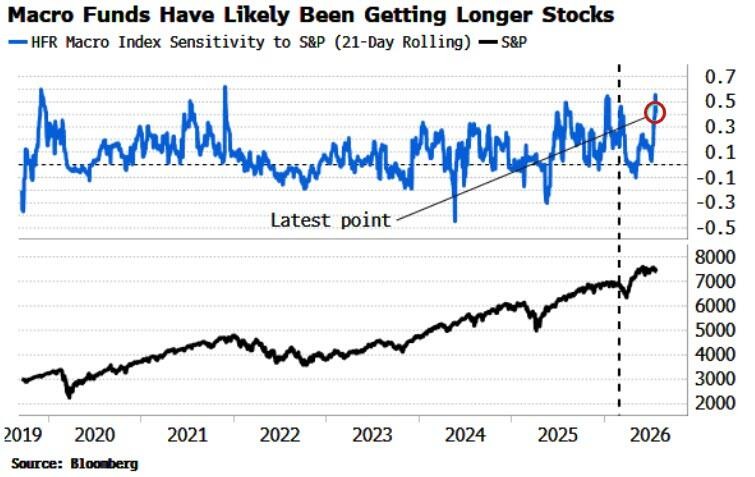
Simon White pointed out that this indicator suggests funds may be indirectly increasing equity exposure through instruments highly correlated with the S&P 500, but a more direct interpretation is that funds are increasing their direct exposure to stocks themselves.
While declining yields provided a brief respite, the stock market failed to re-establish an upward trend, reflecting that bulls still face directional pressure.
High Bank Leverage Supply, Latent Liquidity Risk
The scale of stock financing provided by banks to the market, primarily to hedge funds and leveraged ETFs, remains near high levels.
Current stock financing rates have declined somewhat, and swap spreads have remained stable, indicating that bank balance sheets are not yet under pressure and the likelihood of active financing contraction in the short term is limited.
However, historical experience repeatedly shows that this situation can reverse abruptly. Once banks are forced to tighten financing, highly leveraged positions will face pressure from forced liquidation, and selling may accelerate in a non-linear manner.
Meanwhile, liquidity is being squeezed, and the interest rate environment continues to tighten. The Federal Reserve's interest rate decision meeting this Wednesday is drawing significant attention, with interest rate futures currently showing a probability of a rate hike of about 30% to 35%. Policy uncertainty adds extra variables to the market.
VaR Shock Risk Cannot Be Ignored, SpaceX as a Risk Barometer
Simon White warned that US stocks currently face multiple "single point of failure" risks. Once triggered, market correlation will jump suddenly, pushing up the VIX volatility index, which in turn triggers a VaR shock, prompting banks and leveraged institutions to rapidly reduce risk exposure.
A VaR shock (Value at Risk Shock) refers to a scenario in financial markets where violent fluctuations cause institutional investors' Value at Risk (VaR) models to breach preset limits, triggering collective, mandatory, and indiscriminate asset sales to reduce risk exposure. This ultimately leads to a self-reinforcing stampede phenomenon characterized by "selling as prices fall, causing prices to fall further."
Simon White singled out SpaceX as a microcosm of current potential market risk themes: accumulated leverage, excessive speculation, and tech companies shifting from stock buybacks to selling their own shares.
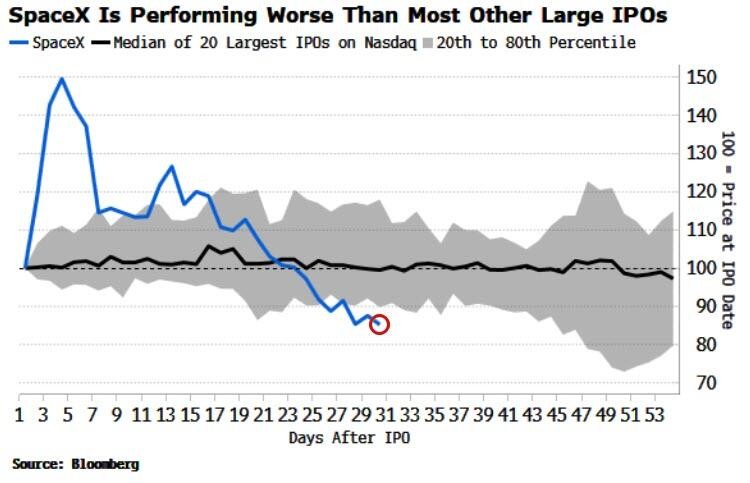
According to Bloomberg, the stock price of Elon Musk's SpaceX continues to decline and has fallen below its IPO issue price, performing significantly worse than most recent large IPOs. This reflects the market's re-evaluation of high-valuation tech assets.
For investors, the core contradiction in the current market is that high positions and leverage mean the destructive power of any negative catalyst could be multiplied. Once a trigger point appears, the speed of deleveraging often exceeds expectations.
