


"Black July" Looms: South Korean Stock Market Fights to Defend the 6,000-Point Mark
Hit by the dual shocks of CXMT's listing and global doubts over AI profitability, the South Korean KOSPI index fell below 6,000 points during trading for the first time since April 14, with foreign investors recording net sales of 3.7 trillion South Korean won. The current 12-month forward P/E ratio has dropped to 5x, the lowest level since 2000. Analysts believe the market is pinning its hopes on this week's earnings reports from SK Hynix and Samsung Electronics to boost confidence; otherwise, the KOSPI could fall further to test the 5,800-point level
The South Korean stock market is experiencing its most brutal round of selling in 2025. The combined impact of CXMT's listing on the STAR Market and doubts regarding returns on AI investments has pushed the South Korean KOSPI index into a historical valuation trough, leaving the 6,000-point support level precarious.
On July 28, the KOSPI closed down 10.84% at 6,023.66 points, briefly falling below the 6,000-point mark during intraday trading for the first time since April 14, and triggering the eighth circuit breaker of the year. SK Hynix dropped more than 14%, and Samsung Electronics fell more than 13%. Together, these two stocks account for more than half of the KOSPI's total market capitalization, becoming the core variables dragging down the index. Foreign investors recorded net sales of approximately 3.7 trillion South Korean won that day, as buying power from individual and institutional investors struggled to withstand the selling pressure.
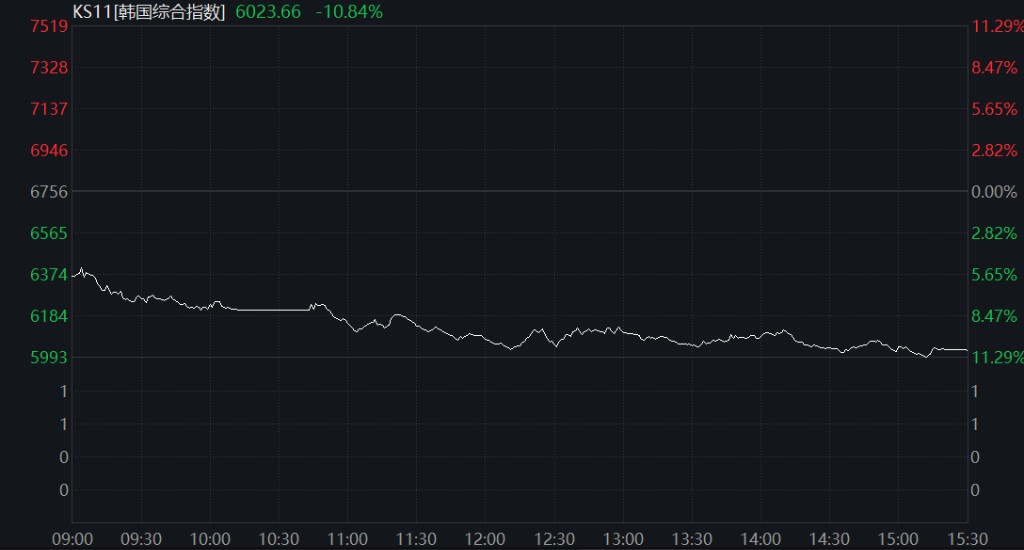
Since early July, the KOSPI's month-to-date decline, based on intraday lows, has reached 28.85%. This not only far exceeds the S&P 500's 1.64% drop and the Nasdaq's 5.49% decline, but also surpasses the 21.42% drop in the Philadelphia Semiconductor Index over the same period. Lee Kyung-min, a researcher at Daishin Securities, pointed out that the market is pricing low-probability risks as fait accompli, stating that "a catalyst is needed to reverse investor sentiment."
Dual Shocks Ignite Selling: CXMT Listing Combined with Doubts Over AI Profitability
According to a report by South Korean media outlet Newsian on July 28, the trigger for this plunge came from simultaneous blows on two fronts.
First, Chinese memory chip manufacturer ChangXin Memory Technologies (CXMT) listed on the Shanghai Stock Exchange's STAR Market the previous day, surging 465% on its debut. Analysts noted that the market is concerned that the expansion of Chinese memory production capacity will intensify medium- to long-term competition, raising the possibility of global semiconductor investment funds shifting toward China, thereby significantly worsening the relative supply and demand dynamics for Samsung Electronics and SK Hynix.
At the same time, controversy over the profitability of AI capital expenditures has reignited. Alphabet's free cash flow (FCF) turned negative, sparking market doubts about whether massive AI investments can translate into actual profits. Analysts pointed out that the correction in US AI-related stocks was transmitted almost instantaneously to investment sentiment in the South Korean semiconductor sector.
The report stated that Lee Kyung-min attributed this phenomenon to a "circular trading" structure—companies invested in by NVIDIA subsequently purchasing NVIDIA's AI chips, which has spread skepticism about the true demand for AI.
Valuations Drop to Historical Extremes, But Disagreement Persists Over the "Bottom"
Just a week ago, the securities industry generally viewed 6,000 points as the effective bottom for the KOSPI.
At that time, Kim Byung-yeon, a researcher at NH Investment & Securities, stated that an expected price-to-book ratio (PBR) of 1.3 to 1.4 times corresponded to a KOSPI level of around 6,000 points, constituting a reasonable and solid bottom. He also believed it was premature to discuss a peak in the semiconductor sector, as corporate earnings forecasts were still being revised upward.
However, the 12-month forward price-to-earnings ratio (PER) corresponding to the intraday break below 6,000 points on the 28th has dropped to approximately 5x, the lowest level since 2000; the 12-month forward PER for the semiconductor sector has even fallen below 4x.
In terms of year-to-date gains, the KOSPI's rise from its intraday high of 122.72% has retreated to the lower end of the 40% range. Some analysts believe that the rebalancing selling pressure from global investors, triggered by the earlier sharp rise in South Korean stocks, may gradually ease.
Nevertheless, analysts simultaneously warned that low valuations alone may not be sufficient to halt the decline. The market is currently in a phase where negative factors are being overly amplified, with extremely depressed investor sentiment, continued foreign selling, and supply-demand imbalances reinforcing each other.
Furthermore, continuous unwinding of leveraged positions, combined with market wait-and-see sentiment regarding the implementation of new margin rules on July 31, has seen KOSPI trading volume recently fall below 10 trillion South Korean won, further amplifying the index's decline.
Earnings Season Becomes a Key Turning Point; Risk of Breaking Below 5,800 Points Cannot Be Ruled Out
According to reports, the South Korean securities industry views the cluster of corporate earnings reports released this week as a key node that could determine whether market sentiment can be reversed.
SK Hynix will announce its results on the 29th, followed by Samsung Electronics on the 30th. The core focus of the market lies in whether these two companies can rebuild confidence in semiconductor profitability through forward-looking performance guidance, and whether they will make specific statements regarding shareholder return policies and long-term supply contracts.
A previous Wallstreetcn article stated that the market expects SK Hynix's Q2 operating profit margin to reach 75%~77%, surpassing TSMC for the third consecutive quarter. The core drivers of growth are its leadership in HBM and the explosive demand from AI data centers.
Notably, US tech giants will also release their earnings reports sequentially this week, with Microsoft and Meta reporting on the 30th, and Amazon and Apple on the 31st. The market will closely verify whether AI investments have translated into actual profits.
For Microsoft, the key lies in whether Azure cloud service growth can maintain a level of 39% to 40%, and whether the gap between its capital expenditure plan of over $40 billion and actual execution can narrow; for Meta, it is necessary to verify whether improvements in AI advertising efficiency have manifested as revenue growth.
The South Korean securities industry believes that cloud computing companies are likely to release signals similar to Alphabet's—"supply cannot keep up with demand"—but the market's interpretation of future capital investment plans, rather than the earnings figures themselves, will ultimately determine whether semiconductor stocks can rebound.
If the earnings reports fail to effectively boost sentiment, and foreign selling and supply-demand imbalances persist, the risk of the KOSPI falling below 6,000 points will be difficult to rule out. Lee Kyung-min stated:
"In the short term, the 6,000-point level for the KOSPI is a support level corresponding to a 5x forward PER. However, if investor sentiment and supply-demand conditions deteriorate further, an overshoot down to 5,800 points cannot be ruled out—this level corresponds to the 50% retracement of the gain from the low to the high in April 2025."
