


Automakers Rush to Build Humanoid Robots: BYD's Robot to Debut in August, XPeng IRON Nears Mass Production, and Li Auto Pursues a Dual-Track Strategy
BYD officially announced an August debut, XPeng's IRON has started small-batch trial production at its Guangzhou factory, and Li Auto is advancing on two fronts—the wave of Chinese automakers building humanoid robots is suddenly accelerating. The underlying logic is clear: the technological overlap between smart cars and humanoid robots exceeds 70%, supply chains are highly shared, and factories serve as natural testing grounds. Under the pressure of automotive profit margins falling to a decade-low, this crossover from "four wheels" to "two legs" is moving from concept to practical application
The wave of Chinese automakers crossing over into the humanoid robot sector is accelerating. From traditional giants to new EV startups, an industrial extension from "four wheels" to "two legs" has fully entered the stage of practical implementation.
BYD confirmed it will officially release its humanoid robot at "Di Space" in August, marking its first public display of a physical prototype under its official banner. Meanwhile, XPeng's humanoid robot, IRON, has begun small-batch trial production at its Guangzhou factory, with mass production lines entering the final joint debugging phase. Li Auto has planned two robot products—one wheeled and one bipedal—with the wheeled robot scheduled for public release within the year.
The intensive moves by these three automakers mark a critical node where domestic car manufacturers' robot-building efforts are shifting from concept validation to scaled deployment.
The appeal of this sector lies in both technological and commercial logic: the technological overlap between smart cars and humanoid robots exceeds 70%, supply chains are highly shared, and automobile factories themselves are the ideal initial application scenarios for humanoid robots. Against the backdrop of continued pressure on automotive industry profit margins, humanoid robots are increasingly viewed by automakers as a core direction for opening up a second growth curve.
BYD to Debut in August, First Official Public Display of Physical Prototype
BYD's timeline for entering the humanoid robot space dates back to 2022—when the company established an embodied AI research team, laying out its strategy earlier than generally perceived externally.
In May this year, Li Ke, Executive Vice President of BYD, publicly responded to progress for the first time in an interview with "BYD Shareholder Planet," outlining a vision where "every store will deploy robots in the future." She expressed hope that robots would handle standardized tasks such as multilingual vehicle explanations, infotainment system demonstrations, and store interaction to drive foot traffic. In early June, rumors circulated online that BYD's self-developed humanoid robot, codenamed "Yao Shun Yu," planned to deploy 20,000 units internally within the year. BYD promptly debunked these rumors but simultaneously confirmed the fact of its self-developed humanoid robot.
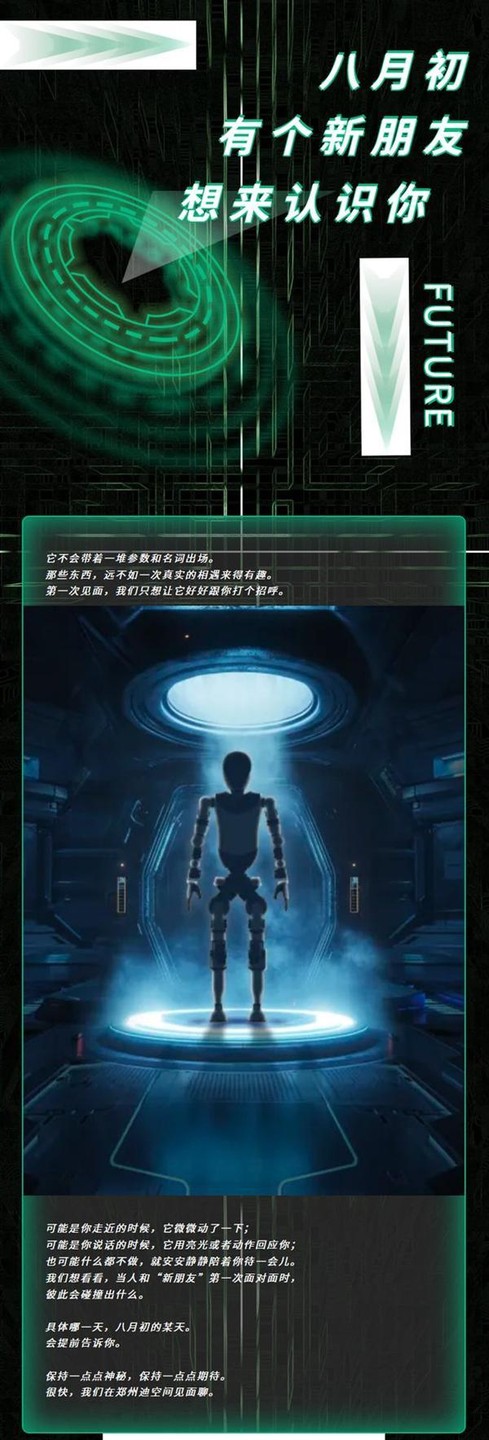
On July 25, BYD's "Di Space" WeChat official account posted a humanoid robot poster stating, "In early August, a new friend wants to meet you." On July 28, BYD confirmed to a reporter from China Securities Journal · Zhongzheng Taurus that the company plans to release its humanoid robot at "Di Space" in August. The industry generally expects this debut to be the first public unveiling of an operational physical prototype, rather than a conceptual technology announcement.
At the strategic level, Li Ke stated that the core of competition in robotics lies in manufacturing, software, and hardware capabilities, and that automotive-related capabilities share the same origins as those in robotics. She also revealed that BYD could operate as an open platform, allowing for both self-development and cooperation with other enterprises. As the global sales champion in new energy vehicles, BYD's deep accumulation in core components such as motors, electronic controls, and reducers heavily overlaps with the humanoid robot supply chain, constituting the core foundation for its cross-industry entry.
XPeng IRON Enters Countdown to Mass Production, Li Auto Advances on Two Fronts
Among the new EV startups, XPeng is the most aggressive in its pace. According to a report by People's Financial News on July 24, XPeng's humanoid robot has officially started small-batch trial production at its Guangzhou factory, with mass production lines simultaneously entering the final joint debugging phase.
XPeng's robot strategy took shape at its 2025 Technology Day. He Xiaopeng announced at the time that XPeng Motors' positioning was upgraded to "a mobility explorer in the physical AI world, an embodied intelligence company facing the globe," and released the first-generation humanoid robot, IRON. In June this year, He Xiaopeng issued an internal letter announcing that he would personally serve as the CEO of the robot business, elevating humanoid robots to the group's highest strategic priority.
According to the plan, XPeng aims to achieve mass production of IRON by the end of 2026, with a monthly capacity target of thousands of units, initially landing commercial applications in stores; it will enter offline stores nationwide in the first quarter of 2027 and expand overseas in the second quarter; by 2028, it will reach more households. IRON stands 178 cm tall, equipped with the Turing AI chip (total computing power of 2250 TOPS) and a self-developed large model for the physical world. It is currently handling processes such as sorting, handling, and quality inspection at the Guangzhou factory. Previously, XPeng also announced Baosteel as an ecological partner for the IRON project, exploring application scenarios in complex industrial fields such as inspection in the future.
Li Auto's progress is also accelerating. According to reports, Li Auto has planned two products: a wheeled robot and a bipedal robot. The wheeled robot is mainly targeted at factory scenarios and is planned for public release within the year. In terms of organizational structure, Li Auto reorganized its intelligence department in February 2026, forming three teams for humanoid robots, software bodies, and base models, with the humanoid robot project codenamed "Nexus." Li Auto stated that the company is simultaneously laying out autonomous driving in the first half of embodied intelligence and general-purpose humanoid robots in the second half. The full-year R&D investment in 2026 is expected to reach as high as RMB 12 billion, with AI-related investments accounting for approximately 50%.
Automakers' "Robot-Building" Landscape: Comprehensive Expansion from New Startups to Traditional Giants
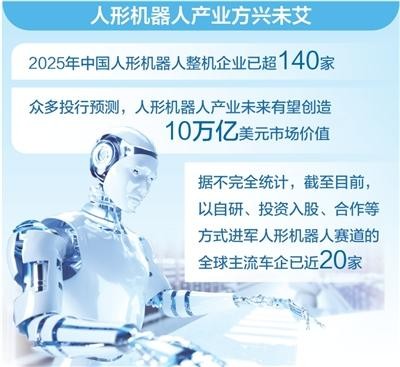
The intensive actions of BYD, XPeng, and Li Auto are just a microcosm of a larger wave of automakers entering the field. According to public reports, nearly 20 mainstream automakers domestically and internationally, including Tesla, BYD Company Limited, XPeng, GAC Group, Chery, Changan Automobile, Xiaomi, Li Auto, BMW, Mercedes-Benz, and Hyundai, have entered the humanoid robot sector through self-development, investment, incubation, and other methods.
Among domestic traditional automakers, GAC Group released the fourth-generation humanoid robot GoMate Mini in February 2026; Changan Automobile invested RMB 450 million to establish "Changan Tianshu Intelligent Robot Technology Co., Ltd."; and Chery launched the "Mo Jia" robot brand. In addition, SAIC Motor's embodied intelligent robot "Neng Zai No. 1" has been put into mass production lines, Geely has entered the field through capital lead investment, and Leapmotor has also ventured into this area.
Source: People's Daily
Regarding overseas automakers, Tesla's Optimus third generation started mass production in the second quarter of 2026. Musk confirmed that it would enter mass production at the Fremont factory in California in late July or August, with the final planned annual capacity of the dedicated Optimus factory at the Texas Gigafactory reaching 1 million units; Hyundai Motor is positioning itself through its subsidiary Boston Dynamics, with the Atlas humanoid robot planned to be used in Hyundai factories starting in 2028; BMW chose direct procurement and will deploy the humanoid robot Aeon, developed by Hexagon Robotics, at its Leipzig factory in Germany starting this summer.
Shared Technology, Endogenous Scenarios: The Underlying Logic for Automakers' Entry
Automakers clustering to "build humans" is not simple cross-industry diversification but follows a clear logic of industrial synergy.
At the technological level, the overlap between smart cars and humanoid robots exceeds 70%. Core hardware for humanoid robots, such as joint drives, energy supply, and sensing control, is highly interchangeable with key components of smart cars; sensing hardware such as LiDAR, cameras, and millimeter-wave radar can be almost seamlessly transplanted; and algorithms for environmental perception, path planning, and real-time decision-making are also highly shared. As quoted by Xinhua News Agency from He Xiaopeng, "70% of an automaker's technological reserves can be directly reused in robots." At the supply chain level, motors, gear systems, screws, bearings, batteries, and sensors are all key components shared by electric vehicles and robots, with the only difference being the precision requirements.
At the scenario level, automobile factories themselves are the ideal initial deployment environment for humanoid robots—production lines are originally designed for human service, so robots can directly adapt to the existing system without large-scale modification. Processes such as handling, assembly, quality inspection, and patrol inspection are all links that humanoid robots can replace first. Commercial scenarios such as store guides and explanations also constitute natural testing grounds, and the high-quality training data generated from internal scenarios can promote rapid product iteration, forming a technological closed loop.
Commercial motivation is equally clear. In 2025, the profit margin of China's automotive industry fell to 4.1%, hitting a new low since 2015. Under the double squeeze of stock competition and price wars, humanoid robots are seen as an important direction for opening up a second growth curve. The humanoid robot industry, predicted by many investment banks to potentially create a market value of $10 trillion in the future, has become a new choice for automakers. Morgan Stanley estimates that the humanoid robot market size could reach $5 trillion by 2050.
Promising Prospects, Challenges Remain
2026 is widely regarded by the industry as the key validation period for humanoid robots going from "0 to 1." Global humanoid robot shipments are expected to exceed 50,000 units this year and surpass 100,000 units in 2027.
However, challenges cannot be ignored. Robots' requirements for actuator precision and dexterous hand tactile sensors far exceed automotive-grade standards. The initial cost per unit is high, and there is still a distance to large-scale commercialization. Xinhua News Agency pointed out that the path from current "showing off skills" based on preset programs to achieving generality and extensively entering households remains long for humanoid robots. This requires not only continuous large-scale capital and talent investment but also breakthroughs in new technologies such as solid-state batteries and flexible sensors, as well as physical AI achieving the next "ChatGPT-style leap."
Market opportunities also need calm assessment. Robotic arms can already handle almost all large-scale mass production scenarios in manufacturing. The remaining processes that cannot replace manual labor are either extremely difficult to substitute or involve a limited number of workers. If automakers want to open up a new growth curve in the short term, they still need to find a balance between cost, performance, and replacement efficiency, and explore sustainable rigid-demand scenarios beyond their own production lines.
However, the advantage of automakers lies precisely in the fact that they do not need to wait for humanoid robots to be "perfect" before applying them. In highly structured factory environments, robots capable of completing specific tasks already possess practical value. From this perspective, this industrial extension from "four wheels" to "two legs" is likely not a brief marketing show.
