


Re-industrialization Rivaling the 'Meiji Restoration'! Deutsche Bank: A 370 Trillion Yen Investment Plan to Drive Japan's Economic Revival
Deutsche Bank released a report stating that Japan has launched a 370 trillion yen public-private investment plan to drive economic revival, with intensity comparable to the Meiji Restoration. Facing high debt pressure, Japan's policy focus is shifting from managing exchange rates to controlling bond issuance costs, which could trigger a repatriation of overseas capital or central bank bond purchases, leading to increased foreign exchange volatility. Going long on JPY volatility is seen as a high-certainty macro trade
Japan stands at a historic fiscal and industrial policy turning point, described by Deutsche Bank as comparable to the Meiji Restoration of 1868.
According to Zhuifeng Trading Desk, Deutsche Bank stated in a major foreign exchange thematic report released on July 24 that, in the face of de-globalization and geopolitical rivalry, the Japanese government is launching a public-private investment plan worth up to 370 trillion yen, attempting to reshape the economy through a state-led investment-driven model. Deutsche Bank believes its scale and intensity are comparable to the "Meiji Restoration" of 1868. However, unlike Germany and South Korea, where debt-to-GDP ratios are below 50%, Japan's government debt exceeds 200% of GDP, meaning Japan must walk a tightrope between "expanding spending" and "fiscal sustainability."
Deutsche Bank points out that Japan's policy focus is undergoing a fundamental shift—from "managing exchange rates (protecting the JPY)" to "managing yields (controlling bond issuance costs)." The report emphasizes that Japan will actively mobilize its massive long-standing domestic savings, a process that could even trigger a significant "great repatriation of overseas capital."
If the Japanese government mandates the Government Pension Investment Fund (GPIF), with assets totaling $1.8 trillion, to repatriate funds domestically, the yen will see a super rebound; but if the Bank of Japan is forced to re-enter the market to purchase Japanese Government Bonds (JGBs) to finance the government, the yen will face immense depreciation pressure.
The bank believes that regardless of which policy path the government ultimately takes, the cost of suppressing bond yield volatility will inevitably be a significant rise in foreign exchange market volatility. Going long on JPY volatility is currently one of the most certain macro trades.
Echoes of the Meiji Restoration: The Background of a Historic Policy Turning Point
The report opens with a historical analogy to set the tone. In 1868, Japan pursued national reconstruction and rapid industrialization through the Meiji Restoration, with its slogan "Rich Country, Strong Army" (Fukoku Kyohei) becoming the spiritual symbol of that era.
Deutsche Bank believes that Japan is once again facing major challenges: fragmentation of globalization, intensified strategic competition among major powers, insecurity in energy and critical mineral supplies, pressure from the AI innovation race, and heavy reliance on external defense. The Takaichi administration's response is to launch an economic blueprint called "Strong and Prosperous Japan," forming a historical resonance with the "Rich Country, Strong Army" of the Meiji era across 150 years.
The 370 Trillion Yen Investment Plan: Ending the "Lost Three Decades" of Low Investment
The Japanese Cabinet has approved the "Honebuto" policy, or the new version of the "Basic Policies for Economic and Fiscal Management." The document explicitly requires moving beyond "traditional thinking," "ending the long-term trend of low investment," and "responding to a new era of fierce global competition in industrial policy."
The core of the policy is a 370 trillion yen public-private investment plan. The government has identified 17 key strategic areas, including:
- Artificial Intelligence and Quantum Technology
- Defense
- Aviation and Shipbuilding
- Critical Minerals
- And other strategic industries
Deutsche Bank specifically points out that the decline in Japan's potential growth rate is not fundamentally due to population aging (although this is the common perception), but rather the collapse of capital stock over decades following the asset bubble burst in 1990. What Japan needs to do now is return to an investment-driven economic model.
Fiscal Arithmetic Under the Sword of Debt: Nominal Growth Must Outpace Bond Issuance Costs (r < g)
Deutsche Bank believes that while Japan seeks re-industrialization and re-armament, its fiscal space is far inferior to that of its peers. To find spending room with debt exceeding 200% of GDP, Japan is making two major policy shifts:
First, changing fiscal targets: no longer mechanically pursuing primary budget balance, but allowing it to deteriorate temporarily, with the new goal becoming "steadily reducing the total debt-to-GDP ratio of national and local governments"; second, implementing the strategy of "Building a Nation on Asset Management."
At the heart of all this is a key debt sustainability mathematical formula: r (average interest rate on debt) must be lower than g (nominal GDP growth rate). As long as financing costs are lower than nominal economic growth, Japan can reduce its debt ratio while maintaining deficits.
- The baseline for g: The government's target is to achieve 3% nominal GDP growth by 2040 (2% inflation + 1% real growth). This explains why policymakers are extremely cautious about any risks that could disrupt nominal growth, such as tariffs or geopolitical conflicts.
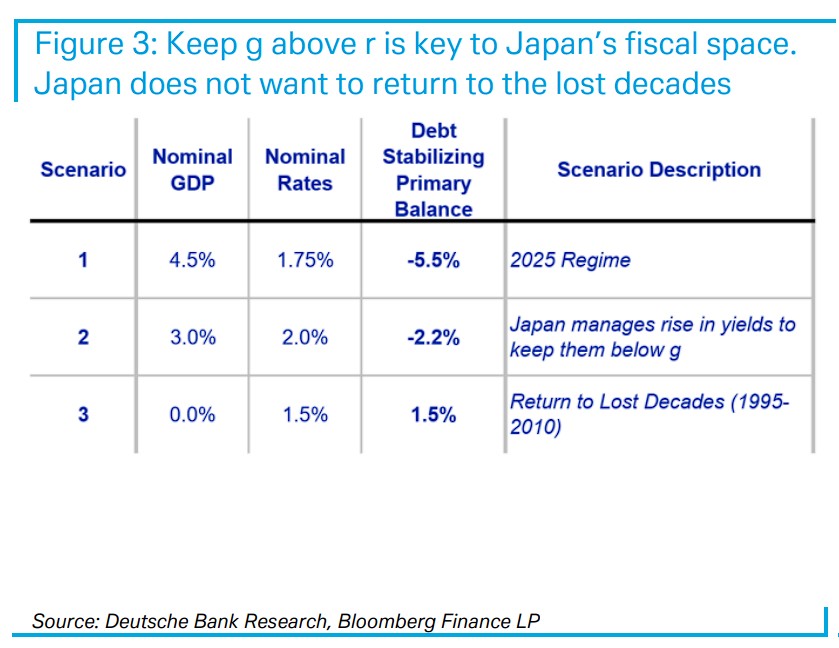
- The pain point for r: The 3% nominal growth target explains why the government is highly sensitive to the 10-year JGB yield touching the 3% level. Currently, the Bank of Japan holds nearly 50% of outstanding JGBs and pays interest on banks' excess reserves, meaning almost half of the consolidated liabilities are linked to front-end floating rates. Roughly calculated, every 100 basis point hike in front-end rates will cost 5 trillion yen (about 0.7% of GDP).
Awakening Sleeping Giant Capital: "Building a Nation on Asset Management" and the Great Repatriation of Overseas Funds
Since bond issuance costs cannot be allowed to spiral out of control, Japan needs to find more buyers for its JGBs. Where will the money come from? Deutsche Bank says the answer lies in Japan's massive domestic savings—currently mostly held in cash and overseas assets.
Japan holds nearly $5 trillion in portfolio assets overseas (exceeding its GDP size). With the rise of global "capital nationalism," if industry and defense need to be based domestically, capital must also return home.
Deutsche Bank points the core focus of the "Building a Nation on Asset Management" strategy toward two major pools of capital:
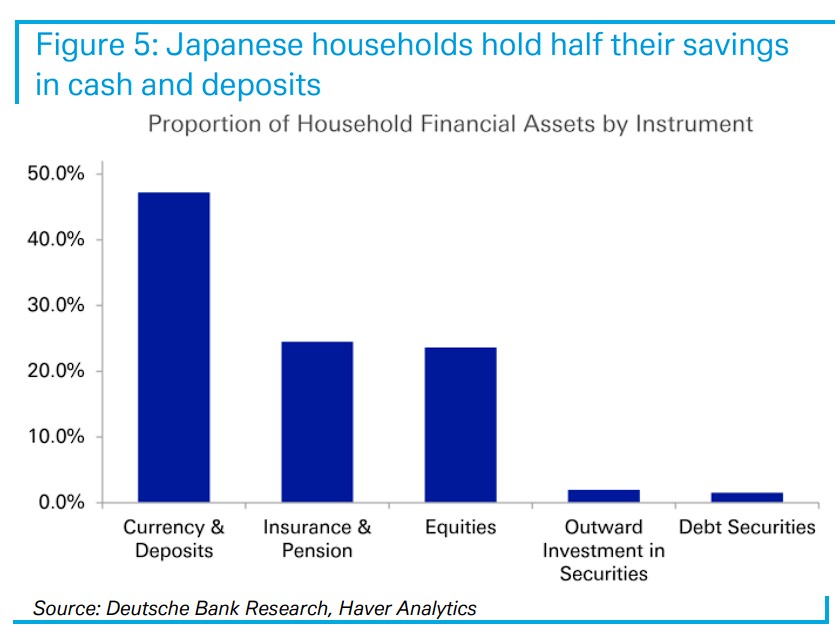
- Household Savings (affecting internal liquidity): Japanese households hold up to $15 trillion in savings, about 50% of which (i.e., 1,000 trillion yen, a scale almost equivalent to the entire Japanese government bond market) exists in the form of cash and deposits. The government is attempting to channel these deposits into the bond market through tax-exempt NISA plans or tokenization technology. This helps manage yields but has little impact on foreign exchange due to being domestic flow.
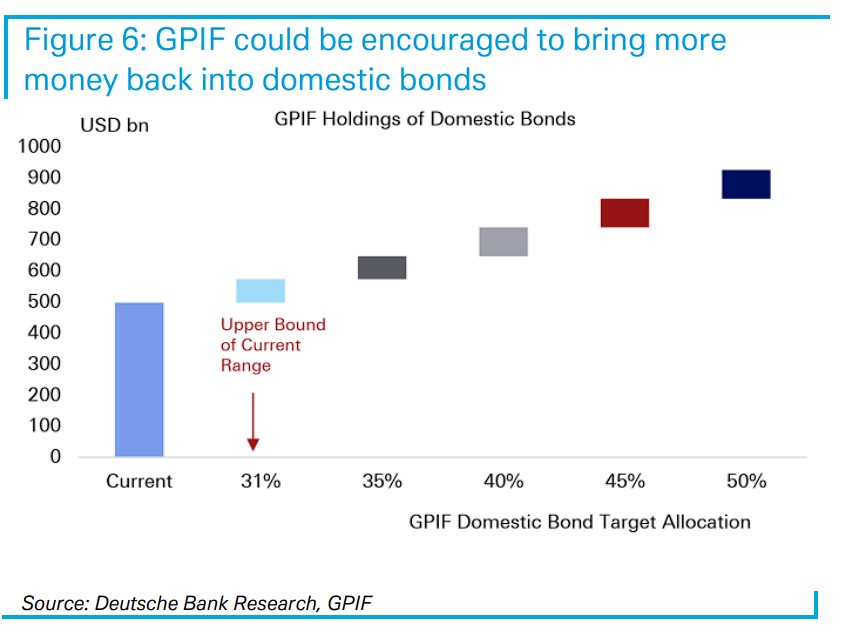
- GPIF (the key determining the yen's fate): The Japanese Government Pension Investment Fund (GPIF) is sized at $1.8 trillion, with 50% currently invested overseas. The Japanese Prime Minister has clearly stated that having the GPIF invest in domestic assets is a key measure.
If the GPIF only adjusts to the upper limit within the scope permitted by existing policies, about $200 billion will repatriate to Japan ($130 billion into the domestic stock market and $75 billion into domestic bonds).
If a more aggressive policy review is conducted, assuming the target share of domestic bonds doubles to 50% (a ratio that was as high as 67% before Abenomics in 2012), then over $400 billion of huge capital will flood into Japanese government bonds. This scale of capital repatriation is sufficient to have a massive impact on the yen exchange rate.
Policy Focus Shifts from "Protecting Exchange Rates" to "Controlling Yields," JPY Volatility to Soar
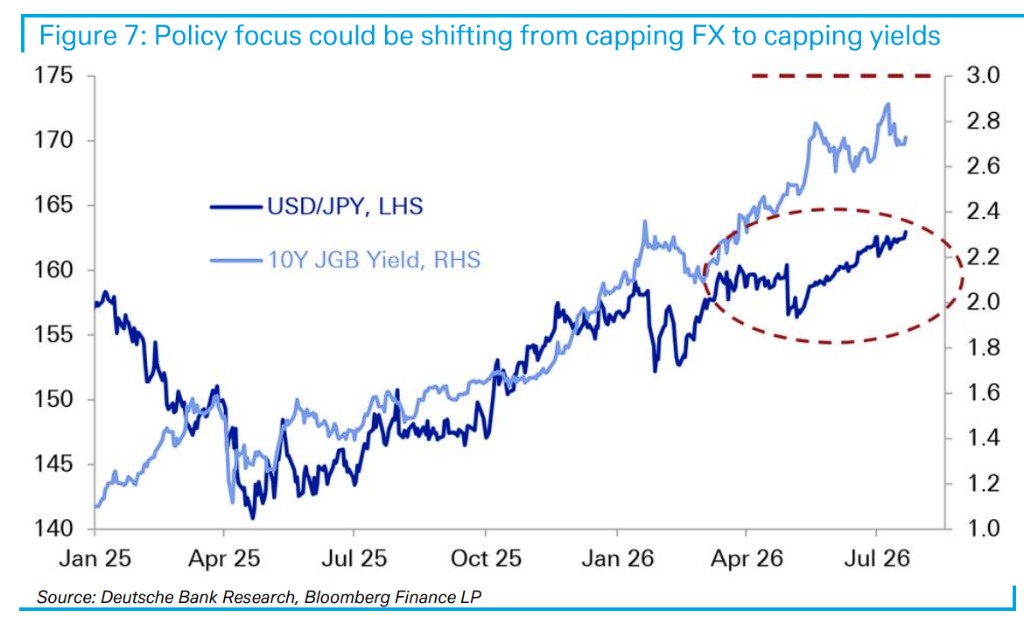
In recent months, due to concerns about imported inflation, Japanese policymakers successfully stabilized USD/JPY around 160 through verbal warnings, exchange rate reviews, and actual intervention. But Deutsche Bank warns that if "fiscal capacity" becomes Japan's most vital policy criterion, policy incentives will shift from "limiting exchange rates" to "limiting 10-year yields and borrowing costs."
The cost of suppressing interest rate volatility will be the amplification of foreign exchange market volatility. The ultimate direction of USD/JPY depends on which lever the government chooses to pull:
Super Bullish JPY Scenario: If the GPIF is mandated to repatriate a larger proportion of assets domestically, or if the Bank of Japan is encouraged to accelerate tightening to manage the inflation risk premium in long-end yields, this would be extremely bullish for the yen.
Super Bearish JPY Scenario: If the Bank of Japan is dragged in to "save the day" by resuming JGB purchases to support yield management, or is forced to remain dovish to prioritize the "r < g" fiscal arithmetic, this would be devastating for the yen.
Regardless of the direction, efforts to suppress yields will inevitably accompany severe volatility in the foreign exchange market. Deutsche Bank points out that this is extremely favorable for going long on JPY volatility (currently, USD/JPY volatility is near multi-year lows, with the breakeven point for 1-year USD/JPY straddles roughly below 150 or around 170), and one should be highly alert to this shift in macro paradigm.
The above exciting content comes from Zhuifeng Trading Desk.
For more detailed interpretations, including real-time analysis and frontline research, please join the [**Zhuifeng Trading Desk ▪ Annual Membership**]

Risk Warning and Disclaimer
The market carries risks; investment requires caution. This article does not constitute personal investment advice, nor does it take into account the specific investment objectives, financial status, or needs of individual users. Users should consider whether any opinions, views, or conclusions in this article align with their specific circumstances. Responsibility for investments made based on this lies solely with the investor.