


Boeing Q2 Revenue and Cash Flow Rebound, But Huge Losses Return as "Air Force One" Project Drags Down Profitability | Earnings Review
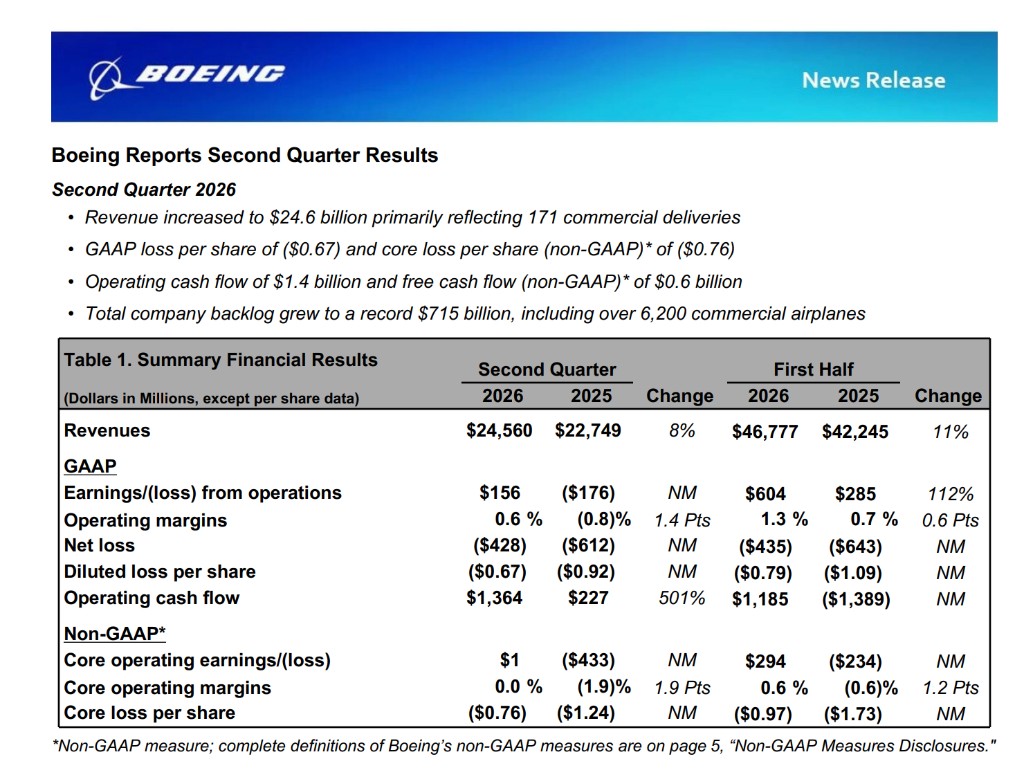
Boeing's Q2 revenue reached $24.6 billion, an 8% year-over-year increase; free cash flow was $631 million, far exceeding the expected net outflow of $331 million. However, the net loss stood at $428 million, or $0.67 per share, significantly worse than the expected loss of $0.28 per share. The delivery of 171 aircraft drove cash flow improvement, while the Air Force One project added another $280 million in losses, dragging down profitability. Backlog orders hit a record high of $715 billion, and the full-year cash flow guidance remains at $1 billion to $3 billion
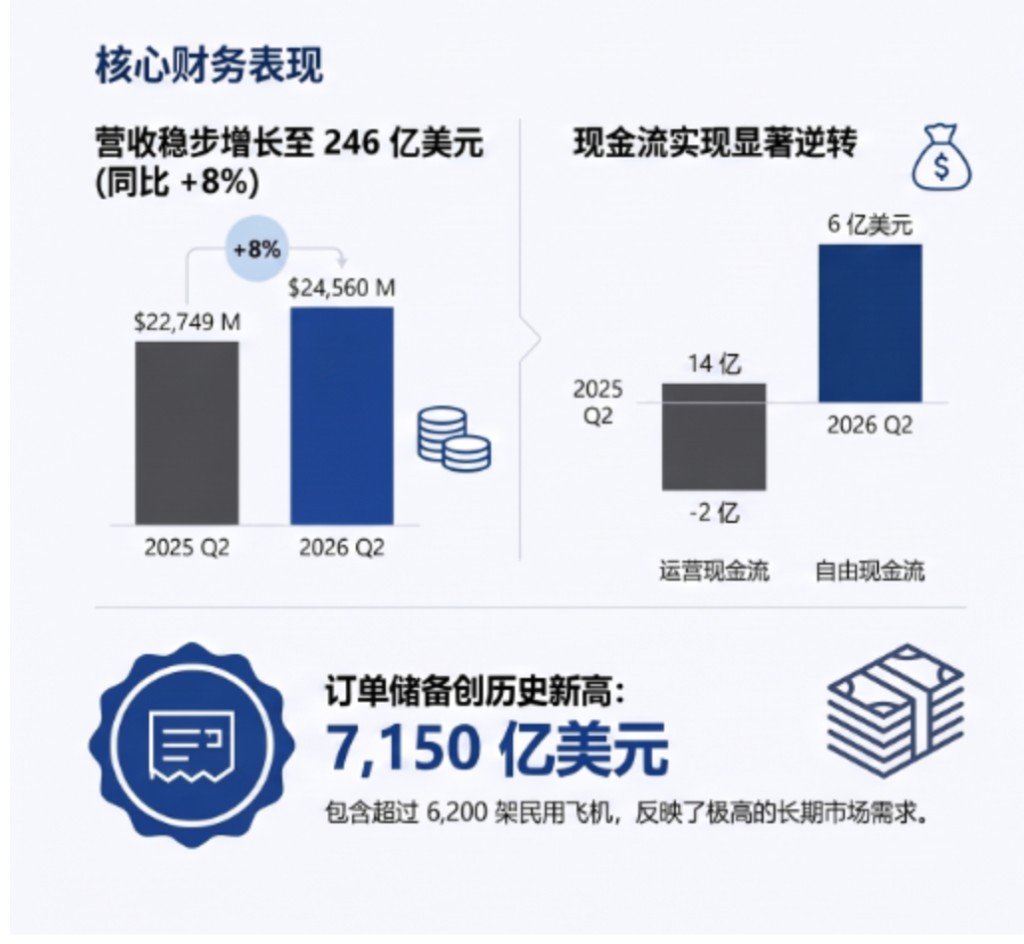
On July 28, Boeing released its financial results for the second quarter of 2026. Both revenue and cash flow showed signs of recovery, but profitability fell far short of expectations.
Driven by accelerated deliveries of commercial aircraft, the company's Q2 revenue reached $24.6 billion, an 8% year-over-year increase; free cash flow amounted to $631 million, significantly surpassing the market's prior expectation of a net outflow of approximately $331 million. This strong cash flow performance continues Boeing's process of repairing its balance sheet after years of crisis, and the company maintained its full-year free cash flow guidance of $1 billion to $3 billion unchanged.
However, profitability remains under significant pressure. The GAAP loss per share for the quarter was $0.67, with a core loss per share of $0.76. The net loss reached $428 million, far higher than the market's expected adjusted loss per share of about $0.28. Notably, the VC-25B presidential aircraft ("Air Force One" replacement) project added another $280 million in losses for the quarter, bringing cumulative cost overruns to more than $3 billion.
Performance on the orders front was impressive. As of the end of the quarter, global backlog orders reached a record $715 billion, with commercial aircraft backlog exceeding 6,200 units, corresponding to an order value of $596.7 billion. Net new orders for the quarter totaled 246 aircraft, with customers including Korean Air, Delta Air Lines, and SMBC Capital, further bolstering the order book following the Farnborough Airshow.
Boeing CEO Kelly Ortberg stated that the company's operations are stabilizing, certification programs are proceeding as planned, and "a better Boeing is emerging." However, he also cautioned that uncertainties remain until development projects are fully completed, necessitating continued strengthening of quality control and production systems. Following the earnings release, Boeing's pre-market stock price fell 1.5%.
Commercial Airplanes: Delivery Acceleration, 737 and 777X Certifications Enter Critical Phase
Commercial Airplanes (BCA) remains the core driver of Boeing's recovery.
In the second quarter, the segment generated revenue of $11.8 billion, an 8% year-over-year increase; operating loss narrowed from $557 million in the same period last year to $322 million, with the operating loss margin improving from 5.1% to 2.7%. The improvement was primarily driven by increased aircraft deliveries, optimized product mix, and enhanced production efficiency.
Boeing delivered a total of 171 commercial aircraft in Q2, an increase of 21 units year-over-year. Progress on the 737 program has drawn particular attention. The company stated that the 737 production line has begun ramping up toward the target of 47 units per month. Currently, 737 Max production has reached 47 units per month, with plans to further increase this to 63 units in the future.
Meanwhile, certification for the two derivative models, the 737-7 and 737-10, has entered its final stage. Boeing expects the 737-7 to be certified in 2026, and the 737-10 is also expected to complete certification later this year. Regulatory breakthroughs for these two models are crucial for Boeing to challenge Airbus's dominance in the narrow-body aircraft market.
Regarding the 777X program, Boeing has received approval from the U.S. Federal Aviation Administration (FAA) to begin certification flight tests under the "Type Inspection Authorization 4B" (TIA 4B) framework. The first delivery is still expected in 2027.
The recovery of the 737 Max series and the on-schedule progress of the 777X will directly determine the speed of Boeing's capacity release and cash flow improvement in the coming years.
Defense Sector: Revenue Growth Masks Continued Drag from "Air Force One"
The Defense, Space & Security (BDS) segment reported Q2 revenue of $7.5 billion, a 13% year-over-year increase. H1 revenue grew 17% year-over-year to $15.1 billion, making it the fastest-growing segment among the three major businesses. However, profitability deteriorated significantly. The segment recorded an operating loss of $15 million in Q2, with the operating margin dropping from 1.7% in the same period last year to -0.2%.
The primary drag came from the VC-25B presidential aircraft project. Boeing stated that the project incurred another $280 million in cost overruns due to the addition of engineering and quality personnel to support production and the allocation of more resources to advance the certification process. The project has suffered from long-term delays and rising costs, accumulating losses of over $3 billion and drawing continuous attention from the U.S. government.
Boeing previously estimated that the new generation of presidential aircraft would not be delivered until 2028 at the earliest. This timeline, which is only months before the end of a potential second Trump term, has led to market skepticism about whether the project can be completed on schedule.
Nevertheless, there were positive developments in the defense business. The company won a contract for dedicated communication capabilities for the U.S. Space Force, the MQ-25A "Stingray" unmanned aerial refueler completed its first flight and passed key milestone reviews, and low-rate initial production began for the T-7A "Red Hawk" trainer jet. As of the end of the quarter, the segment's backlog orders reached $85 billion, with 27% coming from customers outside the United States.
Global Services: Maintaining Core Profitability, But Margins Under Pressure
Global Services (BGS) continues to serve as the "ballast stone" for Boeing's cash flow. In Q2, the business generated revenue of $5.3 billion, a 1% year-over-year increase; operating profit reached $968 million, with an operating margin of 18.1%, making it the only segment among the company's three major businesses to maintain a double-digit profit margin.
However, compared to the 19.9% margin in the same period last year, BGS profitability declined, mainly due to the divestiture of the digital aviation solutions business, rising costs, and changes in business structure.
During the quarter, the business secured a contract for the U.S. Navy's P-8A training system and partnered with Alaska Airlines to promote the "Boeing Virtual Aircraft" training solution. As of the end of the quarter, the Global Services backlog reached $33 billion, providing stable support for future revenue.
Cash Flow Significantly Improves, But $45.9 Billion Debt Remains a Challenge
Improved cash flow was the most positive signal in this quarter's earnings report. Boeing's operating cash flow in Q2 reached $1.4 billion, a substantial year-over-year improvement; free cash flow amounted to $631 million, significantly beating market expectations. Operating cash flow for the first half of the year also turned positive to $1.185 billion, compared to a net outflow of $1.389 billion in the same period last year.
However, increased capital expenditures limited further improvements in cash flow. Capital expenditures in Q2 reached $733 million, a 72% year-over-year increase, mainly used for the expansion of production bases in Charleston and St. Louis. Free cash flow for the first half of the year remained negative at -$823 million.
Regarding the balance sheet, Boeing still faces significant debt pressure. As of the end of the quarter, the company's total debt stood at $45.9 billion, down from $47.2 billion in the previous quarter, primarily thanks to repaying approximately $8.4 billion in debt during the first half of the year. The company also holds approximately $20 billion in cash and investable securities and has a $10 billion standby credit facility.
The high level of debt means the company still needs to bear interest expenses of about $600 million per quarter. This is also a key reason why Boeing's net profit struggles to turn positive quickly, even as its operational performance improves.
